Changing Your Wheel Colour: Refinish, Paint or Wrap?
Published
Why change the colour of wheels you already own
There is a particular kind of car problem that has nothing to do with the engine or the paint. You have wheels you like, the size is right, the offset is right, and the tires fit well. But the finish has gone dull, or the car has been repainted, or you simply want the stance to read differently from the last two years. The wheels are fine. Only the colour is wrong. JRS's wheels service lists three ways to change that colour: wheel refinishing, powder coating, and vinyl wheel wrapping. They are genuinely different jobs with different results, and the difference between them is mostly about what happens to the wheel underneath.
This comes up constantly alongside colour change work, and it is worth settling alongside our colour change service rather than after it. The question is rarely asked on its own; it arrives as part of a bigger decision about how the whole car should read, which is why it so often ends up being decided by whoever is holding the wheel in their hand.
Refinishing: strip it back and start again
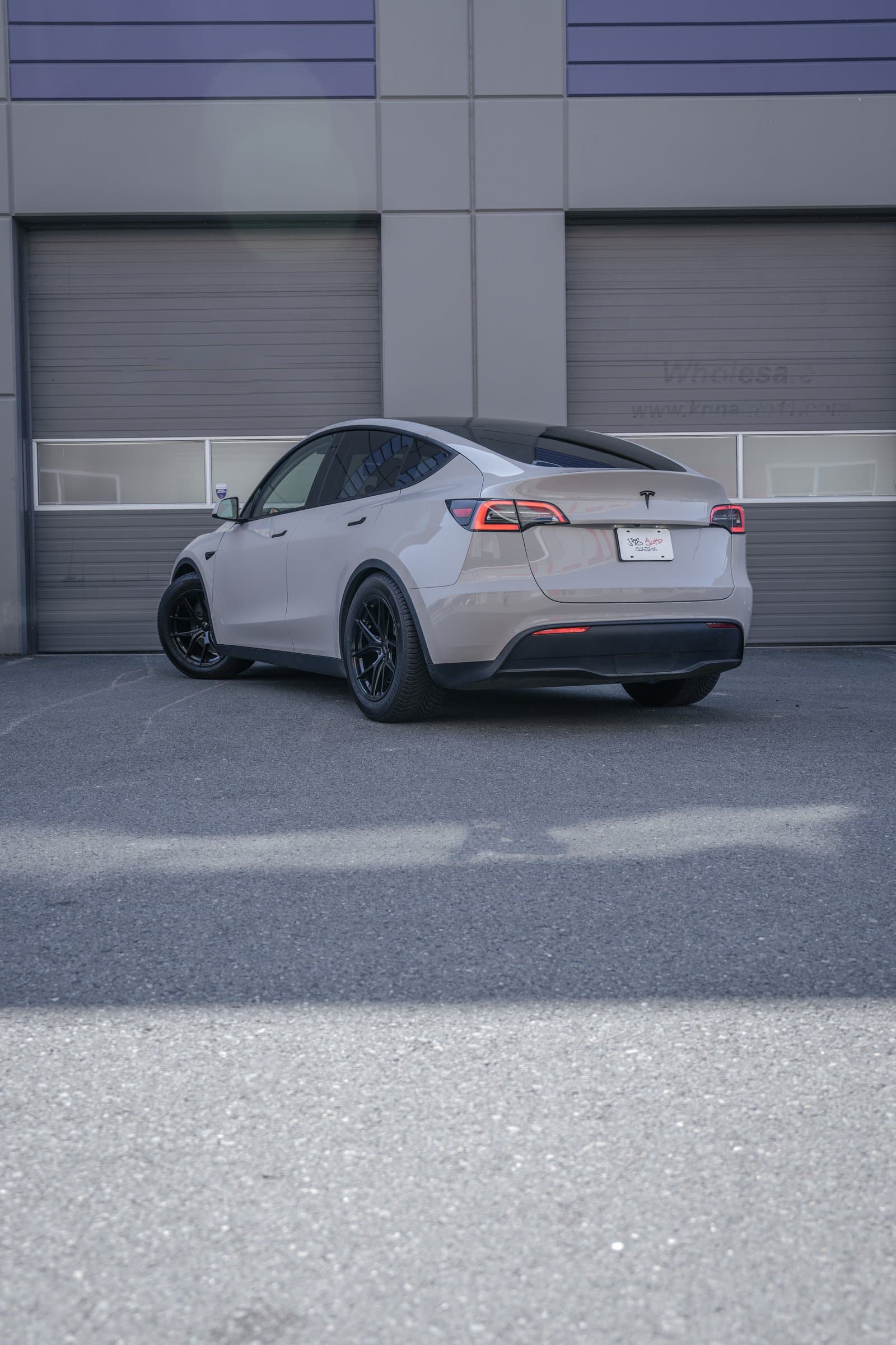
Wheel refinishing is the closest thing to restoring the wheel to what it was. The existing finish is taken off, the wheel is stripped back to bare alloy or to its original coating, and the colour and finish are reapplied. Where the factory applied a finish at the factory, refinishing reproduces something close to the original result. We did exactly this on a Tesla Model Y wrapped in chalk grey, where black wheel refinishing was paired with the body colour to give the car a single continuous read from body to rim. That project is the clearest local example of refinishing used as a design decision rather than a repair.
Refinishing is the right answer when the wheel itself is worth keeping. That means the underlying metal is sound: no deep pitting from years of salt exposure, no cracking, no corrosion that has gone through the metal. It is also the right answer when you want a factory-look result rather than a custom one, because the process produces a clean, even, uniform finish. Our wheel refinishing work starts from the condition of the metal rather than from the colour you want.
The Vancouver reality is that salt is the limiting factor here. Road salt and calcium chloride brine sit in the barrel and behind the spokes for months, and over years they do real damage to a finish. If the wheel has salt pitting or clear coat that has already failed and started to lift, refinishing means stripping that back and dealing with what is underneath, and at some point the wheel has simply reached the end of its life. Refinishing a wheel that is already pitted will not hide it.
Powder coating: a durable painted finish
Powder coating is described by JRS as a durable painted finish for a factory-look upgrade, and that is an accurate summary of the process. The wheel is prepared, then powder is applied and cured into a hard, even layer. It is not a wet paint sprayed and left to dry, which is why it holds up well to chemicals and road salt.
The reason to choose powder coating over refinishing is usually the finish you want. A powder coat comes in a very wide range of colours and textures, and it can be specified for exactly the finish you have in mind in a way that refinishing a factory wheel to a chosen colour cannot always match. It also tends to be the more practical choice for a wheel that has taken cosmetic damage, because a new coating over prepared metal covers the surface rather than requiring you to restore what was there. And for a car that lives on Vancouver roads in the winter, a cured coating has no solvent in it to soften when the temperature drops, which is where a traditionally painted finish is more vulnerable.
Vinyl wheel wrapping: colour without touching the wheel
The third option is the most conservative one. Vinyl wheel wrapping puts film over the wheel rather than altering the wheel itself, and JRS lists it as vinyl-wrapped wheels in any colour or finish. The wheel underneath is untouched, and the film can be changed later or removed entirely, which means the decision does not have to be permanent.
That reversibility is the real argument for it, and it is the reason some drivers reach for it instead of refinishing. It also gives a consistency option that the other two cannot: matching the wheel colour to a specific body colour or finish. Where a refinished or powder-coated wheel is its own finish, a wrapped wheel can be specified to sit deliberately with a colour change wrap on the body, which is the approach on that same Tesla Model Y project, where the wheel and body were treated as one composition rather than two separate decisions.
The trade-off with film is the edge. A wheel is a curved, three-dimensional object with a spoke gap, a barrel, a lip and a mounting face, and film has to follow all of it. The edge is where the work is judged, and the edge is also where the film will start to lift or peel first if it is not finished well. Cleaning around the edge takes more care than cleaning a coated wheel does.
Which one fits your situation
The decision reduces to three questions. First, is the wheel worth keeping? If the metal underneath is sound and the size and offset are right for the car, you have three good options and the choice is about the result you want. If the wheel is pitted, cracked or corroded through, then refinishing is expensive work on a compromised base, and a new set may be the more sensible call. A shop that fits tires will know the offset your car takes, which is the starting point for all three options.
Second, is the colour permanent? If you want to try a direction and might want to change it in a few years, or you want to keep the original wheel available, film answers that without cost. If you have decided on a colour and you want it to be part of the car for the long term, a coating is the more durable answer.
Third, what is the car doing? A wheel that has been on the road through a Vancouver winter has salt in the barrel and brake dust etched into the surface behind the spokes, and whatever finish goes on will need to survive that. Whatever route you take, a proper wash of the barrel before any work starts makes a larger difference than most people expect, and it is part of the maintenance service rather than an extra to remember.
None of this is a matter of which option is best. A wheel that has been refinished properly, a wheel that has been powder coated, and a wheel covered in film can all end up looking better than they did, and each one fails in a different way if the preparation is rushed. Once the colour is settled, protecting the result is a separate job, and ceramic coating is one of the ways that gets done. The reason to decide deliberately is that the wheel is the part of the car people look at, and it is also the part where the work shows.
Related project: Tesla Model Y — Chalk Grey Color Change with Black Wheels