
Should You Choose Gloss or Matte Carbon for Your Aero?
Published
Three finishes, three very different cars
When you order a carbon fibre splitter, a wing, a diffuser or a set of mirror caps, the first thing the supplier asks about is not the part itself. It is the finish. Carbon fibre reinforced polymer is a weave of fibres set in resin, and the weave you see is the structural layer, not a colour. What you actually look at on the street is a surface coating applied over that weave, and the finish you choose changes how the car looks, how it ages, and how much attention it needs in a coastal climate.
There are three common options, and they behave very differently. Gloss, or clear-coated carbon, has a smooth high-gloss clear layer over the weave that reflects light the way car paint does. Matte carbon has a flattened, textured clear layer that does not reflect, so it reads as a soft satin surface under any lighting. Raw carbon, sometimes sold as uncoated or exposed weave, has the fibre surface itself showing, with a characteristic depth that shifts as you move around it.
Gloss is the most familiar. It looks expensive, it pairs with paint without argument, and because the clear layer is smooth, water beads on it and dirt sits on the surface rather than working into it. The cost of gloss is that it is a coated surface, which means it can be polished, and that means it can be damaged, and that means UV damage shows up as yellowing or haze that a correction can sometimes remove.
Matte is the opposite trade. It hides a great deal. It will not show swirl marks, it will not show fingerprints the way gloss does, and a light film of road grime changes its appearance far less than it changes gloss. What it will show is UV degradation, and that is the important part for a Vancouver car: once matte clear has faded, correcting it is difficult without changing the finish. It is a surface you protect rather than one you restore.
Raw carbon is the most demanding of the three. It shows the weave and nothing else, with none of the UV protection that a coating provides, and it collects road film in a way that makes the surface look dull long before the material is affected. It is also the finish that most needs explaining to people who have only ever seen it in photographs, where the depth in the weave is the entire point.
What each finish is like on a real build
The finish you pick should match how the car is used and how it is stored, not only how it looks in a photograph. Our performance service handles carbon aero as standard, and the honest summary is that the finish is a maintenance decision before it is a styling one.
A gloss carbon splitter on a daily-driven car is the easiest to live with. It behaves like paint in most respects, which means the products and techniques that work on your bodywork work on it too, and a coated carbon part can be protected with the same ceramic coating you would put on the paint underneath it. It also shows everything. Chips, scuffs and swirl are visible from across a car park, and a glossy panel next to a matte one makes any difference between them more obvious.
Matte carbon suits a car that is driven hard and parked outside. It forgives a great deal. The reason is that the surface does not have a sharp reflection, so it does not show the fine circular scratches that appear on gloss after a few seasons of city driving. It also looks correct in photographs at almost any angle, because it does not depend on a highlight running across it to read well.
Raw carbon is a choice for people who want the material to be the visible feature, and for builds where the carbon is a signature element rather than an accent. It is worth being clear-eyed that it is the hardest of the three to keep presentable, and that the labour involved in caring for it is not small.
Matching the finish to the rest of the car
This is the question that decides it for most people, and it is not really about carbon. If the bodywork around the part is gloss, a gloss carbon part will sit in the silhouette without drawing attention to itself, and a matte one will read as a deliberate contrast. Both are legitimate, but they are different statements, and they are visible.
A car that has been wrapped in a matte film, or finished in matte paint, already has a very specific visual character, and glossy carbon against it looks like two different cars that were parked next to each other. A matte carbon part on the same car simply looks intentional. The reverse is equally true: on a gloss car, matte carbon reads as an accent that was chosen deliberately rather than a default.
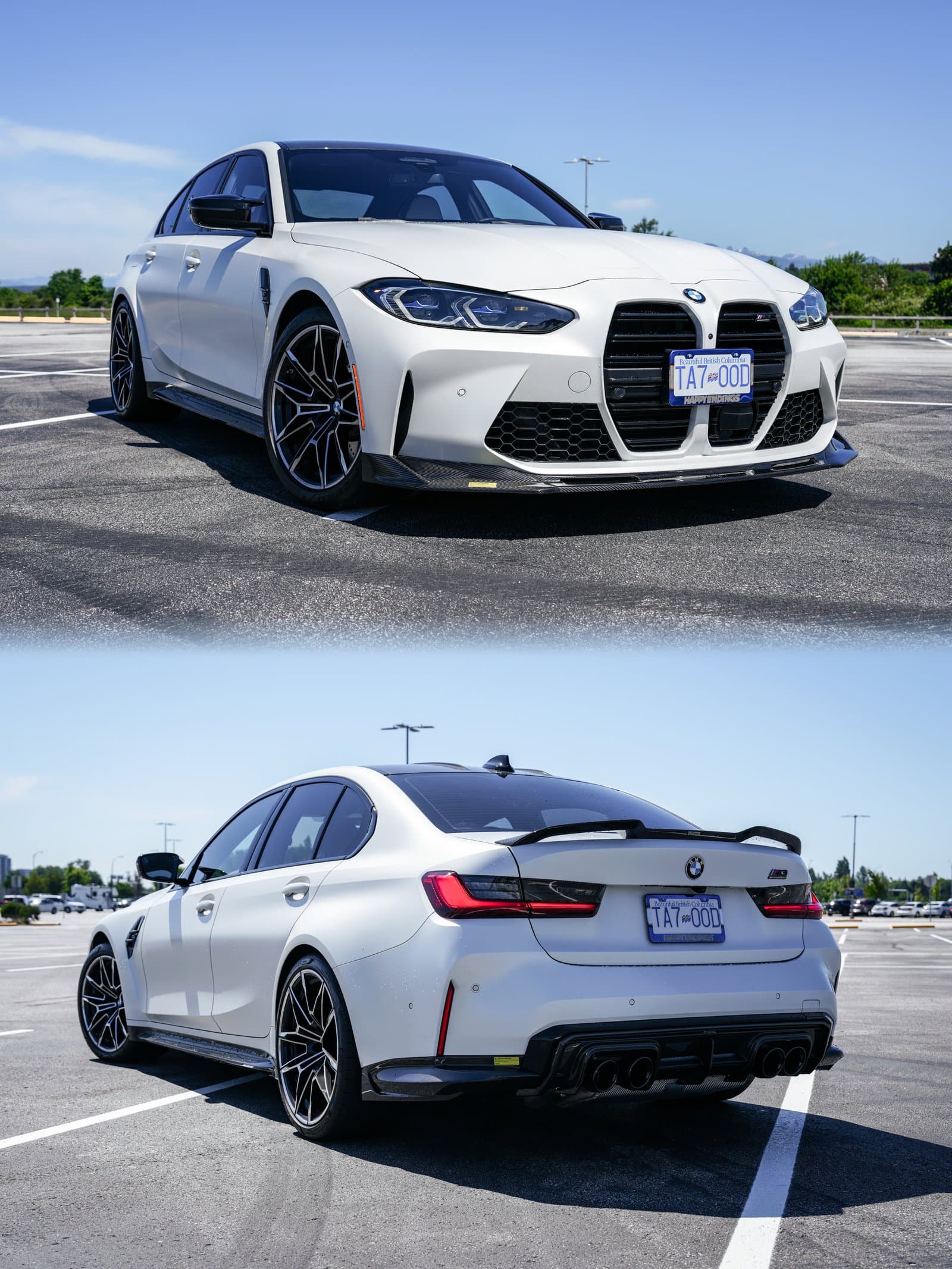
If you want to see what a complete carbon package looks like when it is treated as one piece rather than a collection of parts, the BMW M3 with a Vorsteiner aero kit in our portfolio is a good reference point. The description covers the combination that matters for this question, because the front splitter, side skirts and rear diffuser all share one finish, and it is that consistency across parts, rather than any one of them, that decides whether a build looks deliberate.
If you are deciding between finishes and want to be certain before committing, ask to see the parts in daylight and in a car park light at night. Gloss changes character completely depending on what is reflecting off it, and matte does the opposite, staying visually stable. A supplier who can show you both under the same conditions is doing you a real service.
The questions worth asking before you order
Whatever finish you choose, there are a few things that are worth settling before the order goes in, because they are much harder to change afterwards.
Ask whether the part is coated at the factory or coated in-house, and how many layers are involved. A single-layer coating and a properly layered one look very similar when new and behave completely differently after a winter. Ask what the coating is, because that determines which cleaning products and which protection you can use on the part for the rest of its life.
Ask about the edges and the mounting points, because that is where carbon fibre actually gives problems. A splitter that flexes under load, or a wing whose fixings loosen, is an engineering issue rather than a finish issue, and no coating will change that. The shape of the part and how it attaches matters more to how the car feels afterwards than the gloss level ever will.
And ask what care the finish needs in a climate with salt on the road for four months of the year. Coastal air and winter road salt are hard on coatings, and a part that is going to live under the bumper line will see more of both than the ones you can see from the driver's seat. Our ceramic coating service can be applied to carbon parts, and a hydrophobic surface is the easiest answer to road film and winter salt.
The short version is that gloss is the forgiving choice to live with and the demanding one to keep looking right, matte is the forgiving one to look at and the one that punishes neglect, and raw is the choice that shows the material most and asks the most of you in return. Pick the one that matches how the car is actually used, and the fact that it was the finish you chose rather than the finish that was available will not be obvious to anyone but you.
Related project: BMW M3 — Vorsteiner Aero Kit