
After You Buy a Used Car: First Steps for Paint Care
Published
You bought the car. The handshake is done, the payment cleared, and you are standing in the parking lot with the keys. And then the first real question of ownership arrives, the one nobody warns you about: what do you actually do about the paint now?
This is where most used car ownership goes wrong, and it is not because owners are careless. It is because the advice available online is written for cars that already look good. You will read about ceramic coating, about paint protection film, about correction and gloss and hydrophobic surfaces, all of it framed around a car whose paint is already in decent condition. The car you just bought is not that car. It is a car with a history you did not choose, a paint surface that has been through some number of Vancouver winters, and possibly a previous owner who cared about it or possibly one who did not.
The mistake is treating protection as something you apply to the car. On a car you have just bought, protection is the second half of a two-part decision. The first half is working out what you are actually dealing with, because a coating applied over an unprepared surface does not fix that surface. It seals it in place, condition and all.
Start with a condition assessment, not a product
The single most useful thing you can do in the first week of ownership is get a proper condition assessment of the paint before any product goes on. JRS runs this as the first step of every ceramic coating job, and the reasoning is simple: they assess your paint's condition, note existing defects, and recommend the right prep and coating package. The assessment is not a formality. It is what determines everything downstream.
A used car in Vancouver is likely to carry road salt damage, oxidation on the clear coat, swirl marks from automated car washes, and possibly stone chips on the hood and front bumper from highway driving. Some of that is polishable. Some of it is not. The paint thickness under your fingertips on a leading edge tells you how much clear coat is left, and that number decides whether correction is a sensible option or a risky one.
It also matters whether the car already has film on it. A used car can arrive with paint protection film already fitted, and it may be in good condition, or it may be lifting at the edges after a winter of salt getting underneath. That is a different conversation entirely from protecting bare paint, and it is much easier to have that conversation before you commit to anything new.
Decide what you are protecting the paint from
Once you know the condition, the next question is what you are trying to prevent. For a car that has just joined your daily routine, the honest answer is usually a combination of two very different things. The first is stone chips and road debris, which is what paint protection film is built for. The second is the slow accumulation of salt, grime, and weather exposure, which is what a ceramic coating and a regular wash routine are built for.
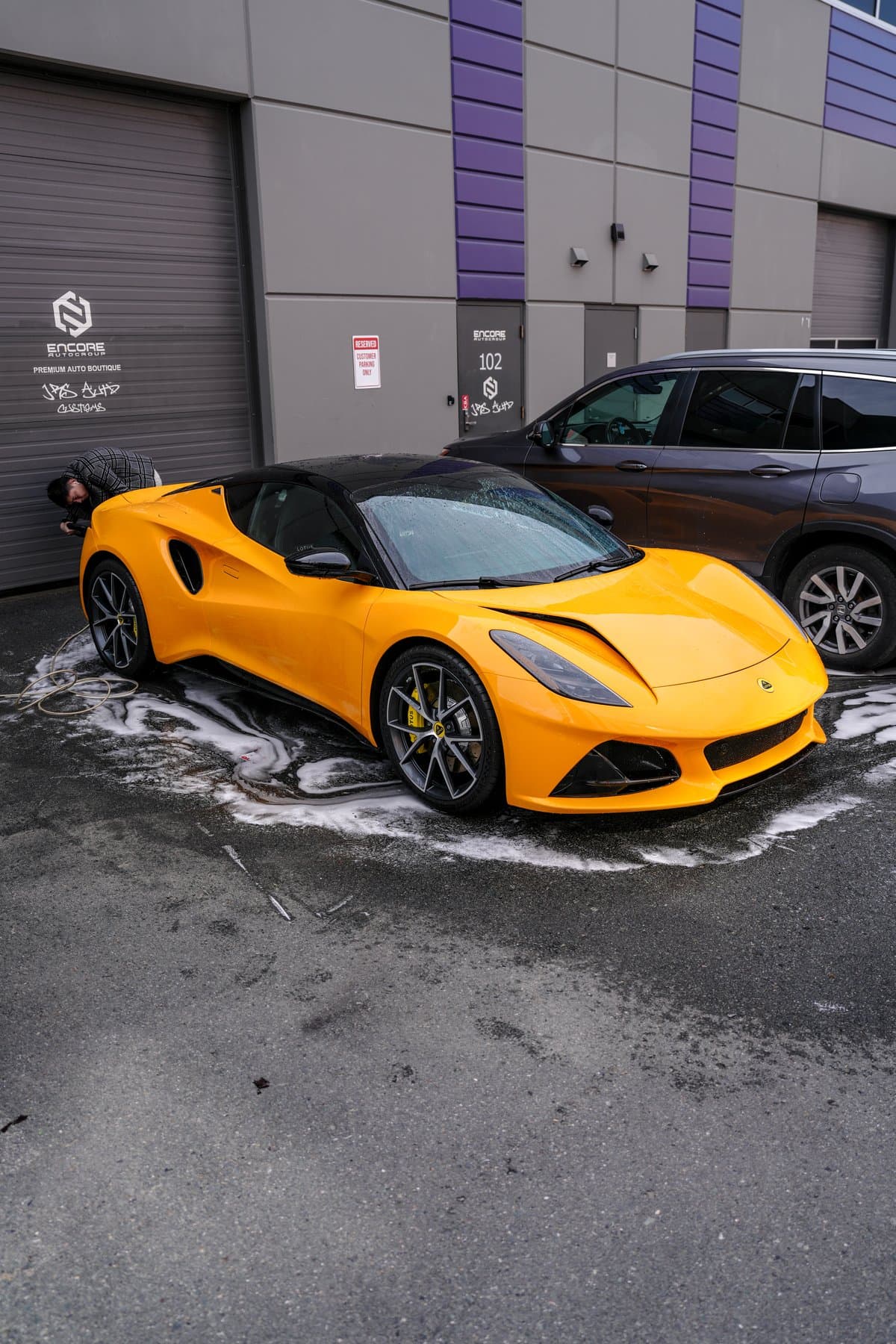
These are not competing products so much as they are aimed at different problems, and treating them as interchangeable is the second common mistake. Film is a physical barrier that absorbs impact. A coating is a bonded chemical layer that resists chemical attack and makes the surface harder to hold dirt. If your priority is the highway and the parking garage, film. If your priority is a car that stays cleaner between washes and shrugs off acid rain and bird droppings, coating. Most owners of a car they drive daily end up wanting some combination, and the portfolio of work JRS has done on cars like the Lotus Emira is a good example of the sequence: multi-stage paint correction first, then the coating applied to a surface that was genuinely ready for it.
The order of operations is not optional
This is where a lot of good intentions turn into an expensive mistake. The coating amplifies whatever is underneath. If you apply it to a surface with swirl marks, oxidation, and bonded contamination, you have sealed all of that under a layer of gloss, and now it looks like a defect in your new coating rather than a problem in the old paint. You get one shot at it. A coating applied over an unprepared surface is not better protection. It is a more expensive layer over a worse surface.
The same logic applies to film, and to the two together. If you are going to correct the paint, that happens first. If you are going to fit film, it goes on before the coating. If the car has had a panel repainted, that paint needs its own curing time before anything is bonded to it, and a shop that rushes that stage is the one you do not want.
There is a practical version of this you can run yourself in the driveway. Wash the car properly, dry it, and then look at it in direct sunlight or under a strong light at an angle. What shows up at that angle is what a coating would amplify. If the paint reads clean at that angle, you are in a good place. If it does not, the correction step is not optional, and skipping it is the mistake that costs the most.
Protect the car you actually own
There is a point where the thinking has to stop and the work has to happen, and a used car makes the timing specific. If you bought in autumn, you have a Vancouver winter ahead of the car, and salt is going to do more to it in the next four months than the previous three years did. Getting the car assessed, corrected if it needs it, and protected before the salt arrives is the sensible order.
If you bought in spring, you are probably thinking about the summer road grime, the parking garage exposure, and the bird droppings that sit on a hood in the sun. The same logic applies in a different order, but the assessment still comes first.
Either way, the point of doing this properly is that you end up with a car you understand. You know what state the paint was in when you bought it. You know what was corrected and what was not. You know what is protecting it now and what it is actually protected against. That knowledge is worth more than the product itself, because it is what tells you what to do next.
If you want an assessment before you commit to any work, JRS offers that as a standalone step, and it is a better starting point than picking a package first and working backwards. You can read how the coating process actually runs, from the initial inspection through to the final handoff, on the ceramic coating service page, and what a maintenance routine looks like once the protection is in place is covered on the maintenance service page. The order is the same either way, and it starts with knowing what you have.
Related project: Lotus Emira — Ceramic Coating