Leaf Stains on Paint: What They Do and How to Treat Them
Published
What a leaf stain actually is
Every autumn the same thing happens in Vancouver. Leaves come down, sit on a car for a few days, and leave a brown mark that does not wash off. Most owners assume this is a hygiene problem, like bird mess or road grime, and reach for the same response: soapy water and a sponge. It is not the same problem. Leaf stains are caused by tannin, the organic compound that gives leaves and bark their colour. Tannin is not a pigment that sits on the surface waiting to be rinsed away. It binds to the clear coat and turns brown as it oxidises, which is why the mark is warm amber-brown rather than the green of the leaf itself. That distinction decides everything else. A contaminant sitting on top of the paint comes off with a wash. Tannin has chemically bonded to the clear coat, so it needs a decontamination step a normal bucket wash does not include. JRS separates these two things deliberately: a wash handles loose dirt, decontamination removes what a wash cannot. Our paint decontamination guide spells out the difference.
Why leaves are a bigger problem than they look
A leaf on a car roof is not doing much. A leaf on a horizontal painted panel in the sun is doing a great deal, and the reason is heat and moisture together. Tannin removal is a chemical reaction, and chemical reactions run faster when they are warm. A leaf lying on a bonnet in direct sun holds moisture against the paint from above while the panel heats up from below. The contact time that would be harmless on a cool car in the shade becomes an extended soak on a warm one. Vancouver autumns give exactly the conditions this needs: mild days, damp nights, and long spells of low sun with leaf cover. The second factor is that leaves are porous and wet. A leaf is not a sealed lid; it holds water against the paint for as long as it sits there, so the contact is warm and wet at once. That is the combination that lets tannin migrate into the clear coat rather than drying on top of it. It is also why the mark usually appears as an outline matching the leaf: tannin concentrates where the leaf sat and fades out at the edges where only the moisture was.
The timing decision most owners get wrong
The instinct when you see leaves on a car is to remove them immediately, and that usually means scraping or scrubbing dry leaves across dry paint. A dried leaf is not a loose object. It has bonded to the clear coat through its own tannins and through whatever grime was on the surface. Dragging it across the paint takes the bonded layer with it, and the leaf acts as an abrasive loaded with road film. That is how a car ends up with fine scratches in panels that were previously clean, and it is a self-inflicted wound at the moment someone is trying to protect the finish. The correct sequence is the reverse of the reflex. Wet the leaves first, let them soften and lift off on their own, then wash. Water breaks the tannin bond and the leaf releases rather than dragging. If the leaves have baked onto the panel over a week, the answer is not a scraper either. It is a wash that lifts the leaf, then a decontamination stage for what it left behind. And the honest assessment of how much is left: a leaf that rained on and was rinsed within a day or two usually takes its mark with it. A leaf that has sat through a warm spell and dried onto the panel usually leaves something behind. The timeline decides whether this is a five-minute rinse or a booked appointment.
Where leaves actually land
The obvious place is the horizontal panels: the bonnet, the roof, the boot lid, and the top of the tailgate. These collect the deepest leaf cover and the most sun, so they are where staining is worst and most often ignored, because it is above eye level. The windscreen is the second area, and it behaves differently. Glass has no clear coat, so there is nothing to bond into and a washed leaf leaves a film rather than a stain. The real problem on glass is different. A wiper moving across a windscreen with dried leaves or grit on it is the most common way a car gets swirl marks in autumn, and the damage happens every time the wiper runs rather than once. Rinsing the glass and clearing the wiper channel before the first cold morning prevents it. The third area is the lower body, where leaf fragments collect and hold against the paint in the damp: mirror housings, the lower edge of the doors, the sills, and the wheel arches. These are the panels most likely to be missed, because nobody crouches down to look at a sill in October.
What a wash can and cannot fix
This is the question that decides whether an owner books anything at all, so it is worth being precise. A wash is the right tool for leaves that are recent. If the tannin has not had time to bond, a normal wash with a proper shampoo takes the whole thing off. This is the case most of the time in a wet autumn, because rain keeps rinsing the panels. Decontamination is the right tool for tannin that has bonded. It is a separate stage in JRS packages for a reason: the 1-Year Sealant package lists hand wash and contact-free decon, iron particle removal and a clay bar treatment as separate steps, while the Showroom Detail adds a full exterior decon and a clay bar with decon iron remover. The clay bar and iron remover physically lift bonded contamination that a wash leaves behind. Our guide to decontamination in Vancouver covers which method suits which situation. Paint correction is the right tool only when the tannin has etched far enough into the clear coat to dull the finish rather than stain it. That is a smaller group of cars than people expect. If the paint feels rough after washing, that is bonded contamination still on the surface. If it feels smooth but the gloss has gone flat in the leaf-shaped areas, that is material removed from the clear coat and it needs a machine. Treating a bonded-contamination problem with a full correction is paying for work you do not need, and treating an etching problem with a wash is spending money and keeping the damage.
Prevention, and the autumn routine that works
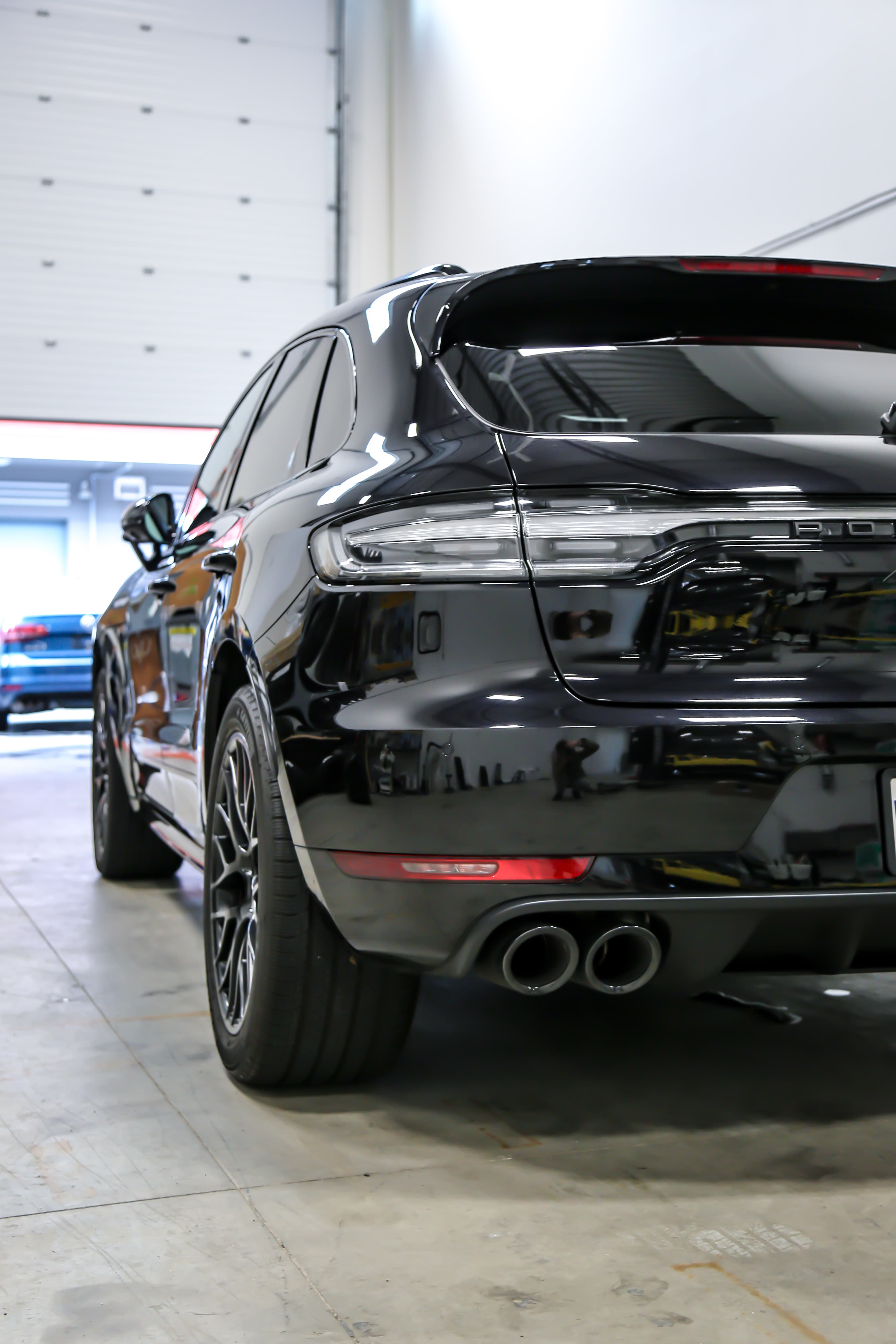
The simplest prevention is timing. A Vancouver autumn is predictable: a spell of dry, mild weather with leaf cover, then rain. A rinse before that rain comes has far more effect than any product, because it stops the tannin from sitting warm and wet against the paint in the first place. Protection changes the second half of the problem. A hydrophobic layer means water beads and runs off rather than sitting against the clear coat, and a leaf on a hydrophobic panel sheds the water underneath it instead of holding it there. That is the same reason JRS applies ceramic coating over a corrected surface rather than over whatever the car happens to be carrying, and it is why our ceramic coating service always starts with preparation. What protection does is make the contact shorter and less wet. A car that has had leaves sitting on it through a dry spell is not a candidate for a quick fix. The work has to be sequenced properly: rinse the leaves off, wash, decontaminate, and only then reassess whether the finish needs correcting. JRS handled a Porsche Macan GTS on exactly that basis, with a thorough decontamination and paint preparation process before the coating went on. The order is the point. A coating applied over bonded leaf tannin bonds to the tannin, not to the paint, and traps the contamination under a layer meant to protect the surface.
What to do this week
If the leaves have been on the car a few days and the panels are clean when you touch them, rinse them off and check the finish in daylight. Nothing more is needed. If the leaves have been sitting through a warm spell, rinse first and never scrub them off dry. Then wash, and look at the result in daylight. If the gloss is flat in the shape of the leaves, that needs a professional look rather than another wash. If the car has been under trees with no rinse for weeks, the answer is a booked decontamination rather than an afternoon in the driveway.
Related project: 2020 Porsche Macan GTS | GYEON MOHS EVO Ceramic Coating