
Bumper Scuffs: What Can Be Polished Out and What Cannot
Published
The Most Common Damage Your Car Will Ever Get
Nobody plans to scuff a bumper. You back out of a parking space a centimetre too fast, someone opens a door a little wide in a parkade, or you catch a concrete pillar with a wheel at an awkward angle. It happens to nearly every car in the city, and it is almost always a bumper. The frustrating part is that the answer is not simply "fix it" or "leave it". A scuff can sit comfortably inside the range of what a machine polisher can take out, or it can sit just past it. Knowing which one you are looking at saves you from paying for a repair that was never going to work, and saves you from leaving damage that could have been removed.
First: Is It the Bumper Itself or the Paint on It?
Before anything else, establish what you are actually looking at. Modern bumpers are not painted metal. Most are a textured or grainy plastic, or a painted plastic cover over a structural piece. On a plastic bumper the scuff has usually pulled some of that surface texture away with it. That difference matters because a scuff on a textured plastic bumper and a scuff on painted bodywork are corrected with different tools and different expectations. Run your fingernail across the mark. If it feels like a groove in the surface, you are dealing with something below the top layer. If the surface still feels textured under your nail, the damage is in the texture itself and is much more likely to come out.
Surface Marks: Transfer, Scuff and Swirl
The most common bumper scuff in Vancouver is not a deep gouge. It is a transfer mark: paint from a pillar, another car door, or a shopping cart sitting on the clear coat. It looks dramatic because it is a different colour, but it is often just a thin layer of foreign material sitting on top of the finish. The second type is a true scuff, where the clear coat has been disturbed and flattened without being cut through. That is the category machine polishing is built for, and our maintenance page describes paint correction as the step that removes swirl marks, scratches and oxidation. On a coloured bumper, scuffs read more harshly than they do on white or silver because the disturbed clear coat scatters light differently from the surrounding paint. A third category is the swirl, and if it happens to be a swirl rather than a scuff, you are in luck. Swirl marks are the fine, circular scratches that come from washing or automated car washes, and they are among the easiest paint problems to correct.
Damage That Polishing Will Not Fix
There are two kinds of damage that no amount of polishing will touch. The first is a deep gouge that has cut through the clear coat and into the colour or the primer underneath. You can see it because the mark has a hard edge, and often a different colour sits inside it. Polishing can soften the edges around that kind of damage, but it cannot fill it. The second is a crack or a split. Modern bumper plastic is thin and it flexes, but it does not stretch indefinitely. A hard enough impact will split the cover, and once the crack has started, it tends to travel. Our article on rock chip damage covers the other end of the scale, where the damage is small enough to treat before it becomes anything larger. If you find a crack, a split, or a scuff that has torn into a different material, stop. That is a panel question rather than a polish question.
Why the Front Bumper Takes More Than the Rest
Not all bumpers get equal treatment. The front bumper sits closest to the road, directly in the path of gravel, winter salt and slush thrown up by the vehicle ahead. It is also the part of the car most likely to be clipped by a parking space you misjudge in reverse. That is why front-end protection has become one of the most common requests we get. Our Tesla Model Y protection package is a good example of the standard approach: full PPF on the hood, bumper, fenders and mirrors, with ceramic coating across the rest of the car. The film takes the impact so the paint does not have to. If you are deciding between correcting a scuffed front bumper and preventing the next one, prevention is usually the cheaper conversation.
What a Correction Appointment Actually Involves
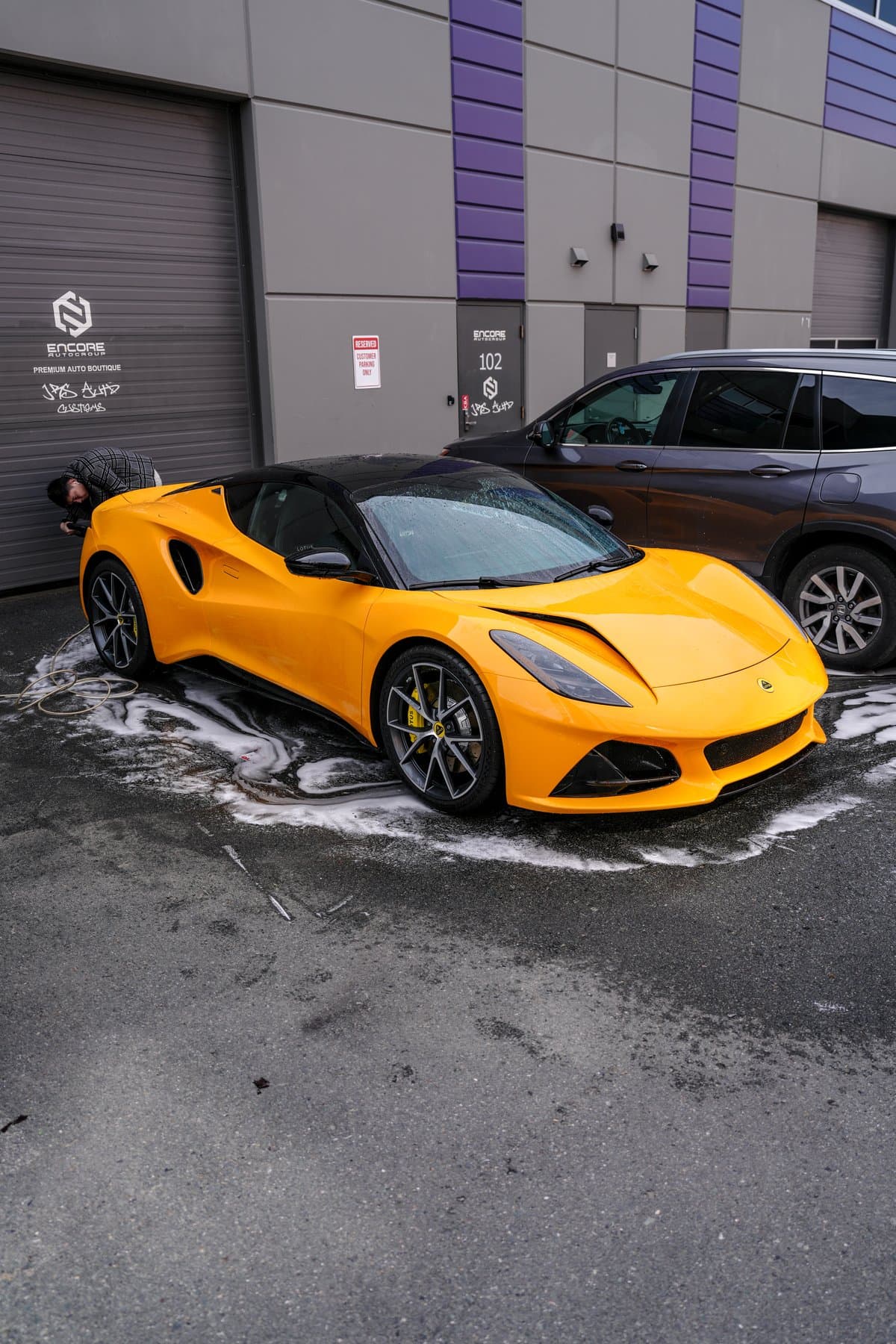
Polishing is not a single step and it is not a quick one. Before a machine can touch the paint, the surface has to be clean. Brake dust, road film and the bonded contaminants that come off Vancouver winter roads get removed first, because polishing a dirty surface grinds that contamination into the clear coat. Our ceramic coating page describes the same order of operations, since a coating over an uncorrected surface just seals in whatever was already there. The correction itself is a staged process. A single-stage polish is often enough for light scuffs and general swirl. Multi-stage work is what a car with heavier damage needs, and the Lotus Emira we corrected is a good reference: it came to us for multi-stage paint correction before the ceramic coating went on. After the polishing, the surface gets wiped down to remove polish residue, and only then does any protection get applied. The honest part of this conversation is that a bumper scuff on a textured plastic surface will never look identical to a brand new bumper again. The texture is repaired, but a corrected area can read slightly differently under strong light. A smooth, painted bumper usually comes back much closer to original than a textured one.
A Practical Order of Decisions
If you are standing in a parkade with a scuffed bumper, this is the order we would suggest. Run a fingernail across it. If the mark is a colour transfer and the texture underneath still feels normal, it is likely a polish away and there is no reason to spend more than that. If the surface feels grooved, get an honest assessment of whether the clear coat is still intact. If it is, correction is reasonable. If it is not, you are looking at a panel, and it is worth knowing that before you commit to anything. And if the car is going to stay in city traffic, have the protection conversation at the same time. We have a longer piece on how parkade damage accumulates over time that covers the slower version of this same problem. Correcting the scuff you can see is worthwhile. Preventing the next one is what keeps the correction from being a recurring line item.
Related project: Lotus Emira — Ceramic Coating