
Carbon Mirror Caps: A Small Upgrade With a Big Effect
Published
The Smallest Part on the Car That People Notice Most
There is a part on every modern car that almost nobody thinks about until it is gone: the mirror cap. It is the painted or plastic shell that sits over the mirror glass assembly, and on a car from the last fifteen years it is usually a piece of unpainted black plastic that starts grey within a couple of seasons. Swapping it for a dry carbon replacement is a small job that changes how the front of the car reads, and it is one of the more cost-effective upgrades in the performance and accessories side of the work we do.
JRS lists carbon fibre accessories on its performance page — dry carbon mirror caps, trim pieces and custom components — alongside the aero work it does, so this sits in the same category of job as the rest of a build rather than being a separate errand. If you are planning other work on the car, our performance service page explains the range and how the parts are sourced.
Why the Mirror Cap Is the First Part to Go Grey
The lower bumper, the plastic moulding along the rocker, the window trim and the badge surrounds all go grey eventually, and we have written about why elsewhere. The mirror cap is usually the earliest of them to do it, because it sits high on the car at the widest point of the body, so it catches the same salt spray and road film as the front bumper but receives far less of the washing and less of the rub from a mitt that only reaches the front of the car.
The result is a car whose mirrors look tired from across a car park, right where the eye lands first. A mirror cap is also one of the few small parts where a visual change reads as a deliberate choice rather than a repair, because the weave and the depth of a carbon part are unmistakably not factory trim.
What Dry Carbon Actually Is, and Why the Word Matters
When a shop quotes you for carbon, the word is doing a lot of work, because there are two production methods and they are called dry carbon and wet carbon. Our guide to dry carbon versus wet carbon covers the difference in detail. The short version is that dry carbon uses pre-impregnated sheets where the resin has already been worked into the fabric under controlled conditions, and the practical consequence is that the finished part is stiffer and holds its shape better.
That stiffness matters more for a mirror cap than the word suggests. A mirror housing is the piece that takes the most spray of anything on the front of the car, and it is also the piece that gets knocked by a car wash wand, a branch, a parking barrier or a cyclist. A composite part that has been made with a proper structural layer handles that differently from a thin moulded shell with a cosmetic carbon skin.
The Alternative: Wrapping the Mirror Housing
You do not have to replace the part to change how it looks. A mirror housing can be wrapped, and wrapping is one of the main options we offer through our colour change service. It is cheaper, it is fully reversible, and it can be done in a finish that matches the rest of the car rather than forcing carbon into a scheme that was not built around it.
The trade-off is in the material. A wrapped housing is still a plastic part with film on it, so it will still go grey underneath if the wrap is removed or damaged, and a wrap edge on a mirror housing is a small, curved edge that is genuinely difficult to tuck cleanly. A carbon replacement does not have that problem, because there is no film and no edge to tuck.
What the Job Involves
Fitting carbon mirror caps is not a complicated job, but it is not a five-minute one either. The housing has to come off the mirror arm, the replacement has to line up with the factory mounting points, and the fixing needs to be secure without being torqued hard enough to crack the composite. There is also the question of whether the caps are supplied as a pair, whether they are left-hand and right-hand specific, and whether they are finished in gloss or in a clear-coated or matte lacquer.
Those are the questions worth asking before ordering, and they are the questions to ask of any shop. It is also worth asking whether the car will have other carbon parts on it, because a set of mirror caps in carbon on an otherwise standard car reads very differently from the same caps on a car that already has a carbon front lip and a carbon diffuser.
Where It Shows Up in the Rest of the Build
A useful way to think about the mirror caps is that they are the smallest visual item in a package that is usually larger than it looks. On our BMW X3 M40i, the fitted parts are a front splitter, side skirts and a diffuser — a package that changes the whole lower half of the car. The mirror caps are not part of that, and they do not need to be, but they are what finishes the front end when the rest of the car is already a different shape from when it left the factory.
If the car is getting other work, our aero guide explains what the individual parts do, and it is worth reading before deciding how far to take the package. The point of the mirror caps is not that they are the most functional addition available. It is that they are a small, visible, well-made detail on a car that has been taken seriously.
The Questions to Ask Before You Order
Ask what the caps are made from and whether they are dry carbon or a vacuum-formed shell with a cosmetic carbon layer. Ask whether the finish is gloss, satin or matte, and whether the clear coat is already applied. Ask whether the fitting is done with the mirror housing removed and refitted, or whether the caps are clipped over the existing housing — the latter is faster but it leaves the original plastic underneath. Ask about the lead time for the part, because these are usually ordered in rather than pulled off the shelf.
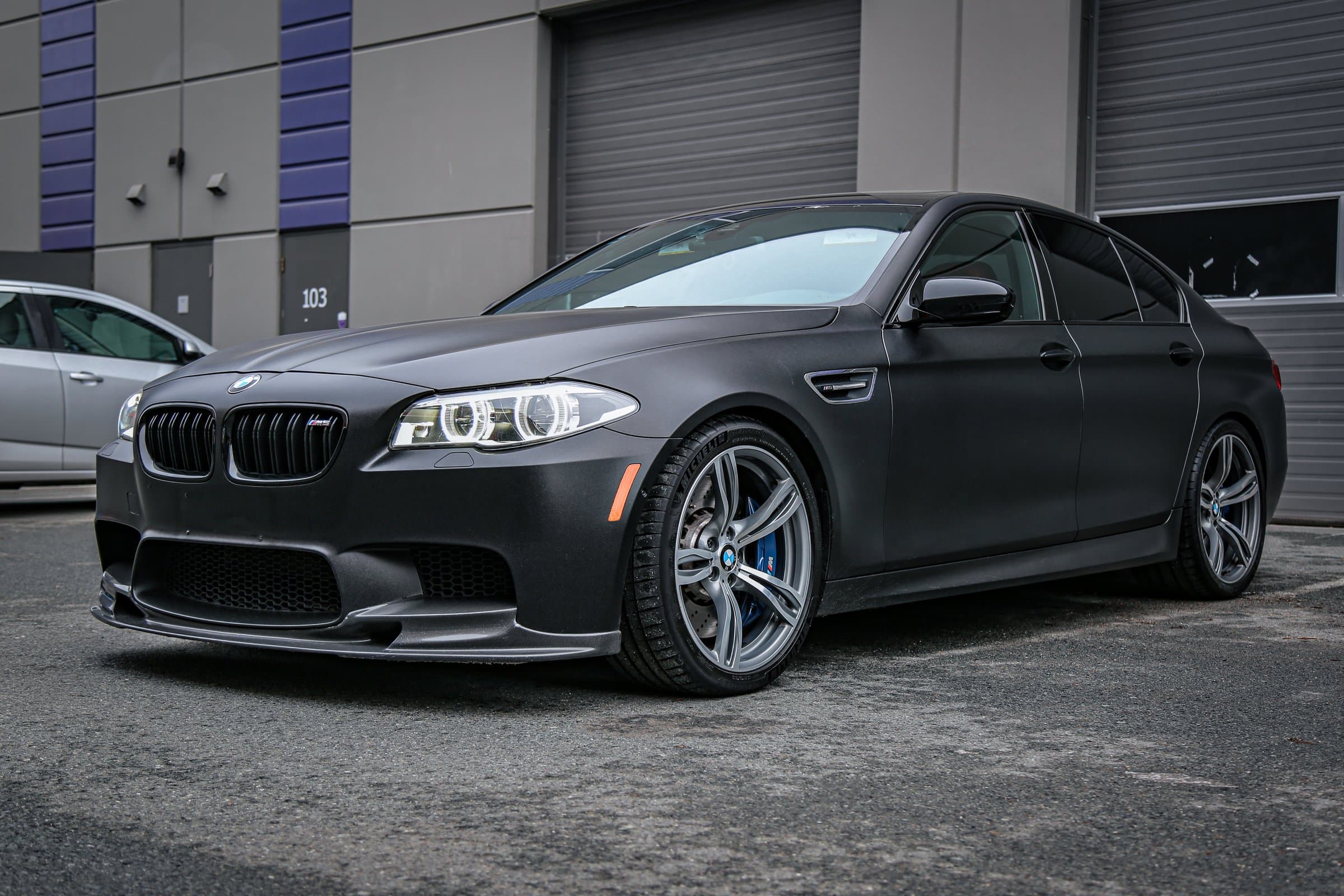
And ask to see the work before it goes back on the car. The BMW M5 in our portfolio carries a full carbon fibre body kit, and on a car like that the small carbon parts and the large ones have to match in weave and finish. That is the standard we hold the small work to as well, because a mirror cap is still a mirror cap and it is still the first thing anyone looks at when they walk around the front of your car.
Related project: BMW M5 — 3D Design + AK Exhaust