
Failing Catalytic Converter: Driveability Effects
Published
Most drivers know that a failing catalytic converter will fail an emissions test. Fewer know what it actually does to the way their car drives — or that in British Columbia, a vehicle with a damaged or missing converter will also fail the provincial inspection under the National Safety Mark programme. This post covers the driveability effects of a failing converter, the signs to watch for, and what options exist for Vancouver drivers.
What a Catalytic Converter Actually Does
The catalytic converter is an emissions device in the exhaust stream that uses chemical reactions — driven by heat — to convert carbon monoxide, unburned hydrocarbons, and nitrogen oxides into less harmful gases. It only works at high temperature, which is why the car runs normally on a cold start until the converter heats up. Once the converter is functioning, it also creates a measurable amount of back-pressure in the exhaust stream, which is why an unrestricted exhaust system and a properly functioning catalytic converter are not the same thing.
When a converter fails, it fails in one of two main ways: it becomes clogged — restricting exhaust flow — or it is damaged internally in a way that destroys the catalyst coating, making it ineffective at emissions conversion without necessarily blocking flow. Both produce different symptoms and different urgency levels.
How a Clogged Converter Affects Driveability
A clogged catalytic converter restricts the flow of exhaust gases out of the engine. This creates measurable back-pressure that the engine has to work against. The effect on driveability is progressive and unmistakable once you know what to look for: a car that feels sluggish even under moderate acceleration, as if the engine is not able to breathe properly. The problem gets worse under load — uphill driving, highway merging, or carrying passengers and cargo — where the engine needs to move more air but cannot.
In a more advanced stage, the engine may stall at idle or after deceleration, because the restricted exhaust flow is enough to disrupt idle air-fuel metering. At wide-open throttle the problem can become severe enough that the car feels like it is being held back by something solid. A simple test is to temporarily remove the oxygen sensor upstream of the converter and test-drive — if the car suddenly feels normal, the converter is the culprit.
What a Damaged or Ineffective Converter Looks Like
A converter whose catalyst washcoat has been destroyed — by contamination, fuel additive damage, or physical shock — may produce no driveability symptoms at all in the short term. The engine drives normally because the exhaust flow is not restricted. The only sign is often a check engine light pointing to the oxygen sensor downstream reading similarly to the upstream sensor, indicating the converter is not converting anything.
In other cases, an overheating converter can begin to melt internally, producing a rattling noise audible from outside the car at idle, particularly when the engine is revved. This is a distinct sound — metallic rattling, not the deeper resonance of a loose heat shield. Any rattling from the converter area should be inspected immediately.
BC Inspection and Driveability Requirements
In British Columbia, passenger vehicles require an inspection under the National Safety Mark programme to be registered or re-registered. Among other items, the inspection covers exhaust system integrity and emissions-related components. A damaged, missing, or ineffective catalytic converter will result in a failed inspection. Unlike the federal Drive Clean programme which used tailpipe testing, the provincial inspection focuses on system presence and condition — but a vehicle with severe driveability issues from a clogged converter will flag the inspection technician attention before they get to the paperwork.
For drivers with modified performance vehicles — particularly those running higher-than-stock boost or fuel maps — an aftermarket high-flow catalytic converter or test pipe is sometimes considered. In BC, replacing the converter with a non-OEM unit that does not meet Canadian standards can cause an inspection failure and potentially affect insurance coverage if the vehicle is involved in an incident. The performance exhaust work that JRS Auto Customs handles works within the framework of components that can be inspected and pass, and the team can advise on what is viable for your specific vehicle.
What to Do If You Suspect a Converter Problem
The right first step is a diagnostic check with a scanner that can read live oxygen sensor data, not just generic check engine light codes. A technician can compare the upstream and downstream sensor readings to determine whether the converter is doing its job. Back-pressure measurement at the exhaust inlet is the most definitive test for a potentially clogged converter.
If replacement is needed, OEM-equivalent converters from a reputable supplier are the standard route. For vehicles where the converter is integrated into the exhaust manifold — increasingly common in modern engines — the repair cost is higher because the entire assembly needs replacement, not just the converter body. Getting an inspection before the problem becomes severe enough to cause a roadside breakdown is significantly cheaper than an emergency repair plus recovery.
Whether your concern is a check engine light, a rattling noise, or sluggish performance on hills, the exhaust system is a place where guesswork costs more than diagnosis. The team at JRS Auto Customs can assess your vehicle exhaust and talk you through what the actual problem is before recommending anything.
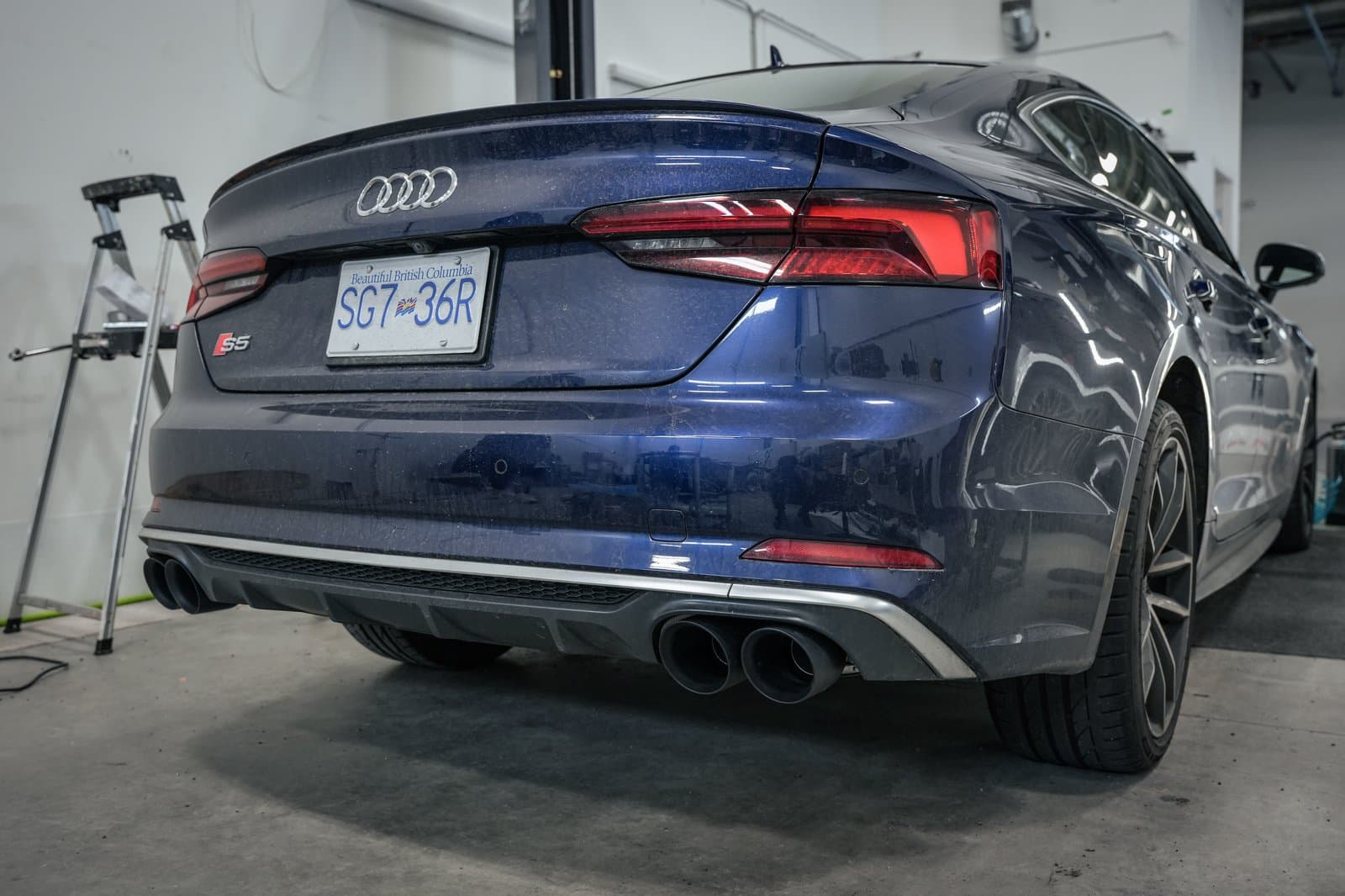
For owners considering an upgrade to a performance exhaust system, an Audi S5 Milltek installation shows what a properly designed exhaust upgrade looks like on a performance vehicle and what the inspection requirements mean in practice.
Related project: Audi S5 — Milltek Exhaust Upgrade