Keep the Cat or Go Catless: A Downpipe Decision
Published
The question arrives in the same shape every time: the shop has a downpipe on the bench, there are two versions, one keeps the catalytic converter and one does not, and the price difference is not trivial. Here is the honest framing. A catted downpipe keeps the factory catalytic converter in place and improves the pipework around it. A catless downpipe removes it entirely and replaces that section of the exhaust with straight pipe. Both are real products. Both are installed by shops every week. The difference between them is not a matter of taste or even of performance alone — it is a question of what happens to your car afterwards, and in British Columbia that question has a concrete answer.
It helps to start with what the catalytic converter actually is, because the marketing language around this choice tends to skip the basics. It is an emissions-control device that sits in the exhaust of a turbocharged engine, upstream of the rest of the system. Its job is to process the exhaust gases leaving the engine so they meet the emissions standard the car was certified to. It is not a performance part. It was never designed to make power, and it was never meant to be a restriction you would want to remove. It was designed to clean the output of an engine that was never intended to run without it.
What each version actually changes
A turbocharged engine has a turbine in the exhaust path, and the turbine needs the exhaust gases arriving at it to be moving at a good speed to spin up efficiently. On a stock system, the downpipe and the converter upstream of the turbine form the narrowest point in the whole exhaust, and gas that has to squeeze through a restrictive passage arrives at the turbine with less energy. That is where the turbo lag you feel comes from.
A catted downpipe replaces the factory pipe with a smoother, larger-bore pipe and keeps the converter mounted in place. The pipework improves; the converter still does its job. You recover some of the flow restriction without removing anything the vehicle needs to keep working as designed. This is the version most people asking this question should seriously consider, and it is why JRS lists catted and catless downpipes as separate options rather than pushing one of them.
A catless downpipe takes the converter out of the equation entirely. That is the whole of it — the pipe from the turbo flange to where the rest of the system begins becomes a straight run. The turbine now sees unrestricted gas and the engine breathes more freely, which is where the headline power figures come from. The cost of that freedom is that the emissions hardware the car was certified with is no longer there.
The part most people are not told about
Here is the piece of information that should drive the decision. On a modern vehicle, the engine management computer continuously compares what the oxygen sensors upstream and downstream of the catalytic converter are reporting. When the two agree closely, it means the converter is doing its job and the computer marks that monitor as complete. When the two disagree, it means something is wrong, and the monitor stays incomplete.
Remove the converter and those readings diverge. The engine computer sees a fault, stores a code, and the check engine light comes on. It does not stay subtle. The car is telling you directly that the emissions system is not what the software expects, and in most cases it will refuse to run its monitors at all until the situation is corrected.
What that means for your inspection in BC
British Columbia runs a periodic inspection program, and the exhaust system falls squarely inside what an examiner looks at. On vehicles originally equipped with a catalytic converter, removing it or replacing it with a non-OEM component is treated as a fail item. The inspection is largely a scan of the vehicle's own diagnostics rather than a tailpipe measurement, so the check engine light being on will stop the inspection from proceeding regardless of anything else about the car.
This is not a technicality and it is not a grey area. It also affects ownership independently of the inspection. A car sitting with a check engine light has a fault code stored in it that needs resolving, and a vehicle with an outstanding failed inspection cannot be transferred to a new owner. If you are buying the car to keep, you are signing up for that. If you might sell it, that follows the car rather than you.
The middle path worth knowing about
There is a third option that a lot of drivers never hear mentioned because it is not a headline product. A high-flow catalytic converter replaces the factory unit with a less restrictive substrate while keeping the converter physically present and functioning. The engine computer still sees a converter that behaves the way it expects, the monitors still complete, and the check engine light stays off — while the flow restriction is meaningfully lower than stock.
Whether that arrangement passes inspection depends on the equipment the inspection facility uses and the assessment of the technician looking at the car. That is a conversation to have before you spend money, not after. Reputable shops will tell you where you stand before you commit, and they will not install something they know is going to fail. A pre-inspection walk-through on the car before the official appointment is the simplest insurance available.
So how do you actually decide
If the car is a daily driver, the honest answer is that the catted downpipe is the sensible choice. It addresses the actual restriction that holds the turbo back, it keeps the vehicle compliant and its monitors healthy, and it leaves you able to sell the car without a problem. The performance difference is real but it is not the difference between a slow car and a fast one. It is the difference between a car that feels a little more responsive and one that does not.
If the car is a dedicated performance build that rarely sees the street, the calculation changes and the catless route becomes defensible — but only with the inspection reality understood in advance, and with the car kept off the road in a way that accepts those conditions.
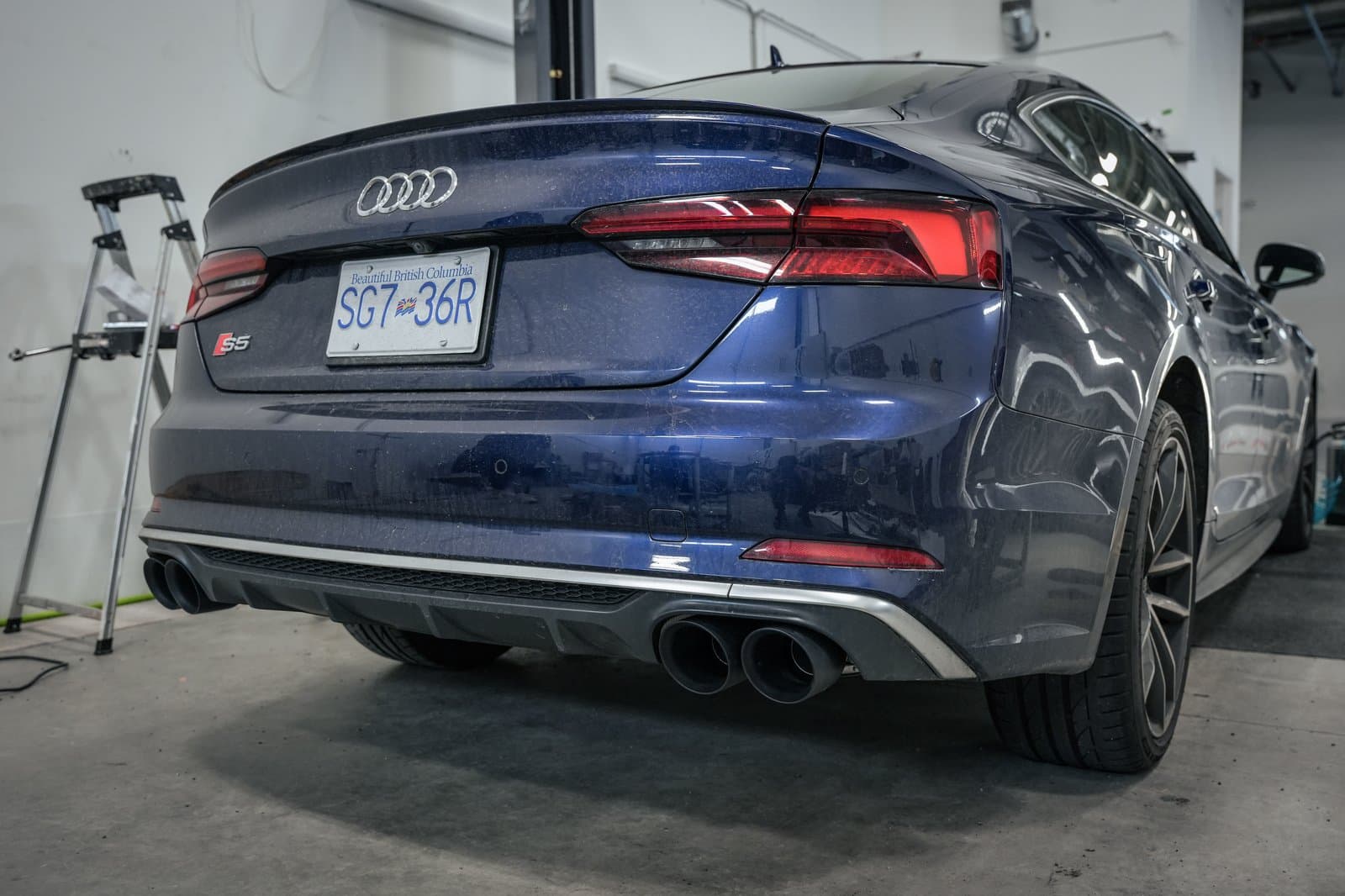
And if the goal is simply a better-sounding, better-breathing exhaust for the car you drive every day, a system that leaves the emissions hardware completely alone is often the more satisfying answer, because it addresses the sound and the flow without putting the vehicle's legality in question. JRS carries an exhaust range covering every configuration on this page, from axle-back through cat-back to catted and catless downpipes, and can advise on which one suits your specific car and inspection situation. A recent turbocharged build on a Audi S5 running a Milltek exhaust shows the kind of work that goes through the shop — the Audi's turbocharged V6 took the upgrade in a way that suits the car rather than fighting it. Browse the exhaust service options, or talk through the specifics for your vehicle.
Related project: Audi S5 — Milltek Exhaust Upgrade