The Realities of a Chrome Wrap in Vancouver
Published
There is a version of this that sounds like an owner's dream. Your car stops being the colour it left the factory in and becomes something you genuinely do not recognise in a car park. A mirror finish does that. The reflective surface picks up the sky, the buildings, the light through a window, and the car reads as an object rather than a vehicle. It is the most dramatic thing you can do to a car's appearance with a roll of film.
It is also the finish that asks the most of you afterwards, and the two facts sit side by side. JRS does chrome and mirror finishes as part of its colour change work — the
color change film service lists gloss, matte, satin and chrome finishes among more than two hundred available, and our
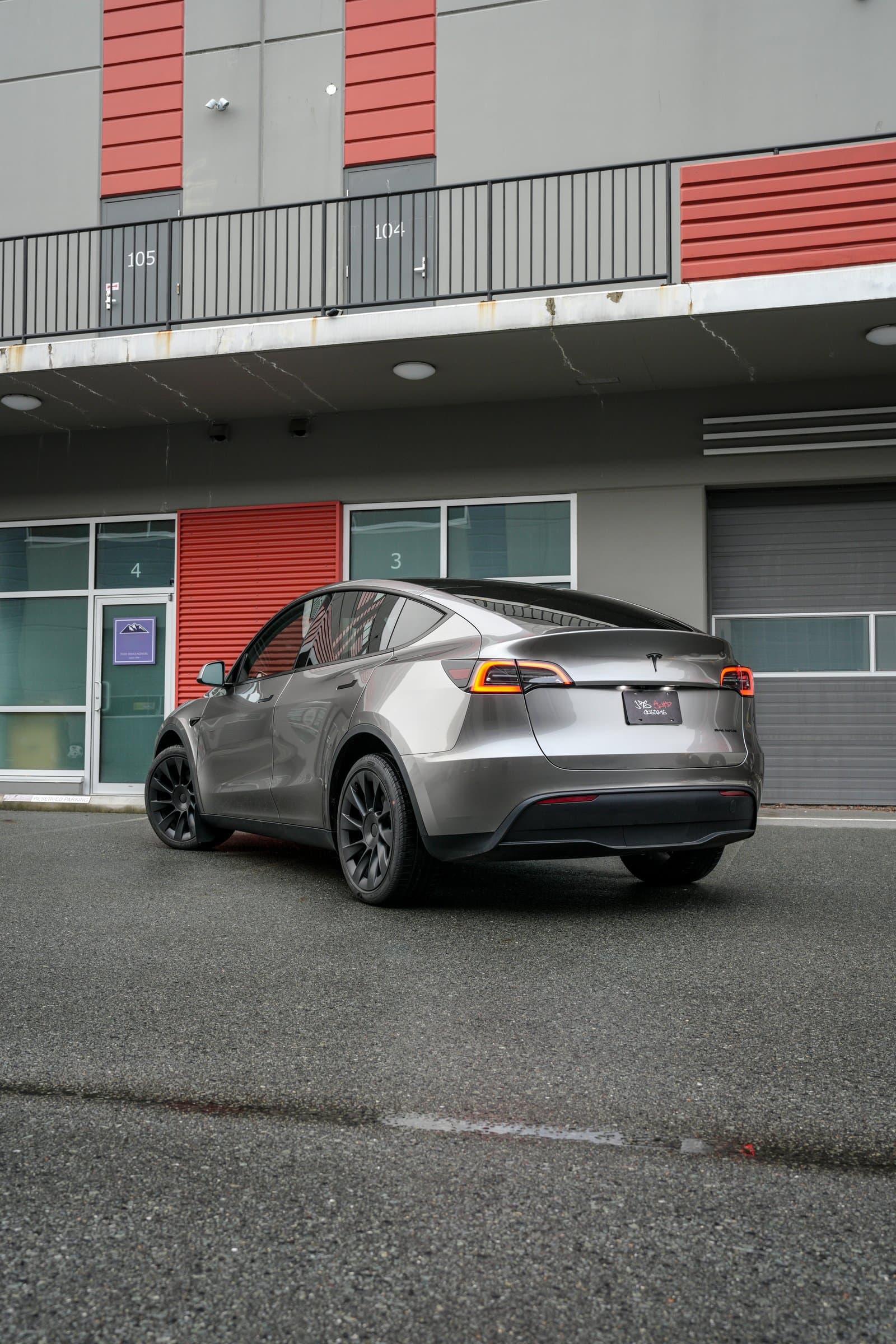
Liquid Metal Silver Model Y is one of the most striking examples we have done.
This is what owning one actually involves in a coastal city, and it is worth being straight about the trade-off rather than only describing how good the car looks.
What a mirror finish actually is
A chrome or mirror wrap is not paint. It is a film with a reflective layer engineered into it, so instead of scattering light the way a metallic or gloss finish does, it reflects it back. The practical difference is that a mirror surface shows you everything. A swirl mark on a gloss wrap is a faint haze under a light. The same mark on a mirror finish is a line across a reflection.
The second thing about mirror film is that it exaggerates the shape underneath it. A curved panel that reads as a smooth, continuous surface in gloss will show every undulation in the reflection on a mirror finish. That is not a defect. It is also why the quality of the installation shows up more clearly than on any other finish — a panel with a slight ripple in the film becomes visible as a waviness in the reflection, and there is no gloss to soften it.
The third is that the finish is unforgiving of fingerprints and dust in a way no other wrap is. Touch the surface and you leave a mark. This is a material property, not a maintenance failure, and it does not go away with a good wash.
What Vancouver rain and salt do to it
Vancouver is a hard place for a mirror finish, and it is worth being honest that this is the argument against the finish as much as for it. A reflective surface shows every drop. Water beads on a hydrophobic surface and rolls off, but on a mirror finish the bead pattern is itself part of the appearance, so what a gloss wrap simply sheds becomes something you can see.
Salt is the more serious issue. Between October and April the city spreads salt and brine on the roads, and that solution ends up on your car as fine, dusty residue. On a gloss or matte finish it sits as dulling that a wash fixes. On a mirror finish it does not just dull the reflection — it etches it, because the salt is chemically active against the surface it is sitting on. The pattern is the same as water spots on glass, and it is permanent.
The wet season adds the other half. Reflective finishes show rain spotting and hard-water marks far more obviously because a spot on a mirror interrupts an otherwise continuous image of the sky. Our
ceramic coating service explains what a hydrophobic layer does and does not do, and it is worth reading before you commit to the finish rather than after.
None of this means a mirror wrap is a bad decision. It means it is a decision that has to be made with your eyes open, and that it asks more of you in the four months of the year when the roads are wet and salted than in the two months when they are not.
The questions worth asking before you choose it
How the car is parked decides a lot. If it lives in a garage, a mirror finish is far more manageable, because the surface stays cleaner and the hardest part of the year never happens to it. If it is on the street or in an open lot through the wet season, you are committing to regular washing and to accepting some etching that no amount of careful work will fully reverse.
What the car is used for matters too. A mirror finish on a car that does short urban trips is a different proposition from one on a car that sees highway grit and construction dust, because the abrasive material in road dust is what does most of the scratching on a reflective surface.
And there is the honest reason people choose it, which is not a maintenance argument at all. Some cars look wrong in anything else. If you have seen the reflection in a Liquid Metal Silver wrap and that is the car you want, the case for it is simply that it is the finish that gives you that car, and a perfectly sensible decision does not become a wrong one because it requires more care than a satin wrap would.
What to expect from the work itself
Mirror film is more demanding to install than a flat colour. The material has to be kept at a consistent temperature through the work, it is easier to mark while it is being laid down, and a panel with complex curvature takes longer to get right. That extra time is why our daily essential package and colour change work is booked two to four weeks out rather than turned around in days.
A specialist detailer can help with what happens next. Our
maintenance service includes a reset of the hydrophobicity on coated cars and a full decontamination wash, both of which are the right service to book in spring after a winter of salt, and neither is a substitute for the wash cycle the finish needs every week or two in the wet season.
The work that matters most is the least dramatic part. A mirror finish lives or dies on how it is washed — clean tools, clean water, and a drying step that does not leave mineral spots behind. Hand washing is not optional here in the way it can be optional on a satin wrap, because the reflection shows you every technique mistake you make.
A reflective finish is a genuine option and JRS does them, but it is not the default choice, and a shop that sells it without telling you what the wet season does to it is selling you the photographs rather than the car. If you want it, want it knowing what it costs in washing time and in a few permanent marks you will find when the light is right.
Related project: Tesla Model Y — Liquid Metal Silver Color Change