
Should You Take the Dealer's Paint Protection Package?
Published
There is a moment in the dealership that almost every new car owner has experienced. You have signed the paperwork, you have the keys, and someone walks you over to a desk where a laminated sheet lists the protection options. Ceramic coating. Paint protection film. A package combining the two. Each has a price attached and a timer that suggests it is a decision you should be making now, in this building, before you drive away. It is a reasonable thing to want and a reasonable thing to think about. It is also a decision with more variables than the sheet implies.
What the dealer is actually offering
The first thing to understand is that the word ceramic does not identify a product. It identifies a category. Within that category there are coatings that bond to clear coat and coatings that behave more like a sprayed sealant. Both get called ceramic. A dealer package sold at the point of sale is often applied in the shortest time the shop can schedule, which may or may not include the decontamination step that a proper application needs. None of that makes it a bad option, but it does mean the label on the sheet is not a specification.
So the useful question is not whether to accept the offer. It is what you would be getting. Ask what the product is, who applies it, whether the paint is decontaminated first, and how long the coating is left to cure before the car goes outside. Those four questions tell you more than any price on the sheet. If the answers are specific — named product, named process, stated cure time — the offer is probably sound. If they are vague, you are being sold a category rather than a service.
The preparation question nobody answers
Here is the part that matters most and that gets the least attention. A coating bonds chemically to the surface it is applied to. It needs clean paint to bond to — paint that has had its bonded contaminants removed, its metal dust lifted out, and its surface prepared for the product to sit properly on. That process is not a formality. Coating over contamination locks that contamination against the clear coat, and it makes the surface harder to correct later.
Now consider what a new car has been through. It has been driven off a transport trailer, it has been washed at least once by the dealer preparation team, and it may carry transport wax or light prep compounds from the factory. Automated wash equipment with brushes — even soft-touch systems — is the kind of thing that leaves fine swirling in a dark colour. If that is present when the coating goes on, it will be there afterwards, sealed under the layer you paid for.
This is the same reason a car arriving for its first protection gets a full inspection before any product is applied. The condition of the paint before coating determines how much of the finish you actually see afterwards. A coating preserves the paint as it was found. If the paint was corrected first, it preserves a corrected surface. If it was not, it preserves the swirls, and adds a layer over them.
Film and coating are different purchases
Paint protection film and ceramic coating solve different problems, and the package that combines them is genuinely attractive. Film is a physical barrier. It is a thick urethane layer that takes the impact of road debris before it reaches the paint, which is the one thing a coating cannot do no matter how good the chemistry is. A coating is chemical protection and a hydrophobic surface: the paint sheds water, contaminants have a harder time bonding, and the car is easier to wash.
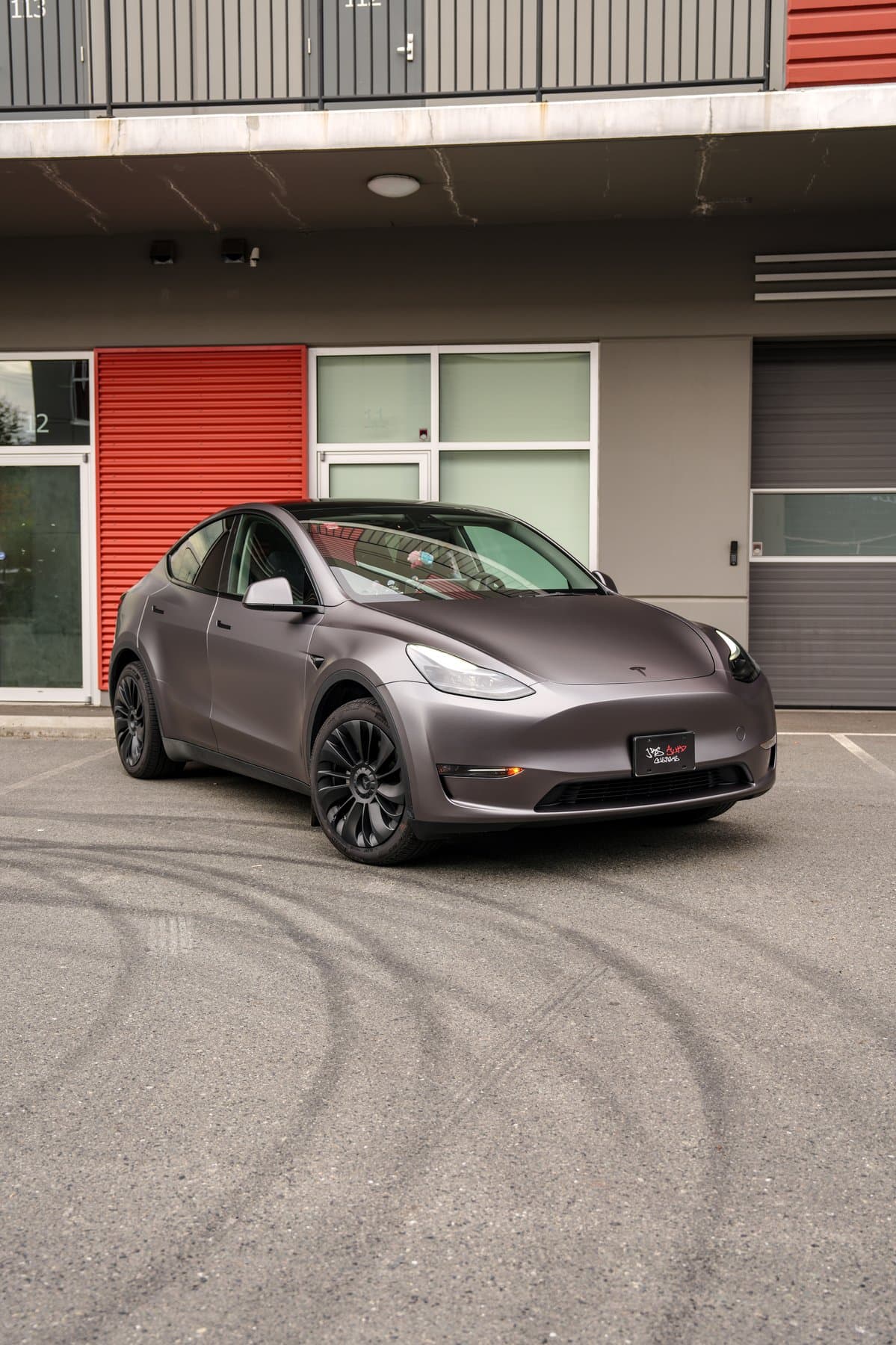
If your thinking is physical protection — highway driving, gravel roads, winter salt, stone chips hitting the leading edge — then film is doing the work and a coating over the rest of the car handles the chemical side. That combination is what JRS builds its packages around, and the Tesla Model Y protection package shows the usual shape of it: front-end film covering the hood, bumper, fenders and mirrors, with ceramic coating across the rest of the car. Same principle as the PPF service and the ceramic coating service offered separately.
The reverse framing matters too. If the car lives in a garage and the concern is mostly rain, salt film in winter and how easy the car is to keep clean, ceramic coating alone is a defensible answer, and the budget you do not spend on film can go into a proper preparation.
Timing matters more than the product in Vancouver
This is where a dealership offer can be quietly wrong even when the product itself is fine. A coating needs to cure before it meets weather. Vancouver's road salt typically starts in October, and October also brings the first serious rain of the season. A coating applied in the last week of September and driven out into heavy rain the following morning has not been given a fair chance to cure.
A car delivered in spring or summer has a window. Book the protection before the autumn, let it cure properly, and it is in place before the first salt application of the year. That is also the natural argument for getting protection sorted early rather than in the first cold week, when every shop in the city is at capacity and lead times stretch.
How to make the decision
Take the offer if the answers to those four questions are specific, if the preparation is included, and if there is time for the coating to cure before the weather turns. There is real value in having it done while you are already at the dealership, and there is no rule that says a car protected on day one is a car protected badly.
Decline it if you want front-end film rather than a coating, if the paint needs correcting first and that correction is not included, or if the timing means the coating goes on days before the first storm. A repainted panel or a car with dealer swirl will not be fixed by coating over it.
And if you would rather have it done properly than cheaply, that is a reasonable position to take. JRS runs a full vehicle inspection before protection work so you know what condition the paint is actually in, and offers maintenance plans that include coating inspection, edge checks and hydrophobicity resets — the part that determines whether a coating still works a year later. Ask for a quote for the specific protection you want, and see what it includes.
Related project: Tesla Model Y — Protection Package