
Exhaust Pipe Size: Why Diameter Changes Sound and Flow
Published
Most people choose an exhaust by how it sounds
A car with a nice exhaust note is the reason most people end up at a shop at all. But the note itself is an outcome. It comes from somewhere more fundamental, and that somewhere is the diameter of the pipe the gas travels through. Two systems can sound completely different while doing the same job, and a lot of that difference comes down to how wide the pipe is at each point along the way. It is the single most useful thing to understand about an exhaust, and the thing most owners never hear explained. Our exhaust service page lists cat-back systems, axle-back systems, downpipes, headers and fully custom fabrication, and every one of those choices is a decision about pipe size at some level. This is what that decision actually controls.
A wider pipe is not simply a louder pipe
It is tempting to think of exhaust sizing as a volume dial. Bigger pipe, more noise, done. That is not how it works, and the misunderstanding is the source of a lot of disappointing purchases. Pipe diameter controls how much gas can move, but it also controls how fast it moves and how the pressure wave behaves as it leaves the engine. A wider pipe moves more gas with less restriction. That is genuinely valuable when the engine is producing a lot of gas and the pipe is the bottleneck. It is much less valuable, and sometimes counterproductive, when it changes the way the pressure pulse travels back up the pipe toward the cylinder it just left. That pulse is the mechanism the engine relies on to clear the cylinder and draw fresh charge in on the next stroke. On a naturally aspirated engine this scavenging effect matters a great deal, which is why JRS advises on header primary tube diameter and length, collector design and muffler selection when a customer is building a performance system for one. The goal is a system that supports scavenging across the power band without adding restriction that is not needed. Too restrictive and the engine is choking at the top end. Too open and the pulse dissipates before it does its job, and mid-range torque drops away. There is a window, and it is narrower than most people expect.
Where the sizing decision actually happens
A system is not one diameter. It is several, and each one does a different job. The primary tubes are the first section, running from the exhaust port down the manifold. The collector is where those tubes merge into one. The pipe that leaves the collector is the mid-pipe. Further back sit the resonator and the muffler. Each section is sized for what it has to do. Headers use smoother, larger-diameter tubing and merge into a collector to cut turbulence and let gas leave the cylinder efficiently, as we explain in our guide to cat-back, axle-back and header systems. This is also why the difference between an axle-back and a cat-back is as much about size as it is about which parts get replaced. An axle-back replaces the muffler section and leaves the factory mid-pipe and resonator in place, and the factory mid-pipe is a fixed diameter that limits how much the sound and flow can change. A cat-back replaces everything rearward of the converter, so the diameter can be chosen fresh from the collector back.
Sound, drone and the law are all downstream of size
This is where sizing stops being a performance conversation and becomes an ownership one. A system that is too wide for its resonator configuration will sound different, not just louder. Resonators are chambers tuned to absorb specific frequencies, and they are often the difference between a system that measures quiet and a system that measures loud on the same base car. As our piece on BC aftermarket exhaust noise law puts it, the variables that decide where a car lands on the meter are the muffler design, the pipe diameter and whether the system includes resonators. The diameter is the part you can influence and the part that is easiest to get wrong. There is also a drone problem, which is separate from volume. A system can sit below the legal limit and still be tiring to live with, because drone is a low-frequency resonance that shows up inside the cabin at steady cruising speed rather than at the maximum reading the officer takes. If you commute the Sea-to-Sky every day, that distinction matters more than the headline number does. And there is one more reason JRS does not fit straight-through racing mufflers to naturally aspirated street cars: the loss of scavenging mid-range is noticeable and rarely worth the marginal high-rev gain.
When you need a diameter no catalogue offers
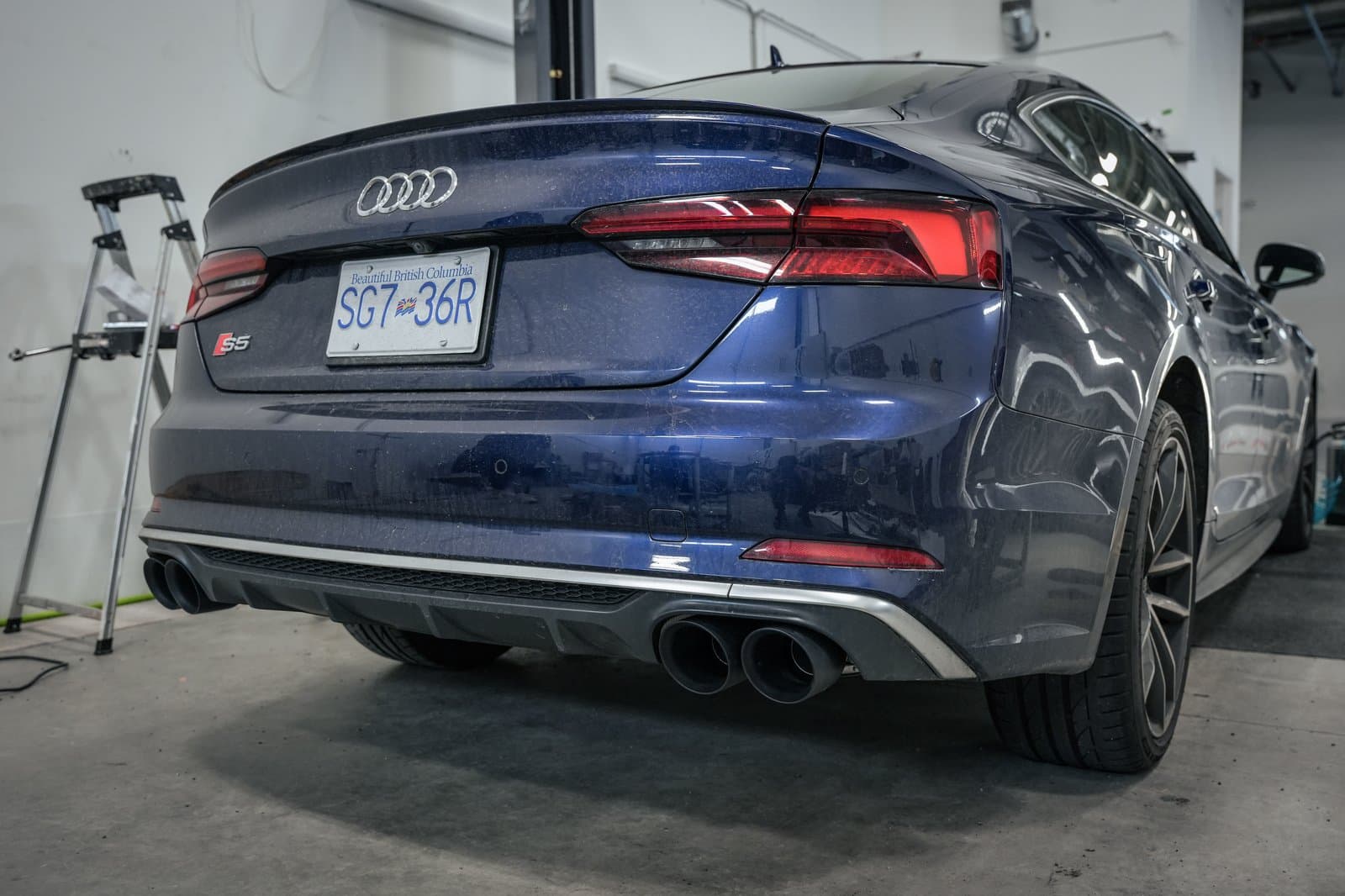
Most of the time, a catalog system is the right answer, and picking the wrong one is a matter of taste and budget rather than engineering. Our axle-back and cat-back comparison covers how the two differ in cost and in how much of the car they change. But some situations are not about the choice between systems. Sometimes a car has no aftermarket system made for it, and the options are thin or limited to a single system with one tone and one diameter. Sometimes the owner wants a specific pipe size that no off-the-shelf product offers, or has heard a hand-built car with a character they want to reproduce. A catalog system with one size and one resonator configuration will not produce that. That is what custom fabrication is for: choosing the diameter at each section, where the bends occur, and whether the original resonator is kept or replaced. It is a different kind of job and a different kind of conversation, and we have covered the reasoning separately. The Audi S5 on a Milltek system in our portfolio is a good counter-example to the idea that custom is always the answer. It runs a British-engineered Milltek system, and the point of it is the tone: refined but assertive, complementing a turbocharged V6 coupe without turning the car into something it is not. The pipe was sized for that result. The Toyota GR86 on an HKS system is the same idea on a boxer engine, where the whole point of the pipe is how it shapes what the engine sounds like. Sometimes the right diameter is the one the manufacturer already decided.
What to ask when you talk to the shop
Three questions will tell you most of what you need. First, what does the system do at each section, and why those sizes. A shop that can talk about the primary, the collector and the rear section as separate decisions is doing engineering rather than quoting a catalogue. Second, will it drone at highway speed in the car you actually drive, and how will you know before it goes in. Third, and this is the one owners most often skip, what does the system do to the sound at idle versus under load. That difference between the two is what tells you how the scavenging is behaving, and it is the difference between an exhaust that sounds good for a minute and one that sounds good every morning. None of this needs a specification sheet at home. It needs a shop willing to explain the reasoning, and that is worth more than the number on the quote. If you want to talk through what a specific system would look like on your car, our exhaust service page sets out every configuration we install.
Related project: Audi S5 — Milltek Exhaust Upgrade