
Black Soot Streaks Behind Your Car: What Causes Them
Published
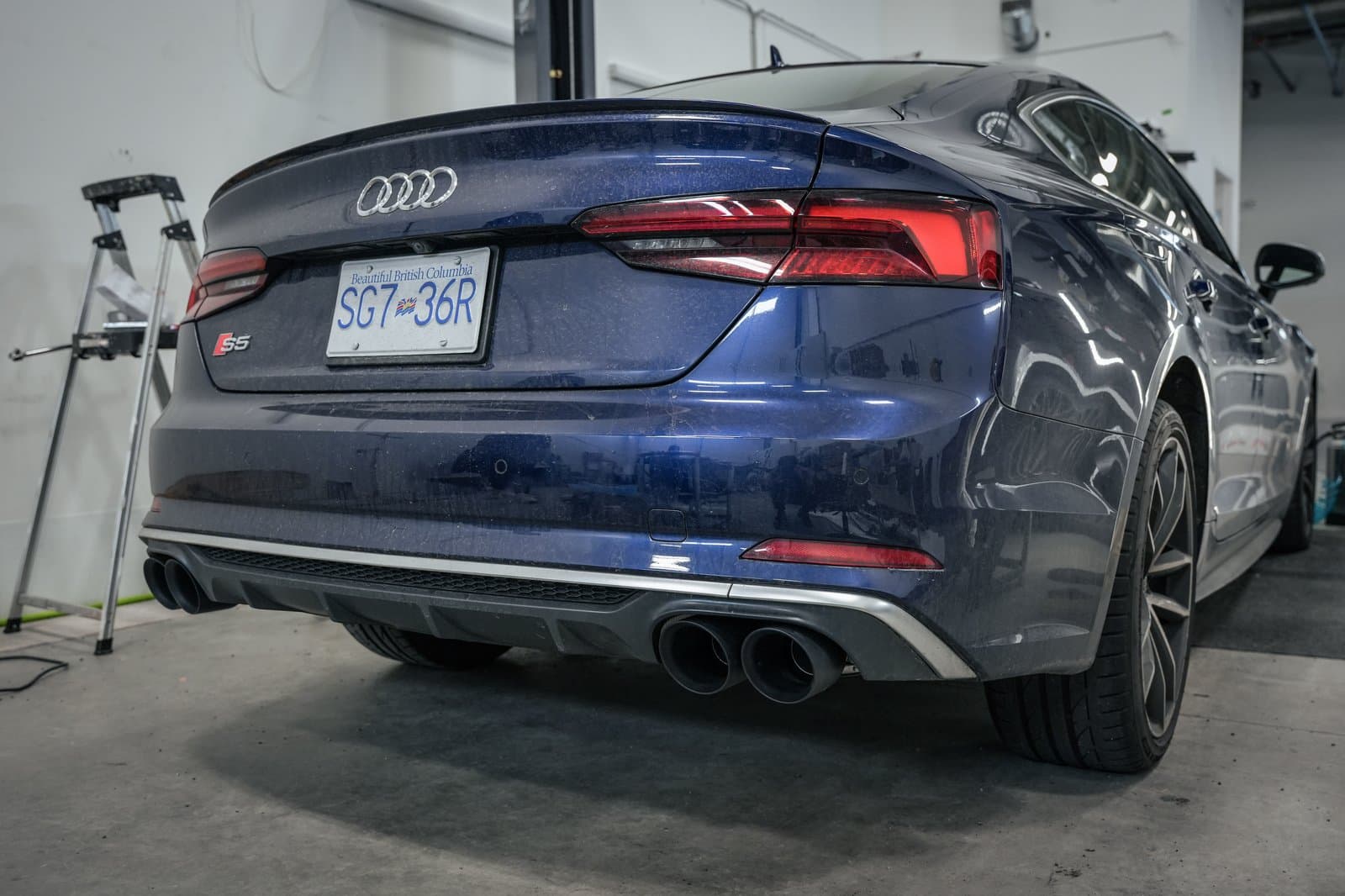
There is a kind of mark on the rear bumper that confuses almost every owner who sees it for the first time. It looks like a film of grey dirt that reappears within days of a wash, it streaks sideways when it rains, and it concentrates right around the exhaust tip. Most people assume road grime, brake dust, or something left behind by a parking garage. It is none of those. It is exhaust soot: carbon particles the engine produces when combustion is not completely clean, released into the air behind your car. This post covers where they come from, why Vancouver drivers see them more often in the darker months, and what to do about the marks you already have. If your car has had recent exhaust work, our exhaust service page is a useful place to start, because tip and system design plays a real role in how much residue ends up on the bodywork.
What the black marks behind your car actually are
Soot is the solid carbon left behind when a fuel mixture burns unevenly. A healthy engine running warm and clean sends most of its exhaust out of the tailpipe as water vapour and clean combustion products. When the mixture runs rich, when the engine is cold, or when it is working hard, the excess fuel does not fully burn and exits as fine black particulate. That particulate settles on the inner walls of the exhaust system and the outlet of the tip, and is carried outward by exhaust pulses.
From there it has two destinations. Some stays on the metal of the tip, which is why tips darken and need cleaning. The rest hangs in the air behind the car and lands on whatever sits behind the exhaust outlet: the rear bumper, the lower valance, the boot lid edge, or the underside of a rear diffuser. In dry weather it is a thin film on the surface. In wet weather it turns into a slurry, runs rearward with road spray, and dries in streaks that look painted on. That is also why the marks seem to appear all at once: a car that sits unused, does one short trip in cold weather, then parks in the rain lays down more residue in an afternoon than a car driven steadily for an hour on a warm highway. How you use the car matters more here than mileage.
Why some cars soil a bumper and others do not
Several factors stack up, and they are worth understanding before spending money on anything. The first is the engine. Older, higher-mileage engines that have not had their fuel system or emissions equipment serviced tend to burn less cleanly, and soot production rises with them. A car that idles in traffic, does a lot of short trips, or lives in cold conditions produces more of it than a car driven long and often.
The second factor is the exhaust system itself, which is the part JRS deals with directly. We install cat-back and axle-back systems, downpipes, headers, active valve-controlled exhaust and fully custom stainless or titanium fabrications, working with brands including iPE Innotech, Akrapovič and Armytrix. Each of those choices changes where residue ends up. Tip diameter, tip length, the angle of the cut, and how close the outlet sits to the bumper all change what leaves the pipe and where it settles. A build like the Audi S5 with a Milltek exhaust in our portfolio shows the sort of finished system we work on, and the same principles apply to any of the configurations listed above.
The third factor is what happens once the residue lands. Soot on a clean, unprotected clear coat sits on top and can be lifted. Soot on a surface already carrying road salt and winter grit bonds to the contaminants underneath, and that version stays through a wash and needs real decontamination to move.
What the marks do to your paint
The damage is mechanical rather than chemical, and the distinction matters. Carbon is not strongly acidic, so soot alone will not eat into clear coat the way bird droppings or acid rain do. The problem is what soot holds: road salt, sand, and the fine metallic grit that comes off brake discs and road surface. Once that grit sits under a layer of soot, dragging a sponge across it grinds those particles into the clear coat. That is how a dirty bumper becomes a bumpy, hazy panel that catches the light.
There is a second risk in how you clean it. Soot films often feel like grit and invite scrubbing. Scrubbing a soft clear coat with an abrasive pad, or clamping down on a dirty mitt, is how a film of carbon becomes a set of swirl marks. If the soot has bonded, it wants to be lifted chemically and gently, then the residue polished off, not fought with pressure.
Protection changes the equation. Our ceramic coating service is built around chemical resistance to acid rain, bird droppings and industrial fallout, and the same barrier logic applies to road film and carbon: a coated panel lets contamination sit on top of the coating rather than bond into the paint, so it comes off in the wash instead of needing a correction. Paint protection film does the same job physically, and it is a sensible choice for a low rear bumper that will always be in the firing line.
Removing soot marks that are already on the bumper
Start with what you would do for any bonded contamination. A pH-neutral wash with a clean mitt and grit guards lifts the loose film and tells you how much work is left. If marks remain they have bonded and need a decontamination step: a dedicated cleaner, dwell time, and a clay bar for what the wash could not. Our maintenance packages are built around exactly this kind of staged approach, with a compatible wash, decontamination, and a clay bar pass included in the fuller options.
Where a mark has genuinely fused into the clear coat, a single-stage polish removes it. That is not a case for an aggressive compound on a dark panel, because the same grit that caused the problem will cause a new one. Check the bumper in good light afterwards, because the difference between a corrected panel and a hazy one is obvious under shop lighting.
The tips themselves need attention at the same time. A tip caked with carbon will keep re-dirtying the bumper behind it, so cleaning the outlet is part of solving the paint problem rather than a separate job. Our guide to exhaust tip cleaning and protection covers the material differences that matter, including why stainless and titanium tips each behave differently in coastal moisture and winter salt.
Preventing the next round of marks
Prevention comes down to three things. Wash the car before the soot has had time to bond, which in practice means a monthly hand wash rather than waiting for the marks to become visible. We offer a scheduled wash plan that uses compatible chemicals on coated and wrapped cars, and the reasoning is covered in our guide to how road salt attacks clear coat — salt and soot behave like two halves of the same problem.
Second, protect the panels that get hit hardest. The lower rear bumper, the area around the tip and the lower edges of the boot lid take most of the deposition. Film on those panels, or a coating across the rear of the car, turns a surface that soots and stains into a surface that wipes clean.
Third, keep the exhaust itself healthy. A system that is fitted correctly and maintained gives cleaner combustion and a predictable result at the outlet, and it makes more sense to address the source of the residue than to keep removing it from the bumper. If the marks got noticeably heavier after exhaust work, or the car runs differently than it used to, get the system checked before booking a paint correction. We can look at the exhaust side at the same time as the paint.
Soot marks are cosmetic rather than catastrophic, and most come out with a wash and a decontamination pass rather than a full correction. What is worth avoiding is the cycle of scrubbing the bumper, scratching the clear coat, and then covering it with protection that was never properly prepared. Fix the panel, protect it, and check the exhaust outlet once a season.
Related project: Audi S5 — Milltek Exhaust Upgrade