
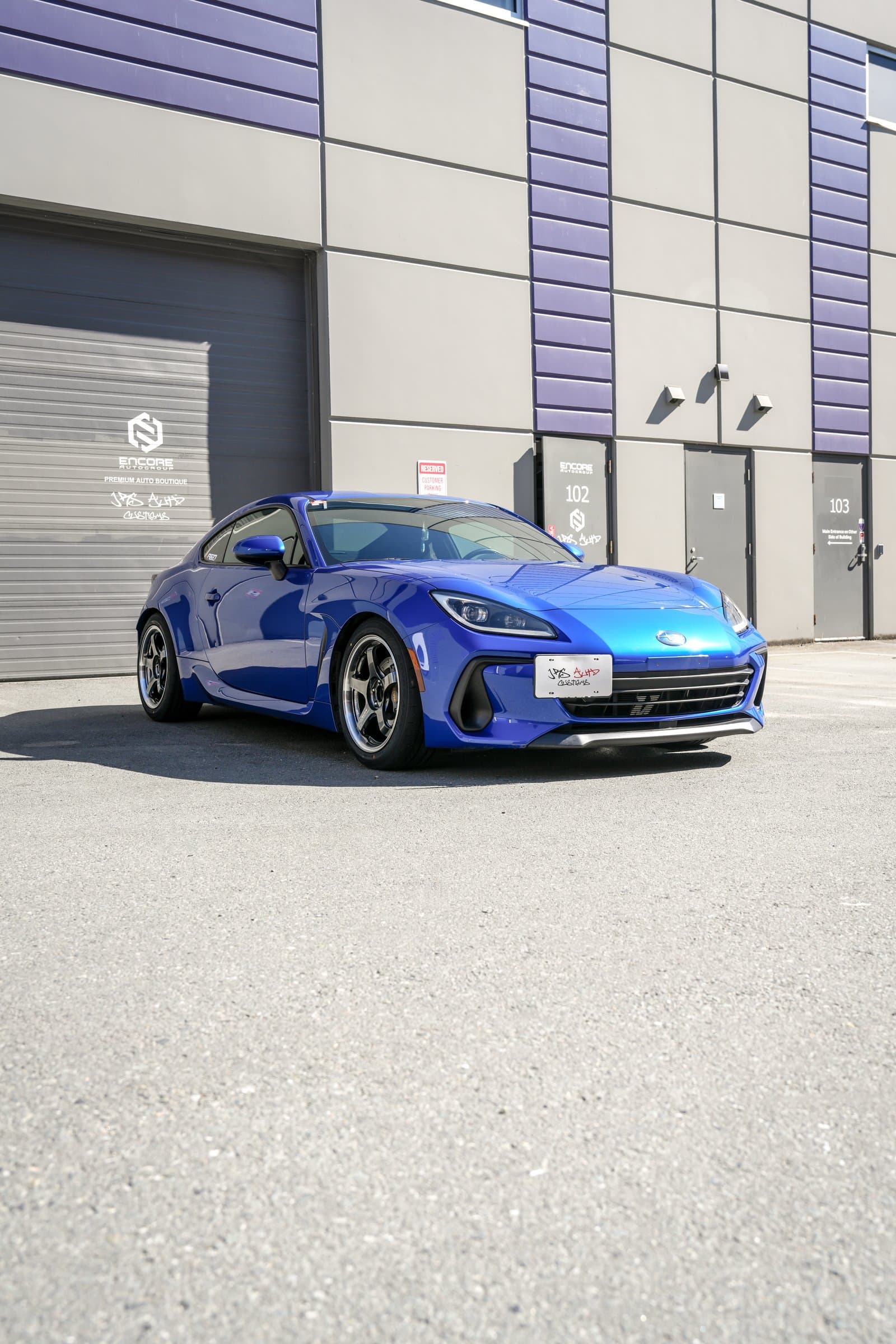
Protecting Your Headlights Before Vancouver Damages Them
Published
Headlights do more work in Vancouver than almost anywhere else in Canada. Coastal fog, endless drizzle, road spray from rain and snow, and clear skies that can be surprisingly bright in the mountains — all of it hits your lenses every time you drive. Most drivers don't think about their headlights until a crack appears or the glass turns cloudy. By then, the repair is more expensive than a proactive step would have been.
Why Vancouver Is Tough on Headlights
Modern polycarbonate headlight lenses are tough, but they are not immune. The material starts life with a UV-stable hard coat applied at the factory. Over years of exposure, that coating breaks down through photo-oxidation — UV radiation attacks the polymer surface, making it brittle and hazy. In Vancouver, this is driven by direct UV on bright coastal days and the reflective bounce off snow in winter.
Beyond UV, physical abrasion is the bigger problem. Rocks, gravel kicked up by trucks on Highway 1, sand and grit on road surfaces — all of it strikes the leading edge of the headlight at speed. Even a small chip or scratch in the lens creates a focal point for further degradation, starting a chain reaction that ends in full-surface hazing.
Oxidised Headlights and the Inspection Reality in BC
Cloudy headlights are not just an appearance issue. In BC, vehicles must meet minimum headlight output standards for road inspection. Severe lens hazing can reduce light output by 50% or more — enough to fail a commercial inspection or create a safety hazard on dark North Shore roads or mountain passes around Squamish and Whistler.
Once oxidation has set in, the options are restoration (wet sanding and UV sealant) or replacement. Both involve cost and, in the case of replacement, can run to significant sums on premium vehicles with adaptive LED or laser headlights. The alternative is protection before the damage occurs.
Paint Protection Film: The Front-Line Defence for Headlights
Applying PPF to headlight lenses is one of the most cost-effective uses of film protection on a vehicle. The lens surface is flat and relatively small — material cost is low and the film is less visible than on painted panels. Many people never notice it is there.
PPF works as a sacrificial layer: it absorbs rock chips, abrasions and UV exposure instead of the lens itself. On the Sea-to-Sky Highway and the Fraser Valley corridor, impact frequency is high. A stone strike on a bare lens can crack or chip the polycarbonate. A stone strike on a protected lens hits the film, which self-heals or can be replaced panel-by-panel.
For full-body protection that includes headlights, JRS Auto Customs offers full PPF installation — discuss coverage scope at your consultation.
Tinted vs. Clear Film: Choosing the Right Product
There are two main approaches. Clear optically transparent PPF offers the highest level of protection without changing the appearance of the headlight or the quality of light output. Smoked or light-tint PPF slightly darkens the lens — which many drivers prefer for the aesthetic on dark-coloured cars — but you need to confirm that any tint level still allows your headlights to pass BC output standards.
Regardless of tint level, the film should be a urethane-based product (not PVC vinyl) for durability, UV stability, and self-healing properties. PVC film is prone to lifting at edges, discolouring, and cracking over time — particularly in a wet climate like Vancouver's.
Signs Your Headlights Are Already Losing the Battle
If you notice any of the following, it is time to act: yellowing or browning across the lens surface, surface scratches that catch your fingernail, reduced night-time visibility even with new bulbs, condensation inside the lens housing, or a chalky appearance in direct sunlight. Early intervention — a professional restoration followed by PPF — is significantly cheaper than full headlight replacement on most vehicles.
Getting Headlight Protection at JRS Auto Customs
Our team installs PPF on headlight lenses as a standalone service for individual lens sets and as part of full-body installations. The film we use is a urethane-based product rated for automotive exterior use — UV-stable, self-healing, and optically clear. We prep each lens surface before application to ensure the film bonds correctly.
If your headlights are already showing signs of oxidation, we also offer restoration: wet sanding to remove surface hazing followed by a UV-stable sealant or ceramic coating to slow future degradation. Film protection locks in the result from there.
Discuss your headlight protection options at our Vancouver shop — bring your car and we can assess lens condition on the spot. For a broader look at film and ceramic protection, explore our ceramic coating service as a complement to PPF on the rest of the vehicle.
Related project: Subaru BRZ — Full Gloss Clear PPF