
Lug Nuts and Studs: What a Tire Swap Does to Your Hardware
Published
Every October, thousands of Vancouver drivers put on winter tires, and every one of those swaps is also a small hardware event. The rubber changes, but so do the lug nuts, the wheel studs, the threads, and the clamp load holding it all together. Most drivers think about the tire. Very few think about the fastener, and by February the difference shows up as a rusty wheel or a nut that no longer seats properly.
This guide covers what a seasonal swap actually does to your wheel hardware, why Vancouver road salt attacks it faster than most people expect, and which questions are worth asking when you book the work.
What a Seasonal Swap Actually Does to Your Wheel Hardware
A tire swap is more than pulling rubber off and pressing new rubber on. Between the old tire and the new one sits a machine job: separating the two halves of the rim, inspecting the barrel, and reseating the tire properly. The wheel comes off the hub, the hardware comes out, and every fastener that goes back in has been handled in a shop environment that is wet, salty and full of brake dust. Our tire service handles seasonal swaps, off-season storage and mount-and-balance work in one visit, so it is the natural place to have the hardware inspected at the same time.
On reassembly the wheel goes back on with a calibrated torque wrench and a defined sequence, usually a star pattern rather than one nut at a time, so the wheel seats evenly against the hub. If your car uses plated lug nuts that have corroded into a solid lump, the swap is often the moment they get replaced, because a seized nut is hard to free once it has rusted itself onto the stud.
Two things get checked while the wheel is off: the condition of the studs, and whether the wheel seats cleanly on the hub. A corroded or bent stud will not carry the same load as a healthy one, and a wheel that rocks on the hub creates a mismatch that shows up later as vibration and uneven wear.
Why Studs and Threads Corrode So Fast Here
Vancouver gets rain through much of the year and road salt through the winter. Salt dissolves in the water that collects in the wheel barrel and in the stud holes, and it stays there wet and active far longer than most drivers assume. The studs are the worst offenders, because they sit in the exact pocket where water and grit collect, and the threads hold moisture even when the face of the wheel has been wiped down.
Bare steel and worn plating show it first. You will see rust bleeding out of the stud hole, and a brown ring around the base of a lug nut. Once corrosion starts under the flange of a nut it spreads underneath, in the one place a socket cannot see it. Corrosion-resistant hardware is an option some drivers choose when a car lives on salted roads.
The tire pressure monitoring system belongs on the same list. The sensors live in the wheel, so they come off and go back on with every seasonal swap. Programming them for the new wheel and tire combination is part of a complete job, and a sensor that has lost its pairing can leave a warning light on long after the tires themselves are in good condition.
The Torque Re-Check Most Drivers Skip
This is the part of the process that gets skipped more than anything else. The specification says the lug nuts go to a certain torque. It does not say that is the end of it. Heat cycling and vibration loosen fasteners, and a wheel that was torqued correctly on a cold shop floor can lose a small amount of clamp load after a week of highway driving in the cold.
This is why a proper swap includes a re-check after the first few hundred kilometres of driving, and another look as the winter goes on. It is a quick job. The wheels come off, the fasteners are checked against the specification for your vehicle, and anything that has moved gets brought back to it. Doing that early is far cheaper than finding out later what a loose wheel does to a rotor or a stud.
The same logic applies to a seasonal set that lives in storage. When the off-season wheels come back out after the summer, the hardware on them has been sitting for months, and the tires need to be checked for pressure and condition before they go back on the car.
Bigger Wheels, Spacers and Thread Engagement
A wheel upgrade changes the fastener picture. A larger diameter wheel with a lower profile tire can change how the wheel sits against the hub and how much of the stud is actually engaged in the mounting hole. The rule of thumb most wheel builders work to is that the fastener should engage at least as much thread as the diameter of the fastener itself, so a 14 mm stud wants at least 14 mm of thread engaged.
Spacers make this more sensitive rather than less. A spacer that centres on the hub, rather than hanging off the lug nuts, keeps the load where it belongs and keeps the fastener engagement at a sensible depth. A spacer that is not hub centric relies on the nuts to centre the wheel, and that introduces vibration at speed and uneven loading across the studs.
If your wheels are changing size as well as style, that is the moment to have offset and backspace checked against your specific vehicle rather than estimated from another car in the same category. Our wheel fitting service covers custom fitment, spacers and adapters, tire pressure monitoring service and curb rash repair, so a hardware question and a fitment question can be answered in the same conversation.
What to Ask For When You Book the Swap
A short list of questions gets you a more complete job. Ask whether the wheels come off with the hardware checked for corrosion and wear, and whether the fastener torque is verified with a calibrated torque wrench rather than an impact gun alone. Ask whether the tire pressure sensors are reprogrammed for the wheel and tire combination going onto the car, and whether the monitoring system is checked afterwards with the car driven.
Ask what happens to your off-season set and where it is stored. If your wheels are a second set that lives in your garage or in a shared parking area, that is a different conversation from a car that goes into storage for the season.
Ask about the tire choice itself. A winter compound stays flexible in cold weather and stops noticeably shorter on a cold, wet road than a summer tire does, which is the entire reason the seasonal swap exists. Beyond winter, most Vancouver drivers pick up an all-season set for the shoulder months and a summer set for the dry stretch.
The Rest of the Car While the Wheels Are Off
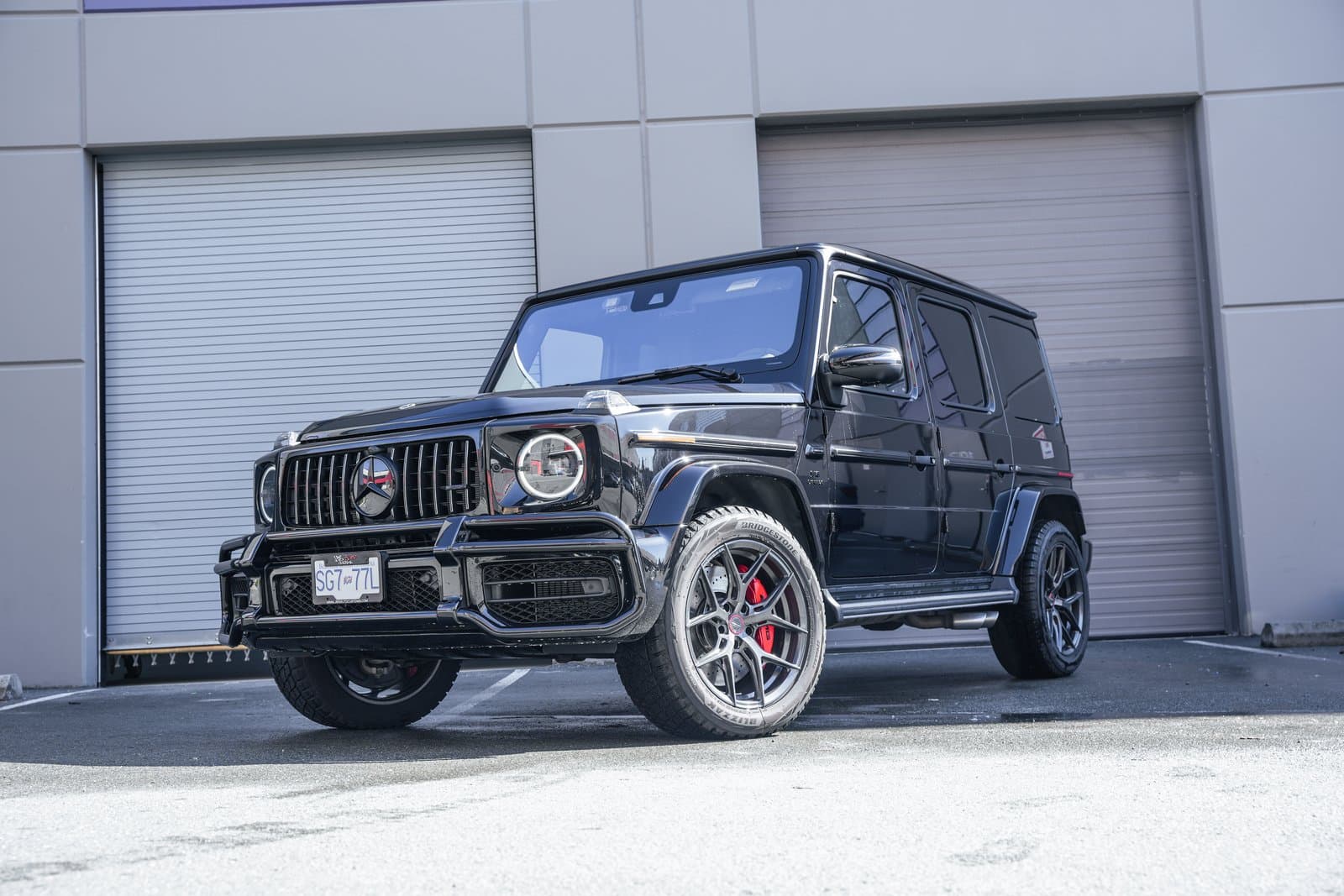
A seasonal swap is the easiest moment to look at the rest of the car, because the car is already up on the lift. If it has been sitting through a winter of salt and grime, a full detail and an inspection of the underbody and suspension components is a sensible pairing with the tire work. Our maintenance service covers the interior and exterior work that a winter of road salt leaves behind, and our wheels and tires project on a 2022 Mercedes-AMG G63 pairs 20 inch Vossen HF5 wheels with Bridgestone winter tires, which is the kind of build where the wheel finish and the tire choice were decided together rather than in two separate appointments.
Salt and grit thrown off a dirty road will chew through a wheel finish and the clear coat behind it if nothing sits between them. A ceramic coating gives the paint and the wheels a surface that water and salt shed off instead of clinging to, and a paint protection film on the panels that take the most abuse takes the stone chips that would otherwise end up in the clear coat. Both are easy to add while the car is already apart for tires.
None of this is complicated, and most of it takes minutes once the wheels are off the car. It is simply the part of a seasonal swap that does not announce itself, and by the time a driver notices it, the options are usually more expensive than a check would have been.
Related project: 2022 G63 AMG — 20" Vossen HF5 Gunmetal Wheels with Bridgestone Winter Tires