
Should You Put Your Car on a Maintenance Wash Plan?
Published
Most drivers wash their car when it looks dirty. The trouble with that rule in Vancouver is that by the time a car looks dirty in this climate, the contamination has usually been sitting on the paint for weeks. Rain is not a clean water source, and road film does not wash away on its own. A recurring wash plan is a different arrangement: instead of booking a detail when the car finally embarrasses you, you book it on a rhythm and the car simply stays ahead of the problem.
What a plan actually changes
A wash plan is not a cheaper version of a full detail. It is a scheduled, repeatable version of a maintenance wash, and what it changes is three things at once. The first is predictability — you know when it happens and roughly what it costs, rather than reacting to a dirty car with an unplanned booking. The second is that the work happens on a fixed cadence, so contamination never gets the weeks it needs to bond to a surface. The third is that someone who sees the car every few weeks notices things early, because a chip, an edge lifting, or a coating that has stopped beading is obvious when you are looking at the car routinely, and invisible when you only see it after six months.
That third point is the one that tends to be underappreciated. A vehicle on a recurring schedule is inspected as a matter of course rather than by accident.
The tiers differ in what gets done
Not every recurring visit needs to be the same visit. JRS structures maintenance around how the car is actually used and protected, and the packages reflect that.
A refresh-tier visit is the baseline: a two-bucket hand wash, wheel face and tire decontamination, door jambs and sills, a spray-on sealant, and an interior vacuum and wipe. That is enough to keep contamination moving and to protect the state of the finish between bigger appointments.
A full decontamination and correction visit is the heavier option. It adds a full exterior decon, clay bar and iron remover, wheels removed and deep cleaned, a single-stage paint correction, a wax and sealant combination, an interior deep clean, and an engine bay detail. This is the one that addresses accumulated damage rather than just removing what has landed since last time.
There is also a protection-specific tier for cars that already carry ceramic coating or paint protection film. It uses a compatible decontamination wash, inspects the coating layer, checks the film edges and re-tucks them, and resets the hydrophobicity so water beads again. That last step is the one that restores the easy-clean behaviour a coating is supposed to give you, and it cannot be skipped if the surface is to keep performing.
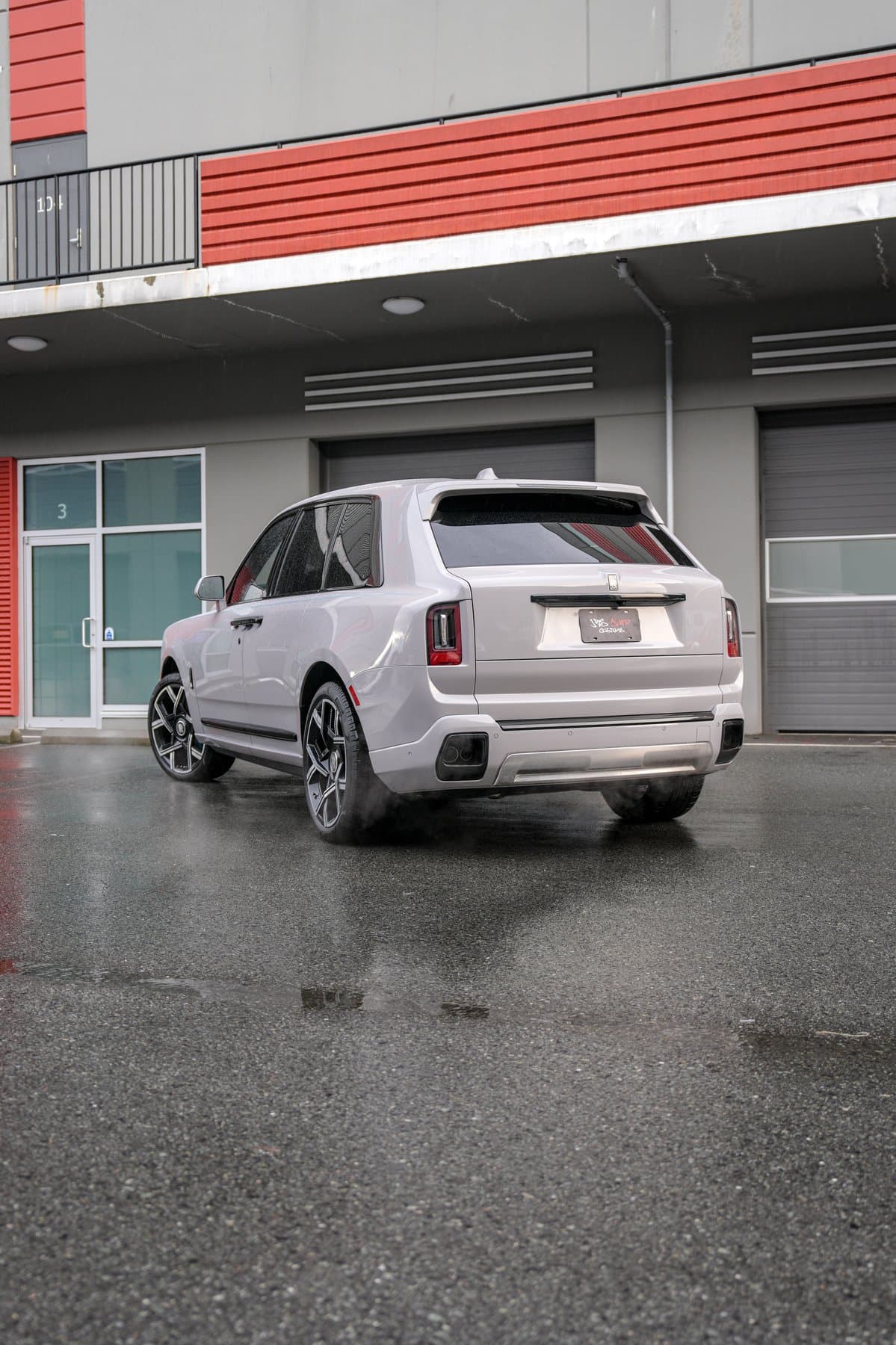
The Rolls-Royce Cullinan in full paint protection film is the kind of car this tier exists for — a full-body film installation with ceramic coating over it, several weeks of prep and install for full coverage on a flagship SUV. Protection at that level is only as good as the maintenance that follows it. A film with lifted edges or a coating that has lost its hydrophobicity does not protect anything, no matter how carefully it was installed.
What the chemistry does to a protection layer
There is a specific reason maintenance packages use compatible chemicals only, and no silicone-loaded dressings. Silicone and similar dressing products are popular because they make tyres and trim look bright, and they do that by leaving a film on the surface. That film interferes with a coating or a film surface. It reduces beading, it makes the surface behave in ways that are not the product you paid for, and it can leave residue that has to be removed later.
Aggressive degreasers near coated surfaces are the other half of the problem. They work well on the greasy build-up they are designed for, and they are careless about the clear coat sitting underneath. On a coated or filmed car, a decontamination step should use products chosen for the surface, not for the soil alone.
JRS makes this point in its own maintenance notes: all packages include compatible chemicals only, no silicone-loaded dressings, and no aggressive degreasers near coated surfaces. It sounds like a small detail. It is the difference between a coating that keeps working for years and one that has to be re-applied because something on top of it stopped the surface from behaving.
Whether it suits the way you drive
A recurring plan makes most sense if the car is outside in all weather, if it is coated or wrapped, or if you simply do not want to think about it. A car that lives in a garage and rarely moves may get more out of an occasional detail than a monthly schedule.
There is also a fair question about whether it is worth it compared with washing it at home. For a car with no protection, the honest answer depends on how much time the wash takes and whether you enjoy it. For a car with a coating or film, the answer shifts, because the products and technique that protect the surface are specific, and the risk of using the wrong one is a repair rather than a wash. The maintenance service sets out the packages and what each one covers, and the ceramic coating service page covers what the coating itself needs over its life.
If you are still deciding, the useful first step is a condition assessment. Knowing what the paint and the protection actually look like right now tells you which tier the car needs, and which tier it does not.
Related project: Rolls-Royce Cullinan — Full PPF