
Off-Road Tires: Winter, All-Terrain or Mud-Terrain?
Published
The three tire categories are not versions of the same thing
Most tire advice for Vancouver falls into two camps. There are winter tires, which the law requires on most BC highways between October 1 and April 30, and there are performance or all-season tires for the rest of the year. That leaves a category that gets sold but rarely gets explained: off-road tires. Our tires page lists the off-road category alongside winter and summer. JRS sells A/T and M/T tires for trucks and SUVs, and they are not a third flavour of the same thing. They are a different set of trade-offs, and a driver who wants a truck for both the highway and the backroad has to choose between them rather than compromise between them.
What makes an off-road tire different
An all-terrain tire is a compromise tire, and a good one. It carries a tread block pattern with some open space for self-cleaning in mud, but it keeps enough continuous centre rib and shoulder structure to stay quiet on the highway and predictable in the wet. That is exactly the trade you want if your truck spends most of its life on pavement and its weekends on a well-maintained forest service road.
A mud-terrain tire drops the compromise. The tread blocks are far more widely spaced, the sidewalls are taller and tougher, and the compound is usually a softer, stickier blend chosen to grip mud and loose rock rather than to run silently for two hours on the Trans-Canada. Everything the mud-terrain gives you on a trail, it takes back on the highway: more noise, more vibration, and a shorter service life.
And here is the part that catches people out in this province. A mud-terrain tire is not a winter tire and should not be treated as one. From October 1 to April 30, BC requires winter or M+S tires on most designated highways, and while a mud-terrain may well be M+S rated, it is engineered for a different failure mode. It is not the answer to a snowstorm on the Coquihalla.
The Vancouver version of the decision
Metro Vancouver's winter is wet more than it is cold, and the mountain passes are a different climate from the city. A driver who lives in the city and drives on the highway has a much easier time than a driver who splits time between a city commute and actual logging roads or deep backcountry access.
For most Vancouver-area truck and SUV owners the honest answer is that an all-terrain tire solves the problem they actually have. It gives up very little on the highway, it survives a winter without the noise and wear penalty of a mud-terrain, and it handles a gravel logging road or a wet forest service track without drama. A mud-terrain earns its compromises only if you are genuinely driving where the mud-terrain was designed to work, often enough for the extra tread life to matter.
There is a third path that solves the conflict outright: two wheel and tire sets, swapped twice a year. That is the arrangement JRS builds its winter packages around, with dedicated winter wheel and tire packages so you can swap in one visit each season. The winter package and off-season storage service. On a truck, the cleanest version of this is a summer wheel and tire set on the street and a separate off-road set on a second pair of wheels that live in the garage or under a cover. It costs more up front and it costs storage space, but the truck always has the right tire on it, and neither compound is asked to do a job it was not built for.
Why wheel choice decides how hard this gets
The tire conversation is really a wheel conversation, because the wheel determines which tire you can fit and how the truck behaves with it. Our wheels service covers the fitment side of this. A 20-inch wheel takes a lower-profile tire, which sharpens steering response and reduces sidewall flex, but it also has less room for a tall sidewall and takes a bigger hit from trail obstacles. A 17- or 18-inch wheel gives you more sidewall height, which is what actually protects the rim and the tire on sharp rock.
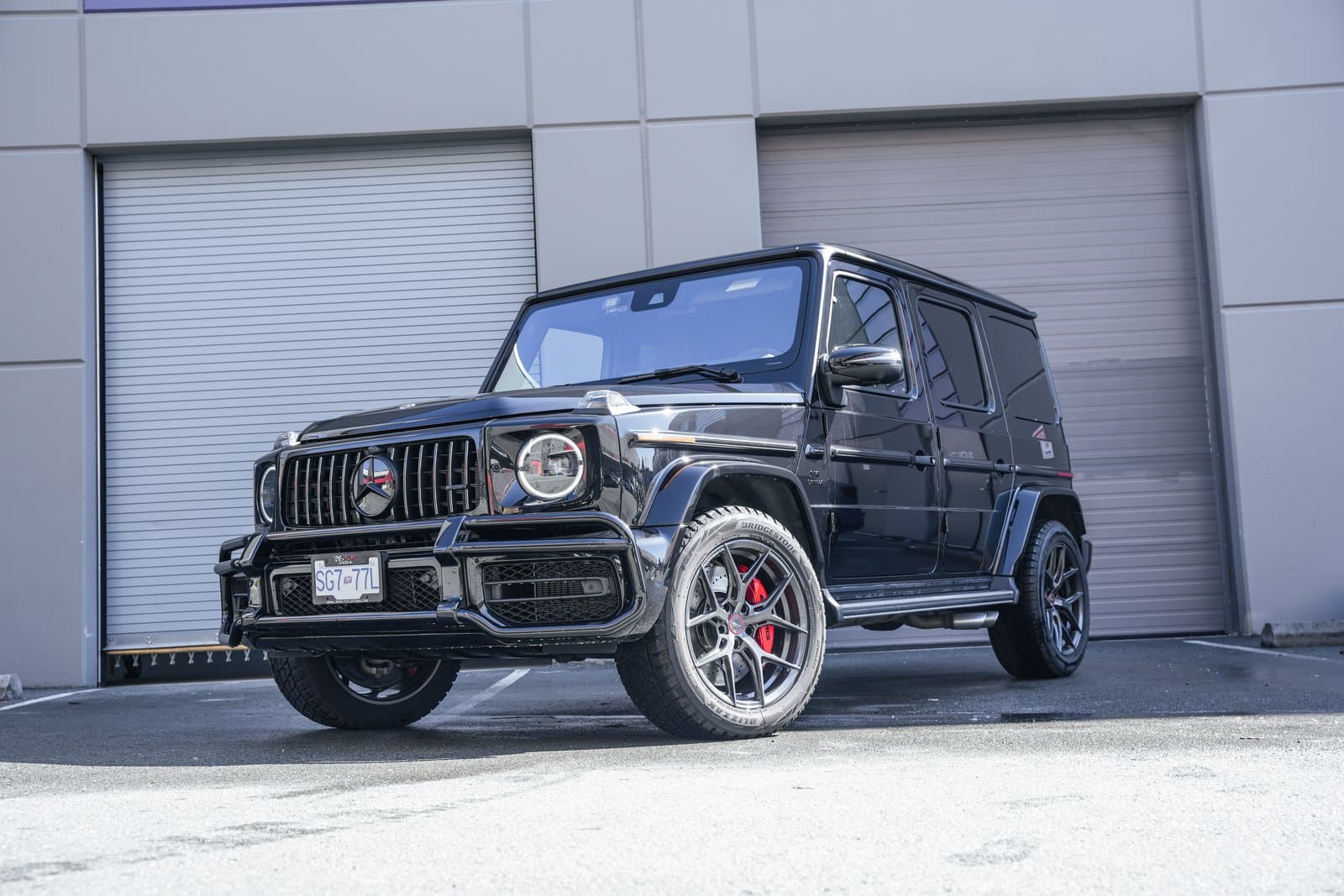
The Mercedes-AMG G63 in our portfolio makes the point neatly. It carries 20-inch Vossen HF5 wheels in gunmetal, and the fitment was chosen specifically because 20 inches works equally well with winter tires, all-season tires, or all-terrain tires. That is a deliberate decision to buy a wheel that does not lock you into one tire category. A truck set up around 20-inch wheels and a low-profile all-season tire has nowhere to go in the snow, and no budget for a second set. See the G63 on Vossen HF5 wheels in our portfolio.
What to ask before you commit
Three questions settle most of this. First, how much of your driving is actually off pavement, and what kind? A gravel logging road is an all-terrain job. Deep mud in a riverbed is a mud-terrain job, and nothing else will do it. Second, how much highway driving is there in the four months when BC requires winter tires? The more there is, the more the highway penalty of an aggressive tread pattern matters.
Third, and most often overlooked, what is the truck actually going to do with these tires while it has them? A truck that carries a contractor's gear, a boat, or a mountain bike through salt-heavy winters is going to have tires replaced more often than one that just drives to work. Budget for a set you will use hard rather than a set you want to look at.
JRS sells and fits every tire category — summer, all-season, winter, off-road, and track — with computer-balanced mounting and puncture repair following industry standard. Our daily-essential service covers the washes and upkeep between tire changes Send your year, make, and model with the inquiry and the fitment can be matched to the vehicle rather than guessed at from a tire size.
Related project: Mercedes-AMG G63 on Vossen HF5 Wheels