Orange Peel on Your Paint: What Causes the Wavy Finish
Published
Some paint problems are obvious the moment you walk up to the car. A scratch, a chip, a dull patch. Orange peel is not like that. It is there, it has probably been there since the car left the factory, and it only becomes visible when the light hits the panel a certain way. A flat panel of paint should reflect like a mirror. If the reflection wobbles, you are looking at orange peel.
It is a frustrating thing to have because there is no single dramatic flaw to point at. The paint is not damaged, it is simply not optically flat. And because it lives in the clear coat rather than the colour underneath, it is a bit more complicated than it sounds.
What orange peel actually is
Modern car paint is a base colour layer with a clear coat on top, and that clear coat is sprayed on and allowed to flow before it hardens. Orange peel happens when that clear coat does not level out completely. The molecules in the coating need a window of time to settle into a completely flat layer, and if that window closes too early, the surface cures with a fine texture, almost like the skin of an orange.
The texture itself is tiny. We are talking about differences measured in thousandths of a millimetre, which is why it does not affect how the car looks in a photograph or from across the street. It becomes visible when the surface is a mirror reflecting something with a hard edge, like a shop ceiling, a building facade or the sky near the horizon.
That is why the first time most people notice orange peel is often somewhere unexpected. They are not looking at the paint deliberately, they are looking at a reflection in the paint and something looks wrong with the reflection.
Why it is more noticeable in some conditions
Vancouver is not the harshest environment for this, but it does add its own factors. Sunlight at a low angle in the morning or late afternoon exaggerates any surface texture because the light arrives at a shallow angle and every tiny undulation casts its own shadow. Overcast light hides it almost completely, which is part of why the same car can look as good as new in the morning and slightly wrong in the late afternoon.
Washing is another factor, but not the one people expect. A dirty or slightly hazy surface scatters light before it reaches the clear coat, which masks the texture. The cleaner the paint, the more it behaves like a mirror, and the more visible the waviness becomes. A car that has just been properly washed can look worse than the same car a week earlier, which is genuinely counterintuitive and worth knowing so you do not assume something was damaged.
Parked outside, it also becomes part of the overall dulling story, because a hazy surface and a wavy surface both scatter light and both make the car look tired. Ourceramic coating servicecovers how coating interacts with the paint underneath it, which matters here.
What can actually be improved
Here is the honest part. Orange peel is a property of the clear coat, so anything that removes clear coat will reduce it. That is the whole mechanism, and it is also why this is not a decision to make lightly.
A light machine polish will often reduce the texture enough that it stops catching low light, which is usually what bothers people. A heavier multi-stage correction will take it further, but each stage removes material, and there is a finite amount of clear coat on the car. On a car that has been corrected many times before, or one that has had panels repainted, the remaining thickness starts to matter.
This is why a proper assessment before the work starts is worth more than a long correction. Some cars have plenty of clear coat and can take a heavier correction without concern. Others have very little left, and the right answer for them is a light touch that improves what is visible without chasing an unattainable result. Ourmaintenance and detailing serviceis where that assessment happens before anything is removed.
It is worth knowing that this is a permanent finish characteristic. Coatings and waxes will not fill it, because they sit on top of a surface that is still wavy. A ceramic coating will improve how the light is handled across the panel and make the overall finish look more even, but it will not make a wavy surface flat.
Deciding whether it is worth doing
If the car is a daily driver that is seen in daylight, parked outdoors, and the paint is otherwise in good shape, a light polish that removes the texture is often a satisfying and relatively affordable improvement. If the car is garage-kept, or the panels in question are secondary, it may not be worth opening up the correction process at all.
The other thing to weigh is what happens afterwards. Corrected paint has a clean, level surface that a coating bonds to better and that holds gloss more evenly, so many owners choose to protect the result rather than leave it exposed to another few winters of salt and grit. Ourpaint protection film serviceis the option where the concern is stone chips and road debris rather than the finish itself.
JRS Auto Customs has been working on cars in Vancouver since 2010. The point of a correction is not to chase a showroom finish, it is to make it look the way you would want it to look. If a light touch gets you there, that is the right answer, and if it does not, we will tell you that too.
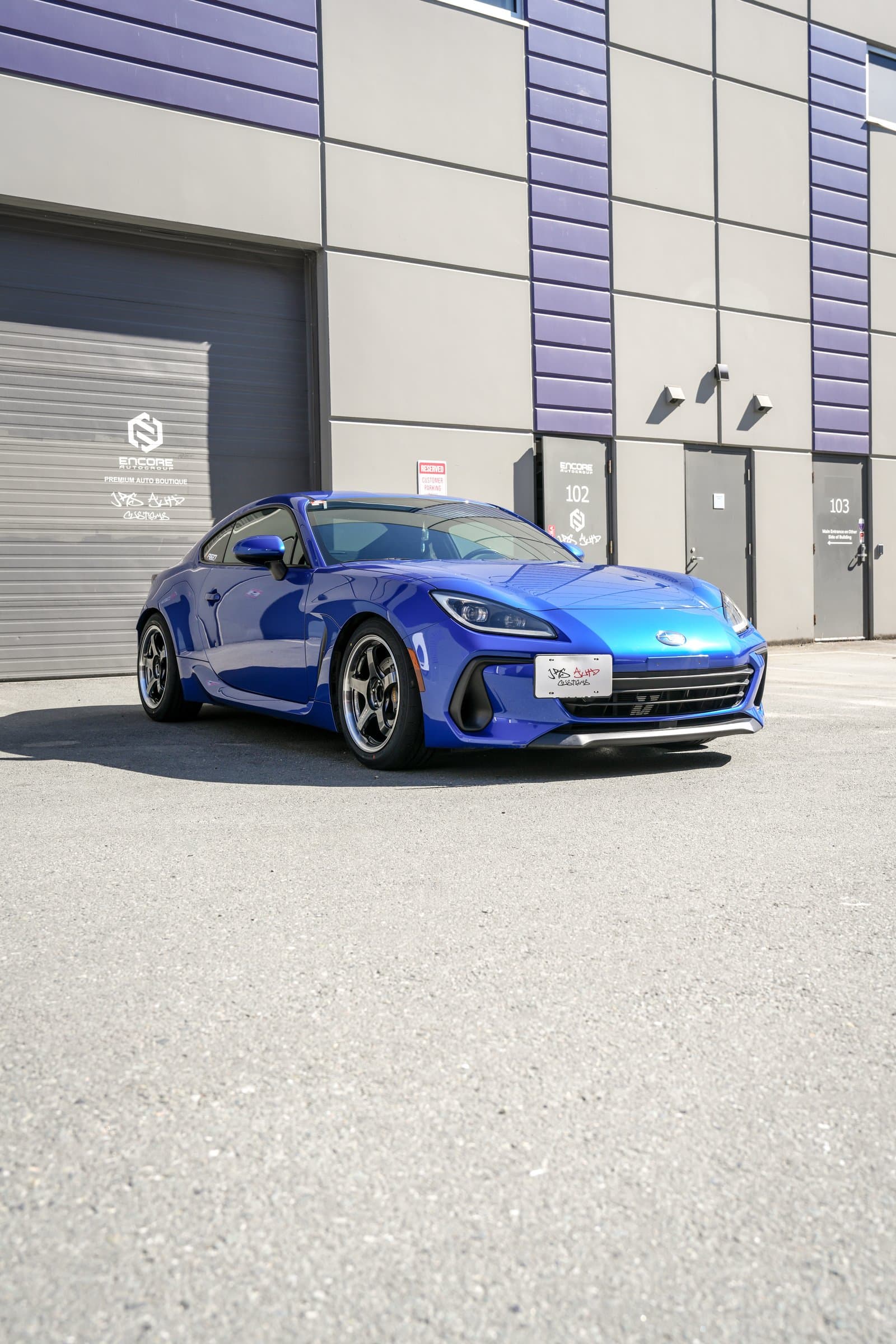
Related project: Subaru BRZ — Full Gloss Clear PPF