Paint Haze After Polishing: What Went Wrong
Published
You bring a car in for a paint correction because the paint has lost its gloss, and it comes back looking worse. The reflections under the parking garage lights are softer than before, the paint reads slightly milky in places, and a colour that looked deep in the shade now looks flat. This is one of the most common outcomes of a correction, and it is also one of the least understood. Paint haze is a temporary optical effect created by the polishing process itself. It is not the same as swirl marks, and it does not mean the paint was damaged. It means the surface needs a different final step than the one it received.
What Paint Haze Actually Is
Modern correction work happens in stages. A heavier stage uses a coarser compound to remove deeper defects, and it leaves behind fine residue and a slightly abraded surface. A finer stage follows to refine that. What can remain at the end is a uniform microscopic pattern of fine scratches across the clear coat, and light scatters off those scratches in every direction instead of reflecting cleanly.
That scattering is what haze is. Where a sound gloss finish reflects a sharp image of what is in front of it, a hazed surface reflects a soft, slightly milky version. The colour is still there. The depth is not. It reads as dullness, and it is most obvious under the kind of lighting that shows off reflections: a garage with strip lights, an underground parkade, an overcast afternoon, or the headlights of the car in front of you.
The important part is that all of this is in the clear coat, and it can be removed.
Haze Is Not Swirl Marks
These two get confused constantly, because from the driver's seat they can look similar and because both are described as fine scratching. They are different problems with different answers.
Swirl marks are individual scratches of varying depth, most often the kind left by a washing mitt that has trapped grit, or by a brush in a car wash. They are unevenly distributed, and they catch light in a way that looks random. You see them most in direct sunlight and most along the horizontal panels that get washed most often.
Haze is even. It covers whole panels more or less uniformly, because it was created by a machine working over the entire surface in a consistent way. It does not pick out individual lines for you to count. It is a finish quality issue rather than a damage pattern, and it usually appears immediately after the work is done rather than developing over weeks.
So if your car came back from a correction looking dull and you are trying to work out what went wrong, ask whether it looked dull before the work or after it. That distinction points at the answer.
Why It Happens
A few things commonly contribute.
The most common is that the correction was stopped at a stage that cut defects but never got refined back to a glossy finish. A single-stage correction is a reasonable choice for many cars, and it does a genuinely useful job on swirls and light oxidation. But if the goal was to bring the paint back to a deep gloss, a single stage on its own often leaves the surface hazed, because the compound that removed the defects also did the fine cutting.
Second, residue left in the paint from the polishing stage can contribute, and this one is fixable at home. A residue that sits on the surface scatters light in much the same way fine scratching does, and it can make a corrected panel look hazy even though the underlying finish is fine.
Third, the lighting. A correction done outdoors in daylight, judged in daylight, can look good and still show haze under a strip-lit garage afterwards. Changes in colour temperature and in how the light source sits relative to the panel reveal things that diffuse daylight hides.
What to Do About It
Start with the least invasive step, because it is often enough.
If the haze appeared straight after a correction, the first thing worth trying is a proper decontamination and a hand wash with a clean, soft mitt, followed by drying with a clean microfibre towel or blower. This clears residue without touching the clear coat at all. If the haze lifts, you were looking at a residue problem rather than a finish problem.
If the haze is still there after a clean, the finish itself is hazed, and it needs another machine step. A finer polish or a finishing stage, followed by a sealant or coating, removes the fine pattern and leaves a surface that reflects properly again. This is normal practice and it is why the correction stage and the gloss stage are treated as separate things.
If a coating is going on afterwards anyway, the coating will largely take care of the appearance, but the underlying finish still matters. Coating a hazed surface seals the haze in rather than correcting it.
If You Are Planning a Correction
A few questions worth asking before the work starts.
Ask what the intended end point is. If you want a deep, uniform gloss, that is a different job from removing light swirls, and it should be described that way.
Ask whether the plan includes a refining stage and how the finish will be judged, because a car can be corrected to a certain level and then locked in with a sealant or coating.
Ask how it will be inspected. Under a bright, even light source, most haze is obvious, and a car that is going home without that check is a car that might come back hazy.
And ask what happens in the weeks after. Freshly corrected paint has a different feel and appearance for a short while, and knowing that in advance makes it easier to judge the result rather than assuming something went wrong.
Our maintenance detailing page covers the correction and protection packages available, our ceramic coating page explains how a coating seals a corrected surface, and if you would rather protect the paint without changing its appearance, the PPF page explains how film sits on top of corrected paint.
Since 2010 we have been correcting and protecting cars in Vancouver, and paint haze is one of those things that looks alarming and resolves cleanly once it is understood.
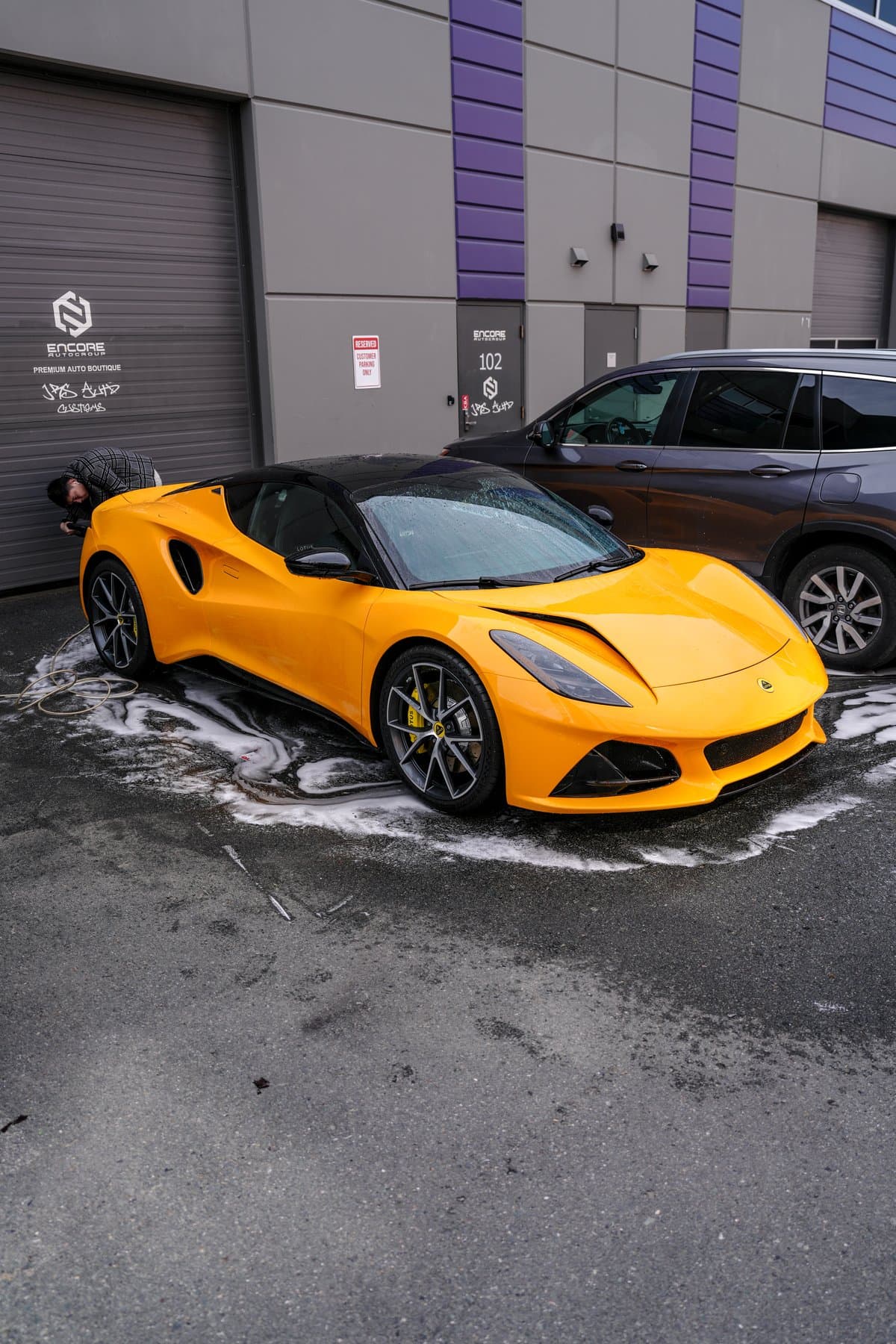
Related project: Lotus Emira — Ceramic Coating