What a Paint Thickness Gauge Tells You About Your Car
Published
Most people meet a paint thickness gauge for the first time in a shop, not in a manual. The technician presses a small probe against a door, watches a number appear, moves to the next panel, and says something reassuring or cautionary. If you have no idea what that number means, the whole exchange is just theatre — and it is theatre that decides how much work your car can take.
The gauge is a small, unglamorous instrument, but it is the most objective thing in the room. It measures how much material is between the outside of the paint and bare metal, and it does not care about what your car is worth, what it looks like in the parking lot, or how much you would like the answer to be good news. Every shop that installs protection — whether a coating, a film, or a wrap — needs this number before the work starts, because it determines what is safe to do next.
What the gauge is actually measuring
Automotive paint is a layered structure, and the gauge reads the total depth of the layers it can sense. At the top sits the clear coat: a transparent layer that takes the sun's ultraviolet light and the abrasive work of washing, and that holds the gloss you see. Underneath that sits the colour coat, which carries the pigment. Underneath that is primer, and finally metal.
Most of the reasoning that happens in a shop is about the clear coat, because that is the layer that can be worked. Colour and primer cannot be polished. If you cut through the clear coat into colour, you have a repair, not a correction. So the number the technician reads is really a measure of how much clear coat you have left to work with — and how much of it you are willing to give up to make the paint look better.
The reading also tells a story about the car's history. Factory paint is applied in an even layer, so panels that have never been repainted tend to read consistently. A panel that was repainted after a repair reads measurably thicker, because repair work adds layers rather than replacing them cleanly.
This is why we assess your paint's condition, note existing defects, and recommend the right prep and coating package before quoting anything. The assessment is not a formality. It sets the limit on what the work can safely include.
What a good reading looks like
There is no single number that means good, because every vehicle, every factory and every paint system is different. What a shop is really looking for is consistency across the car and across panels of the same type. If the hood reads one figure and the door reads another that is wildly different, that difference is information, not noise.
A repainted panel reads high. That sounds like good news and it is not. Extra material on a panel usually means filler and extra layers of primer and base coat sitting under the clear, and those layers do not polish the way factory clear does. They can behave differently, they can show a slightly different colour under angled light, and they are the reason a correction that would be straightforward on an original panel is unpredictable on a repaired one.
A panel that reads low is the other half of the picture. Low readings show up on cars that have been corrected repeatedly, and on cars that have spent their lives outside in salt air and coastal moisture. UV exposure and oxidation consume clear coat slowly, and the erosion is invisible until you start measuring. This is a common Vancouver situation, and it is one of the reasons a spring inspection makes sense on a car that has been outside for a few winters.
There is a third case that catches owners out: a car that has been repainted with a thinner, harder clear than the factory used. It reads in the normal range and it is still not the original surface. Numbers rule a lot out, but they are not the whole answer.
Why the reading changes the work you book
The most useful thing a reading does is tell you which correction is safe. A single-stage correction is a light refinement that removes a small fraction of the clear coat. A multi-stage correction is a deeper cut that takes more material off to address heavier defects. If the measurement shows there is very little clear coat left, the honest recommendation is not a deeper polish. It is a gentler refinement that improves what is there without risking the panel.
This matters more in Vancouver than it does in a dry climate, and for a specific reason. Salt and moisture accelerate the dulling and oxidation that the clear coat is protecting you from, which means more cars here arrive at the point where correction is genuinely limited by remaining thickness rather than by owner preference. It is also why a car that has had good protection from the start often has more to give when it eventually needs work.
For coating and film work, the reading matters for a different reason: adhesion and appearance. Film follows the surface underneath it exactly, and a coating bonds to a clean, sound surface. If the paint is thin or the surface is compromised, the protection is being applied to something that cannot hold it well. Getting the assessment right before the work starts is what separates protection that lasts from protection that disappoints.
If a car has had paint correction, the reading is how we know how much more correction it can take later. That is the honest reason a shop should measure rather than estimate — the estimate is always optimistic, and the gauge is not.
Reading the result properly
There are two details worth knowing when you see a reading taken. First, the probe is placed on a flat, painted area away from trim edges and body lines, because a reading taken on a curve or a crease is not a reading of the panel's thickness — it is a reading of the angle. Second, readings are taken in more than one place, on more than one panel, because a single number cannot describe a car.
If you are buying a used car, a proper paint assessment is worth having before you commit. The visual checks people do in a parking lot — panel gaps, a change in colour under angled light, chips on the leading edge — are genuinely useful and cost nothing. But they cannot tell you what is under the paint, and they cannot distinguish an original panel from one that has been refinished and finished well. A measured reading can.
If you already own the car and are considering protection, the same logic applies for a narrower reason. You want to know what the protection is being bonded to and what condition the surface is in before it is covered, because once it is under film or coating, the question becomes harder to answer. If your paint needs correction, that is a better thing to discover beforehand.
What to ask when you book
Two questions are worth asking any shop, and they cost nothing. Ask where the reading was taken and on which panels, because a reading from the hood alone is a partial assessment. And ask what the reading changed about the recommendation. If the number was taken and made no difference to anything, it was not really being used.
The honest answers are simple. A shop that measures paint will tell you which panels read differently from the rest, what that implies for the work, and where a correction is limited by remaining clear rather than by the defect. That conversation is the useful part of the appointment.
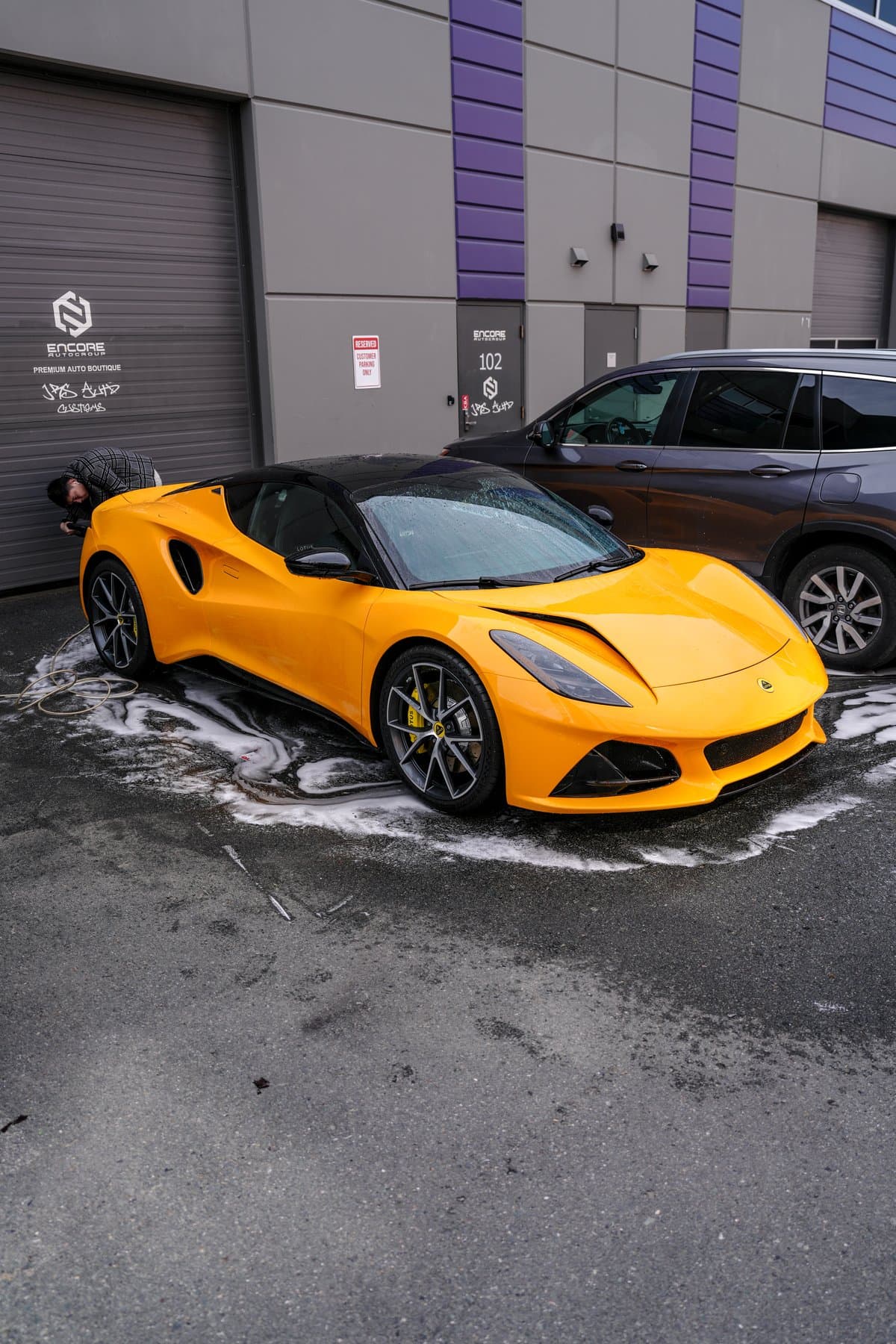
If you want to see what this looks like on a car that has had real work done, the Lotus Emira in our portfolio went through multi-stage paint correction before its ceramic coating, and that correction step is exactly what the reading governs. Our ceramic coating service describes the same sequence from the start — inspection, then prep, then the coating itself.
And if you want the surface assessed before you commit to anything, the daily essential service is where that conversation belongs. It is a much better place to find out what your paint can take than to find out afterwards.
Related project: Lotus Emira — Ceramic Coating