
How Performance Mods Affect Daily Driveability in Vancouver
Published
There is a tension at the heart of modifying a car that gets used every day. The changes that make a car feel faster and more responsive can also make it harsher, noisier, and more tiring to drive in traffic. That tension is especially real in Vancouver, where the average commute involves stop-and-go traffic, rough road surfaces, and enough rain to make noise a factor. JRS Auto Customs has worked on enough modified daily drivers to know what actually changes on the street — not just what the parts catalogues promise.
Suspension: What Actually Changes on Vancouver Streets
The most significant change most people notice after a suspension modification is ride quality. Coilover kits, lowering springs, and strut tower braces all alter how the chassis responds to road imperfections. A set of lowering springs on a stock strut mount will generally make the car more reactive — smaller bumps are felt more directly, and the car pitches and dives more under braking and acceleration.
A properly tuned coilover system — with adjustable damping — gives you the ability to tune that trade-off. Most systems sold through reputable distributors allow you to set the rebound and compression separately, which means you can run a softer spring rate with firm damping and retain more daily comfort than a static lowering spring setup would allow. The key word is properly tuned: a coilover set to maximum stiffness all around is faster at the track than a stock setup, but it is also genuinely unpleasant on Marine Drive in November.
For Vancouver drivers who want improved handling without sacrificing the ability to drive to Whistler and back without a sore back, a conservative lowering spring paired with upgraded dampers often makes more sense than a full coilover kit. The JRS team can assess your driving style and the roads you actually use and give you a realistic picture of what each option does to the way the car feels.
Wheels and Tyres: The Most Direct Effect on Daily Feel
Wheel and tyre changes affect daily driveability more directly than almost any other modification. Larger diameter wheels with lower profile tyres transmit more road texture into the cabin — every expansion joint on the Second Narrows Bridge, every patched section on Main Street, becomes more noticeable. The trade-off is usually improved grip and sharper turn-in response, which matters more on a mountain road than a commute.
Unsprung weight — the weight of the wheels, tyres, and brake rotors — also changes how the car handles bumps. A heavier wheel takes longer to change direction when the road surface moves, which can make the car feel less composed over rough surfaces. Forged wheels are lighter than cast wheels of the same size, which reduces unsprung mass and improves the car's ability to follow road contours. On a daily driver in Vancouver, that difference is noticeable.
Tyre choice has a larger effect on daily driveability than most people expect. A performance summer tyre in near-zero temperatures is not just less grippy — it is also noisier and harder riding than a touring or all-season tyre because the rubber compound is simply stiffer. If the car is driven year-round in Vancouver, the tyre choice matters as much as the wheel choice.
Exhaust and the Daily Drive in a Wet City
An exhaust modification changes the car in ways that go beyond sound. On naturally aspirated engines, a less restrictive exhaust can improve throttle response and make the engine feel more eager to rev — that is the real benefit, more than peak horsepower numbers. On turbocharged engines, the effect is usually smaller because the turbo masks much of the exhaust restriction.
In Vancouver's climate, exhaust considerations include condensation and corrosion. A cat-back or axle-back system that replaces the rear muffler with something lighter may be more susceptible to rust if the car is driven mostly on short trips — the exhaust never fully heats up and dries out, which accelerates internal corrosion. For a daily driver in the Lower Mainland, a quality stainless steel system with a reasonably conservative rear muffler choice is usually a better long-term decision than a titanium or carbon fibre option that looks spectacular for a season and then starts degrading.
Talk to the JRS team before committing to an exhaust if the car is primarily a weekday commuter. The difference between a cat-back and a full headers-back system is not just cost — it is daily driveability, cold-start volume, and long-term durability. You can see examples of what JRS has installed on daily-driven vehicles in the Lower Mainland on the performance upgrades portfolio.
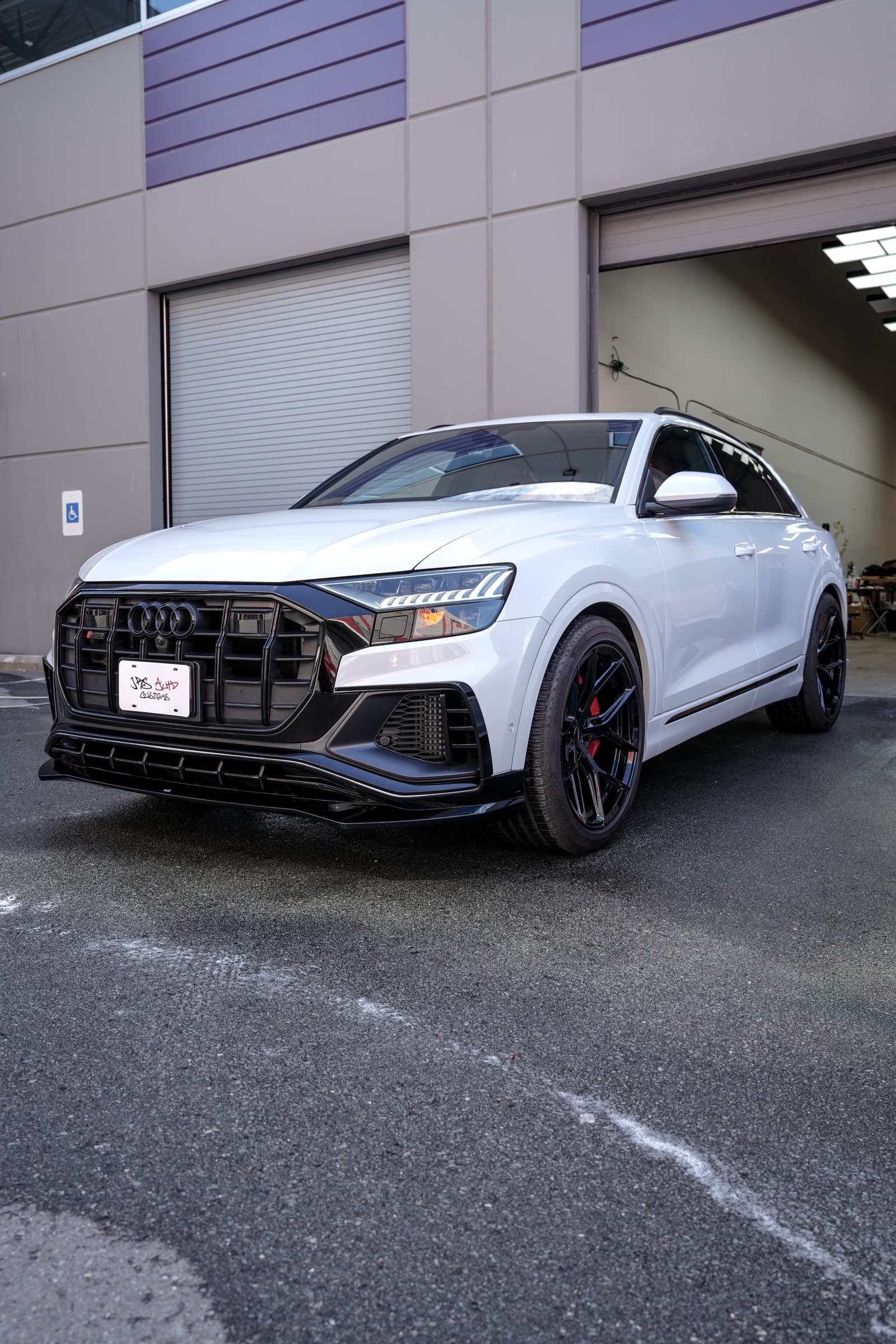
Related project: Audi SQ8 ABT Body Kit & Vossen HF5 Wheels