
How PPF Changes Your Detailing Routine in Vancouver
Published
When people decide to get paint protection film, the motivation is usually stone chips, road debris, or the particular anxiety of watching a new car accumulate damage. Those are valid reasons. But PPF has a secondary effect that becomes more apparent over time: it changes the nature of car care between professional details. For Vancouver drivers, that effect is more significant than in drier climates.
What PPF Actually Protects Against Between Details
A professional detail removes accumulated contamination from the paint surface — bonded iron particles, traffic film, road grime, and the light oxidation that builds up between washes. On uncoated paint, this contamination adheres directly to the clear coat and requires a full decontamination wash to remove. On a PPF-covered surface, the contamination builds up on the film instead, and the film surface is smoother and less porous than clear coat, which means bonded contamination has less to grip onto.
In practice, this means that between professional details, washing a PPF-covered car is more straightforward. Road grime releases more easily from the film surface. The hydrophobic properties of modern PPF mean water sheets off rather than drying into water spots. The surface stays cleaner between washes, and when you do wash it, the rinse is more effective.
The Vancouver Climate Effect on Uncoated Paint
Vancouver's combination of wet weather and coastal salt creates a specific maintenance challenge for uncoated paint. Road film — the mixture of fine particulate, brake dust, and atmospheric residue that coats every vehicle — bonds to paint more aggressively in the presence of moisture and salt. A car that sits outside through a Vancouver winter accumulates this contamination continuously, and it is not removed by a standard touchless car wash.
Professional paint correction requires the surface to be decontaminated first. On uncoated paint that has accumulated a season of Vancouver road film, this step takes longer and the compound work needed to remove the contamination is more aggressive. Over multiple correction cycles, this costs both time and clear coat thickness. On PPF-covered surfaces, the contamination that would otherwise bond to the clear coat is on the film instead, and the film is replaced during PPF maintenance — not the paint.
What Maintenance Looks Like on PPF
PPF maintenance is different from paint maintenance in one important way: the surface can be replaced without affecting the underlying paint. When the film accumulates deep scratches, staining, or edge contamination that cannot be cleaned off, the film itself is replaced rather than the paint being corrected. This means that the surface preparation work at each replacement is primarily cleaning and surface prep rather than abrasion — which is faster, less expensive, and does not remove any clear coat.
The film also changes the nature of the wash between professional details. A two-bucket wash with a pH-neutral shampoo is still the right approach, but the hydrophobic surface means that a rinse-free wash is more effective than it would be on uncoated paint — contamination does not bond as aggressively, and the final rinse carries more of the grime away. For drivers who wash their own car at home, this is a practical benefit.
Combining PPF With Ceramic Coating
The two most common protection strategies — PPF and ceramic coating — are not mutually exclusive. Ceramic coating applied to the PPF surface adds an additional hydrophobic and chemical resistance layer on top of the film's physical protection. This is a common approach on full-coverage PPF installs: the film provides the stone chip and impact protection, and the ceramic coating on top of the film makes the surface easier to clean and more resistant to the chemical contaminants that Vancouver road conditions throw at the vehicle.
For vehicles where the paint surface is already in good condition, applying ceramic coating over the existing clear coat and PPF together means the surfaces are protected from both physical and chemical attack, and the maintenance routine between professional details is simplified across the board.
JRS Auto Customs can advise on whether PPF, ceramic coating, or a combination is the right choice for your vehicle and usage pattern. Ask the team when you book your next appointment. See our PPF services and ceramic coating options for full protection and maintenance guidance.
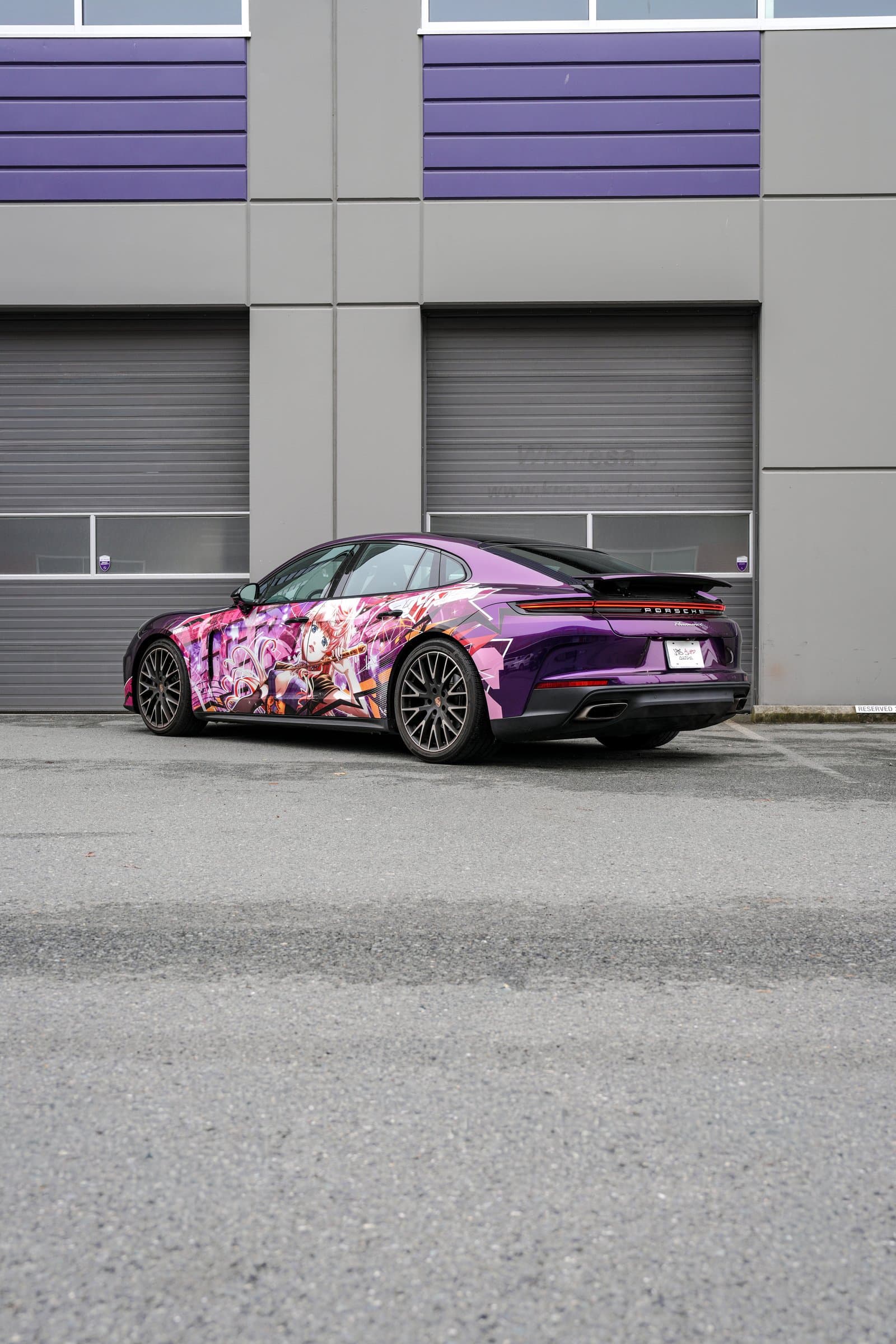
Related project: Porsche Panamera Purple Itasha Anime Wrap