
Rear Diffusers: What a Venturi Diffuser Actually Does
Published
The Part Most People Only Notice Once It Is Missing
Walk around the back of a car with a performance aero kit and you will usually find a set of vertical fins or channels moulded into the lower edge of the rear bumper. Some are deep, some are shallow, and on a lot of cars they are painted body colour so they blend into the valance. Owners point at front splitters and rear wings because those change the shape of a car in a photograph. The diffuser is the part that usually goes unmentioned, and it is the one doing some of the more interesting work underneath. If you are shopping for aero parts at all, it is worth understanding what this piece is for before you decide whether it belongs on your car. JRS installs full performance and aero packages, including rear diffusers, and we get the same question every time: is a diffuser just a styling piece, or does it actually do something?
What a Diffuser Is Actually Doing
A rear diffuser is a shaped panel that sits under the rear bumper. Its job is to manage the air that has already travelled under the car while it was moving. When a car is at speed, the air moving beneath it has to go somewhere, and it leaves the back of the car in a disturbed, turbulent state. Turbulence is drag — the car is working against air that is not flowing cleanly away. A diffuser is designed to let that air slow down and straighten out before it re-enters the wake behind the car. Channels and fins guide the flow, gradually expanding the space the air is moving through so that it decelerates and loses its swirl. Cleaner air leaving the back means less pressure the car has to push against, which means less drag and more of the engine output and power left for acceleration.
Where the Word Venturi Comes From
A Venturi diffuser is a specific version of that idea, named after the Venturi effect: as a fluid moves through a constriction, it speeds up, and as it leaves that constriction into a wider space, it slows down again. In a diffuser the geometry is set so that the underbody airflow is squeezed at one point and then expanded into the channels, which is what converts a fast, turbulent flow into a slower, more organised one. JRS lists Venturi diffusers specifically as one of the rear diffuser options we fit, which is worth knowing when you are comparing quotes. Not every rear bumper treatment is a diffuser at all, and the difference matters for both how the part works and how much clearance it leaves you at the back of the car.
The Part That Actually Costs You: Clearance
Here is the honest catch, and it is the reason more Vancouver owners decide against a diffuser than for one. A diffuser sits lower than the bumper it replaces, and it extends rearward. That puts it in the path of driveways, parking ramps, and the concrete wheel stops that Vancouver parkades are full of. The risk is concrete. If the car bottoms out over a ramp, the diffuser takes the hit, and a carbon or composite part does not bend back into shape the way a factory bumper cover does. Our own guide to what a front splitter and rear wing actually do makes the same point about the front of the car: on a street-driven car, clearance usually matters more to you day to day than the aerodynamic benefit does. Before ordering, measure the real height of your car under load with the suspension compressed, and look at the ramps you actually use. If you drive a car that stays in a parkade, a shallow diffuser is a more sensible choice than a deep one.
How It Fits With the Rest of the Kit
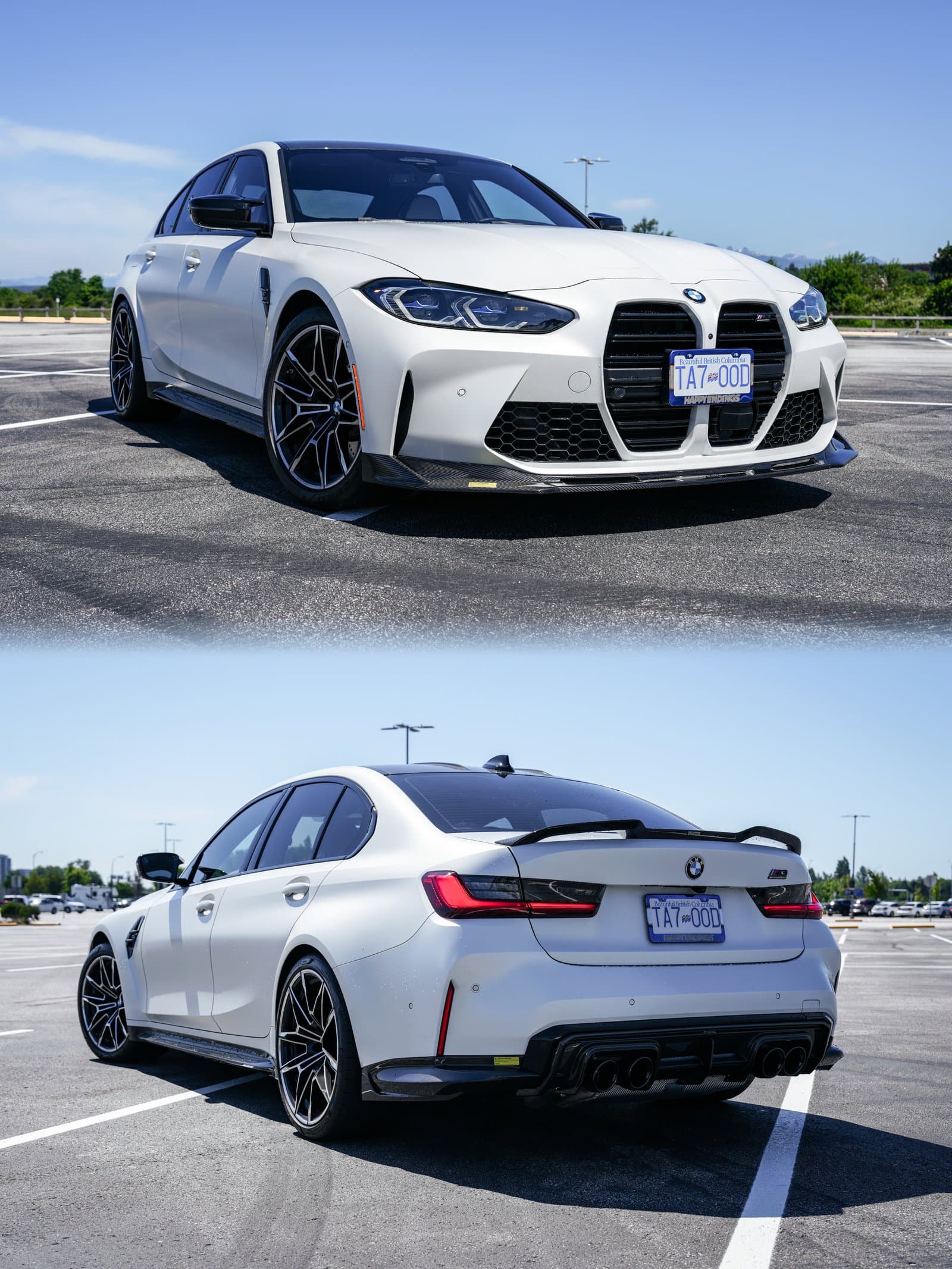
A diffuser only makes sense as part of a set. The airflow it manages is the air that came under the car past the front splitter and along the flat floor, and that path is shaped by the splitter at the front and the side skirts along the sides. Our Vorsteiner M3 build is a good illustration of the complete package. The verified project description names the aggressive front splitter, side skirts, and rear diffuser as one kit, not three separate bolt-ons, and it is that combination that reads as a single designed shape rather than a collection of parts. If you take a look at the BMW M3 Vorsteiner Aero Kit project on our portfolio, you can see how the pieces finish against each other. Finish matters as much as geometry here. A carbon splitter, painted skirts, and a black diffuser make one visual decision; the same diffuser in a different finish makes two. That is why it is worth discussing the whole set with your shop at once rather than ordering parts one at a time — our guide to what an aero kit actually does for your Vancouver car covers how the pieces work together.
What It Is Worth on a Street Car
Being straight about the numbers: the effect of a diffuser is proportional to speed, and it is small at city speeds. The forces it manages become meaningful on the highway and on the sustained mountain routes around Vancouver, and largely irrelevant in stop-and-go traffic. So the honest case for a diffuser on a road car is not a straight-line number. It is that the part is doing the job it was designed for, that the car looks and sounds deliberate, and that underbody aero components are exposed to road salt and moisture more than any factory panel — so fitting one means protecting and maintaining it properly, and thinking about ceramic coating or PPF for the panels around it.
How to Think About It Before You Order
A few things worth settling before you commit. First, what the diffuser is attached to — a factory valance, a replacement bumper, or a bolt-on piece — and who is responsible for the gaps between them. Second, whether the car is lowered, because lowered geometry changes the clearance under the diffuser and the angle the air arrives at. Third, what happens when it is damaged, and whether that is a replacement you would rather avoid. None of this requires a track. It requires a shop that will look at your car, measure it, and talk you through the clearance trade honestly instead of selling you the deepest part available. If you want to see what a finished set looks like on a car in this climate, our BMW M3 Vorsteiner Aero Kit portfolio entry shows the front splitter, side skirts, and rear diffuser fitted together as one package. If you are also protecting the car around the new parts, our performance and aero service page covers what we fit, and our paint protection film service page covers the panels most worth keeping clean afterwards.
Related project: BMW M3 — Vorsteiner Aero Kit