
Salt Stains on Car Seats and Carpet: A Vancouver Guide
Published
The stain that comes in through your shoes
There is a specific kind of damage that Vancouver drivers meet every winter, and it is worth separating out from the rest of the winter cleanup because it is not really an exterior problem. Road salt tracked in on wet boots and soaked into the carpet does not sit on the surface. It wets into the fibre, and when it dries there it leaves a pale crust that no amount of ordinary vacuuming will lift. The same salt that gets sprayed across the lower panels of the car outside is carried into the cabin on the underside of every mat. The reason it matters is what salt does to fibres and to leather. Salt is hygroscopic, which means it pulls moisture out of whatever it is sitting in and holds it there. On fabric that means the pile is being dried out and stiffened from underneath, and on leather it means the surface is being pulled drier than it would otherwise be. Left through a whole season, a salt-stained area can end up looking and feeling permanently different from the rest of the interior, and at that point it is no longer a cleaning problem. This is also why salt staining is one of the things our maintenance service team looks for specifically when a car comes in. The Showroom Detail package at JRS includes a full interior deep clean, and the trigger for booking one is usually exactly this: removing the mats reveals carpet that is damp, discoloured, or salt-stained underneath. At that point a standard clean is no longer sufficient.
Where the salt actually ends up
Three places, in order of how much damage they do.
First, the carpet under the driver and passenger mats. This is where most of the salt collects, because that is where the tracked-in moisture concentrates, and it is also the least visible while the mats are in place. The damage happens quietly and the first sign is usually the mat edges no longer sitting flat because the carpet underneath has gone stiff and lifted.
Second, the seat seams and the crease where the seat back meets the bolster. Salt solution runs down the seat face and pools in those channels. Fabric seats are the most affected, because the weave traps particles. Leather seats are less affected by staining but more affected by drying out, since salt pulls moisture out of the hide as well as sitting on it.
Third, the carpeted footwells on the passenger side, and the side of the centre console, where passengers put their feet on the way in and on the way out. These areas are often skipped, because nobody is looking at the passenger footwell and the mats cover most of it anyway.
What to do before the salt sets
The single most useful thing is to get the salt out of the cabin before it dries in place, and that means doing something quite unglamorous on a regular basis through the winter: take the mats out and rinse them separately, and wipe the carpet underneath rather than only vacuuming it.
A vacuum lifts dry debris well but does essentially nothing to salt that has already crystallised in the fibre. Salt needs to be dissolved first, and then extracted, not lifted. Wiping the area with a damp cloth while the salt is still slightly damp gets it moving, and a stiff brush on dried salt breaks the crust loose so it can be lifted out.
The other half of the job is drying. Salt that is damp but not removed will re-crystallise as it dries, in the same place, more concentrated. Interior that is not drying properly after a wet week is the environment where salt damage becomes permanent. Our guide to leather seat care in this climate goes into the specific conditions that make leather vulnerable, and the same drying logic applies to fabric.
Prevention is the cheap answer
All-weather floor mats are the single highest-impact intervention here, because they are the barrier between the salt on your boots and the carpet underneath. We have written about the trade-offs separately in our guide to all-weather floor mats, and the short version is that a mat which covers the carpet properly and gets rinsed rather than shaken is worth the money. The failure mode is a mat that is too small for the footwell, which protects the centre of the carpet and leaves the edges exposed, which is where the tracked salt runs.
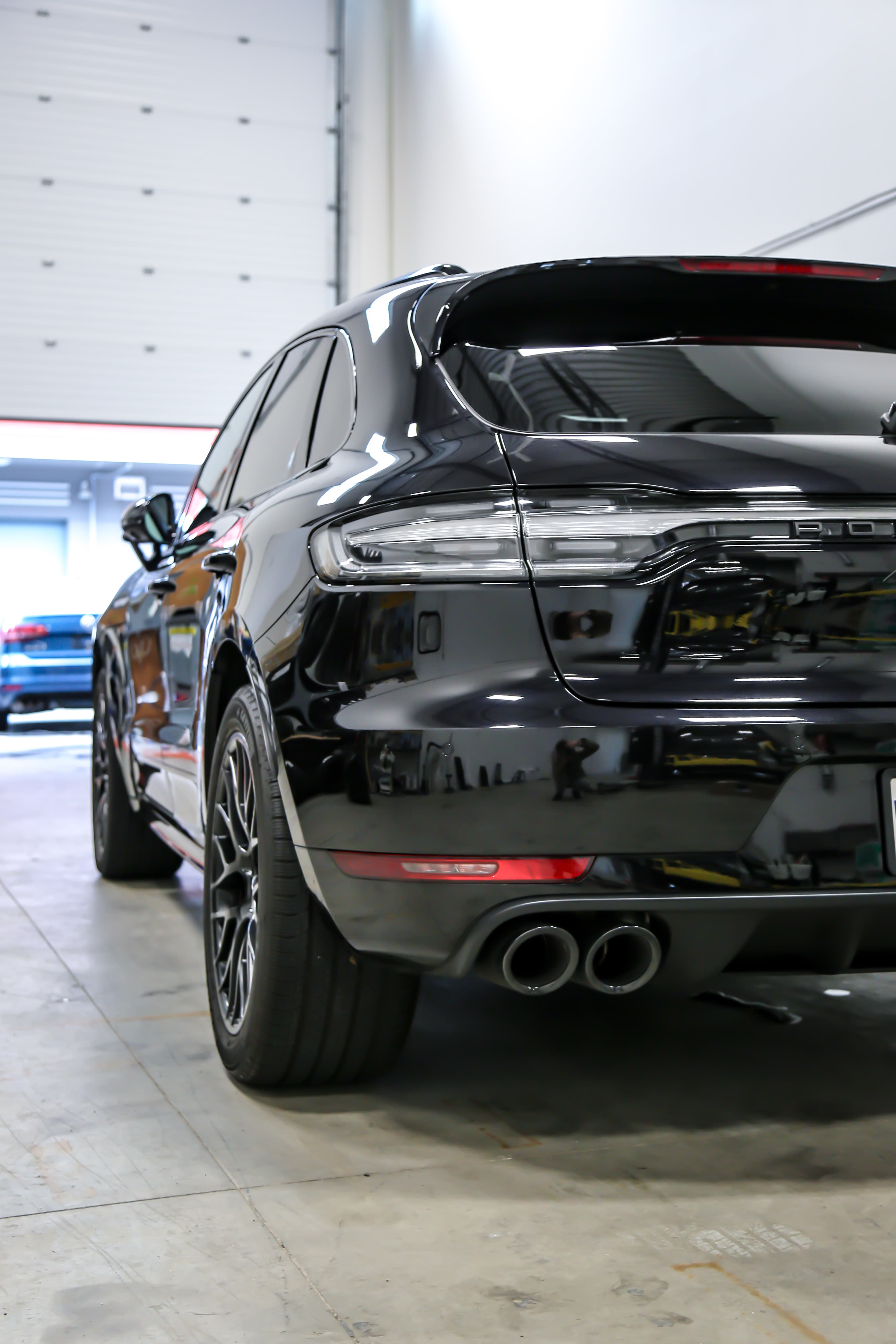
Beyond the mats, there is a case for a fabric or leather protectant applied to clean upholstery before the season starts. Applied to clean carpet it bonds to the fibre and stops the salt moisture from bonding to it instead, which means the stain has a surface it can be lifted from. The same principle applies outside the car, and it is the reasoning behind the decontamination and paint preparation that goes into a coating job, as we did on a Porsche Macan GTS before its ceramic coating.
And there is the timing question. Salt damage accumulates across a season rather than arriving all at once, so a car that gets a proper interior reset in spring is starting the next winter from a clean base. Our spring detailing checklist covers what a post-winter reset should include, and the interior is the part most often deferred until it is too late to be a clean rather than a repair.
When it has already gone too far
There is a point where a salt stain stops being a cleaning job, and it is worth being honest about where that line sits. If the carpet is stiff, discoloured, or has a persistent damp smell, a professional extraction is the right answer rather than more attempts at it yourself. And if the leather on a seat has gone pale and stiff, or the dye has begun to crack, that is a different problem entirely.
The same threshold applies to the rest of the car. Salt does not stop at the sill. If the interior has been wet and salty all winter, it is worth having the exterior assessed at the same time, because the same salt that is crystallised into the carpet has been attacking the lower panels and the wheels. That is the argument for booking a full detail rather than an interior-only clean when the whole car has been through a Vancouver winter untreated.
Our guide to booking a full interior detail covers when a deep clean is worth booking and what it actually involves, and it is worth reading before you decide whether a standard clean will do the job or whether the salt has already gone past the point of a surface clean.
Related project: 2020 Porsche Macan GTS | GYEON MOHS EVO Ceramic Coating