
Same Size, Different Brand: Choosing a Tire Brand
Published
Once you have decided on a tire category — winter, all-season, summer performance or off-road — the next question is narrower and harder to answer. Two tires can sit in the same size on the same rim, carry the same speed rating and load index, and still behave quite differently. The difference is not the number on the sidewall. It is what the manufacturer built behind it.
This matters more in Vancouver than in a place with one long summer and one long winter. Lower Mainland roads see cold wet mornings, warm afternoon rain, construction gravel, salt through the winter months and leaf litter in the fall, sometimes within the same week. When your tire choice has to cover that range, the category is only half the decision. The brand and model are the other half, and they are the part most drivers never examine.
When Two Tires Are the Same Size but Not the Same Tire
Size is a specification. It tells you the section width, the aspect ratio, the rim diameter and the overall rolling diameter, and it tells you the same things about every tire that carries those numbers. It does not tell you how the rubber behaves as it heats up on a highway ramp, whether the tread blocks stay put in standing water, or how the sidewall stiffens when you hit a pothole on Marine Drive.
Different manufacturers use different rubber formulations, different tread block shapes and different internal constructions for the same nominal size. That is why the tire brand question deserves an answer of its own, rather than being folded into a general discussion about tire selection. A guide to choosing tires for this city already covers the categories and the season timing; what follows is the narrower question that comes after all of that is settled.
What a Brand Actually Changes Within One Size
Three things, mostly. The compound is the first. Rubber formulations differ in how they behave across a temperature range, and a compound that stays compliant in the cold tends to be a different compound from one that prioritises warm dry grip. The tread design is the second. Block size, number and shape, the placement of the sipes, and the void ratio all influence how quickly a tire clears water and how it feels over a broken road surface. The construction is the third, and it is the one owners rarely think about, because it decides how the tire handles heat and how the sidewall reacts to impact.
None of that makes one brand better than another in the abstract. It makes them different, and the right question for a Vancouver owner is which differences matter on the roads you actually use.
Reading the Sidewall Before You Compare Anything
Before you start comparing brands, read what is already written on the tire you are replacing. The sidewall carries the size, the load index, the speed rating, the construction type, the traction grades for wet, snow and ice, and in most cases the manufacturer name and the model line. There is also usually a wear rating and a date code.
The traction grades are the part that quietly narrows the field. A tire rated for wet grip and one rated for snow are telling you which conditions the design was tuned for, and that rating is assigned at the model level, not the brand level. Two brands may both sell something called an all-season tire, and those two tires can carry different wet and snow grades.
If your tires are going on wheels you already own, the size of the tire has to fit the rim exactly, and the load index and speed rating have to meet or exceed what your vehicle requires. A shop that fits your tires will check this as part of the mount, but it is still worth knowing what the numbers mean before you choose. The tire service at JRS includes computer-balanced mounting, and climate-controlled storage if you want the off-season set looked after between swaps.
Where Vancouver Conditions Overrule the Spec Sheet
The Lower Mainland has a specific climate profile, and it does not flatter a tire chosen purely for how it looks on a spec sheet. From October 1st to April 30th, BC law requires winter or M+S tires on most highways, and the difference in stopping distance below 7 degrees Celsius is significant enough that compound choice stops being a preference and becomes a safety decision. A winter compound stays flexible in cold weather and can stop a car several car-lengths shorter than an all-season on the same road, which is why the category decision comes before the brand decision.
Then there is the wet season. Vancouver gets more rain than most people expect, and water on a road surface is handled by the tread pattern before it reaches the compound. A pattern of large stiff blocks holds water differently than one built to funnel it out of the contact patch.
None of this produces a single answer, because the roads differ from one end of the region to the other. The best tire for a car that lives on the North Shore and climbs a mountain pass in January is not the best tire for a car that commutes down the Port Mann Bridge twice a day. Ask for the recommendation in terms of your routes rather than in terms of a category label.
Matching Tires to a Wheel You Already Own
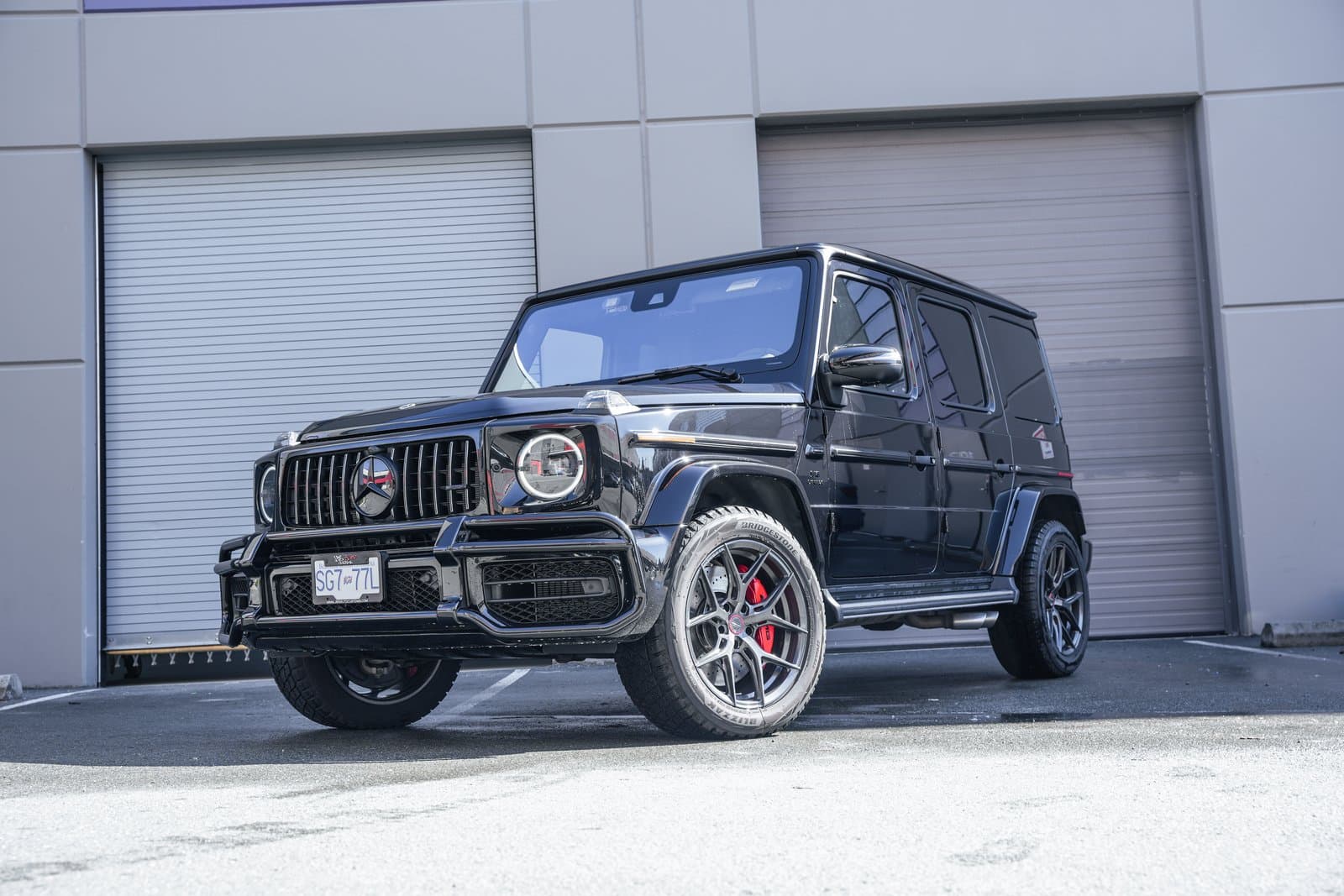
One of our own wheel and tire builds is a good illustration. A 2022 Mercedes-AMG G63 was fitted with 20-inch Vossen HF5 wheels in gunmetal and paired with Bridgestone winter tires. That 20-inch size works across winter, all-season and all-terrain tires, which is exactly why it was chosen for that vehicle: the wheel stayed fixed and the tire changed with the season. You can see that build on our G63 wheel and winter tire portfolio page if you want to know what the finished result looks like.
The same principle applies if you already run staggered sizes across the front and rear axles. In that case the front and rear tires are different by design, and the model of tire you choose for each position needs to be consistent within that position, not across the car.
How to Talk to a Shop About It
Bring a useful question. "What should I run in this size" is reasonable. "Which of these models do you actually fit most often, and in what conditions" gets a better answer, because it lets the shop draw on what they have seen on the road.
At JRS Auto Customs we sell and fit every tire category — summer, all-season, winter, off-road and track — and we carry brands including Nitto, Cooper and Goodyear alongside others. The tire service page covers the rest of that side of the business, including puncture repair following the industry standard, and off-season storage for clients who do not want the second set at home.
When you contact the shop, it helps to say which vehicle you drive, what size you have now, how you drive, and whether you are staying on one set of wheels all year or swapping between two. We respond within one business day with a timeline and any prep notes, and we are currently booking two to four weeks out. You can reach the shop on +1 604-338-6328 or at info@jrsautocustoms.com, at 8889 Laurel St #102 in Vancouver.
If you are still working out whether the size is even right for the car, start with the seasonal selection guide instead — it covers when the switch matters, and it will make the brand question much easier to answer.
Related project: 2022 G63 AMG — 20" Vossen HF5 Gunmetal Wheels with Bridgestone Winter Tires