
Should Your Four Tires Match: The Pairing Question
Published
The most common tire question we hear in Vancouver is not about price or tread depth. It is this: I need one new tire. Do all four have to match? It comes up constantly because the answer is rarely a simple yes or no, and because getting it wrong shows up months later in ways that are hard to trace back to a single decision.
Think about what a tire actually does. It is not a standalone part that grips on its own. It is one quarter of a system that only works as a system: four separate patches of rubber, each one sized, compound and moulded to behave predictably against the road. When those four patches behave differently from each other, the car does not simply have four tires. It has a slightly unpredictable car, and the unpredictability shows up in the places you care about most.
Why Matching Is Not Just About Bookkeeping
The argument for a matched set is usually made in terms of paperwork, which undersells it. The real case is physical. Different tire models use different rubber compounds, different tread designs and different constructions. A tire engineered for wet grip does not accelerate, brake or corner in quite the same way as a tire engineered for the opposite priority. Put two of each on the car and you have four contact patches that do not agree with one another.
On a dry summer afternoon the difference may be something you never consciously notice. In the rain, in slush, or on cold wet pavement, the car can start to feel like it is making small decisions you did not ask it to make. Braking distances that vary slightly depending on which side of the car is loaded up. A pull when the surface is wet and uneven. Uneven wear that shows up in the tread rather than in the paperwork. None of that is dramatic on its own, but it is the difference between a car that feels composed and one that feels like it is negotiating with the road.
Rotation is where mismatching gets practical. Rotating tires front to rear and rear to front is the single most effective thing you can do to even out wear, because it moves each tire through the positions where it does less damage. That only works if the tires are broadly interchangeable in behaviour. Rotate a set of mismatched tires and you are simply redistributing wear among four tires that already behave differently, which helps the tread and does not help the consistency.
Where Mismatched Sets Actually Come From
In practice, mismatched sets almost always arrive through one of four routes, and it is worth working out which one you are in before deciding anything.
The first is a single replacement after a puncture or a sidewall impact. This is the most common case, and it is the one where the decision is genuinely conditional. The second is adding a fifth tire temporarily, usually to avoid driving on a damaged one while you source a replacement. The third is the seasonal set change, where a driver runs winter rubber on one axle for a season or moves to a different wheel and tire package mid-year. The fourth is a performance car built with a staggered fitment, where the front and rear tires are different sizes from the factory by design.
That last one is worth separating out, because it is not a mismatch at all. A staggered setup uses a narrower tire on the front axle and a wider one on the rear, and running that arrangement the way the manufacturer intended is not a compromise. It is the correct configuration. The problem only starts when a staggered car is then given a same-size tire on one side of an axle, because the rolling radius changes and the car behaves differently depending on which way it is facing.
The Vancouver Part: Salt, Slush and the October Changeover
Local conditions make this question less academic than it would be somewhere drier. Between October 1st and April 30th, BC law requires winter or M+S tires on most highways, so in practice the seasonal set change happens in autumn and the second one happens in spring, every single year.
That means the mismatch question gets asked twice annually rather than once every few years, and it means the tires you run in the cold months are the ones that see salt, standing water and slush. A matched winter set behaves consistently across all four corners in exactly the conditions where consistency matters most. A mixed set gives you one tire behaving like a winter tire and three behaving like something else, and slush does not negotiate.
There is a second seasonal factor that gets overlooked. Your off-season set is sitting in storage for months, and rubber does not appreciate being parked. Heat and UV exposure harden a tire that is not being used, and a hardened tire that looks seemingly fine on the shelf can behave differently the first time it goes back on the road. A set that has been stored together, used together and rotated together keeps a consistent history. That is another argument for keeping a matched set together rather than piecing one together from whatever is available.
What to Do When You Are Already Mid-Set
If you are standing in front of this decision right now, the sequence is straightforward. First, work out how much life the other three tires actually have. If the remaining tires are worn close to the limit, replacing all four is the sensible answer, because you will be back here in a year otherwise and you will be paying for the same labour twice.
If the other three have plenty of tread left, a single matched replacement is generally workable on a vehicle that drives all four wheels to the road, and less tidy on one that does not. On a vehicle with a staggered fitment or different front and rear sizes, a single replacement is harder to do cleanly, and replacing a pair on the axle is usually the tidier answer.
Whichever route you take, match on more than the width. Read the full size marking on the sidewall, which gives you the width, the aspect ratio, the rim diameter, the load index and the speed rating. Two tires can look identical on the shelf and differ in load rating or speed rating, and those are not interchangeable with a tire that does not carry the same rating.
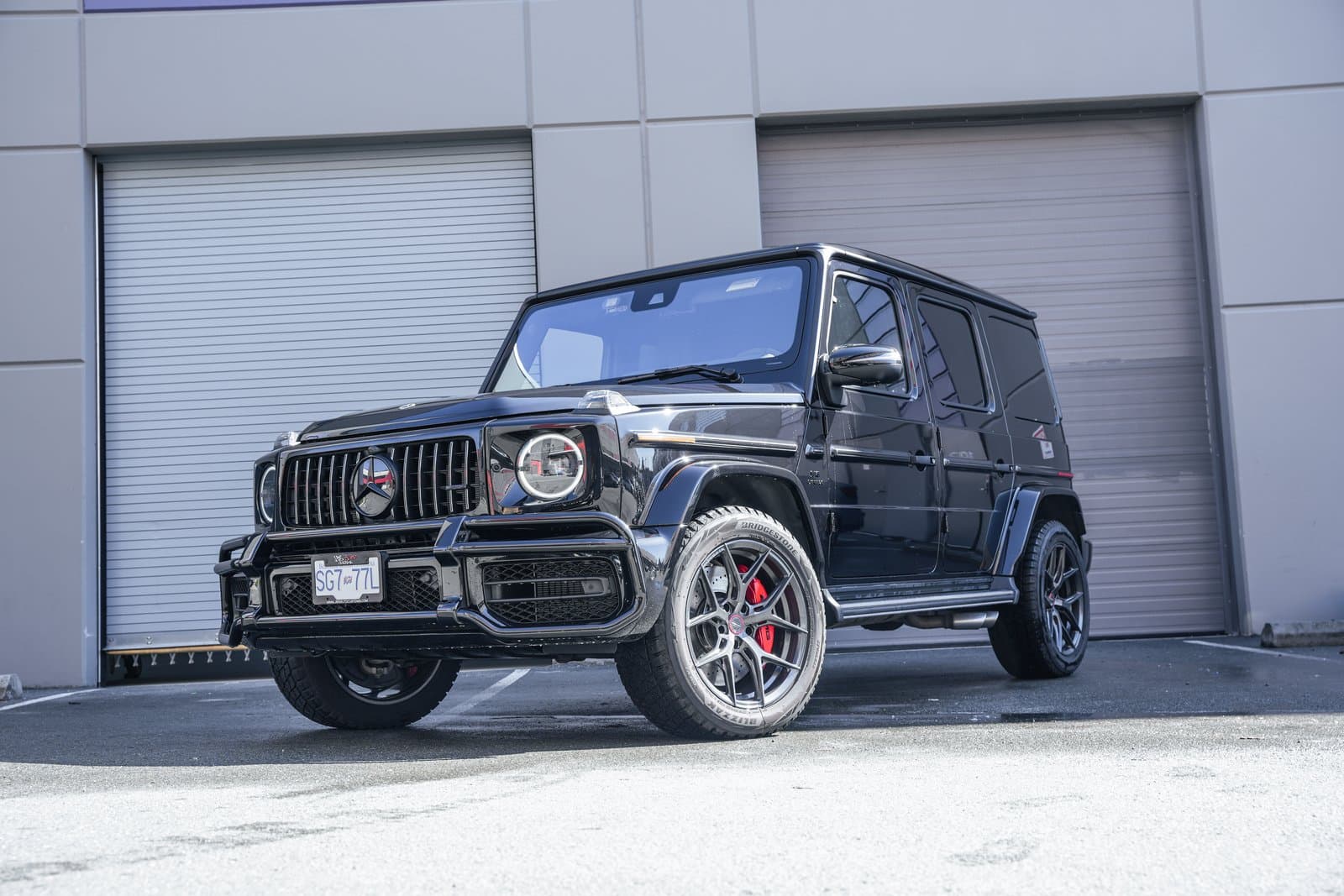
The wider point is that a well-chosen wheel and tire package is designed to serve more than one season. A recent JRS project on a 2022 Mercedes-AMG G63 illustrates the thinking: it was fitted with 20-inch Vossen HF5 wheels in gunmetal, sized specifically because a 20-inch wheel works with winter, all-season and all-terrain rubber alike. One wheel set, three tire choices across the year, and no mixing required. That is what a good fitment buys you.
Questions Worth Asking Before You Book
Whichever way you go, a short conversation before the work starts saves argument afterwards. Ask whether the shop can match your existing tire exactly, and what the full size marking is on the tires you already have. Ask whether the set is being mounted and balanced as a matched group. Ask what the rotation pattern should be on this vehicle and at what interval. Ask how the off-season set gets stored between swaps, and whether they will check and rotate it at the changeover rather than only at the point of sale.
And if you are still deciding between a matched set and piecing one together, the honest answer is that the cost of the second option keeps coming back. Labour gets charged twice, storage gets charged twice, and you end up with a car that handles slightly differently than it should. The maintenance service side of this is unglamorous but it is where most of these decisions quietly get made or lost.
Related project: 2022 G63 AMG — 20" Vossen HF5 Gunmetal Wheels with Bridgestone Winter Tires