Spring Pollen on Your Car: What It Does to Paint and Glass
Published
The yellow film that arrives every spring
Every spring Vancouver gets a coating of its own. Pollen settles on a car parked under street trees and stays there, and for a few weeks the paint looks faintly dusty rather than dirty. It is easy to assume that is the end of it, because pollen is not gritty and does not feel sticky. But pollen is not dust. It is biological, it is mildly acidic, and it bonds to a finish in a way that road grit never does.
That is worth understanding before deciding what to do about it. Pollen does not need to sit on a car for months to cause a problem. It needs weeks, through a few rain cycles, while the coating underneath is trying to do its job.
Why pollen behaves differently from ordinary dust
Road dust is mostly inert mineral. Rinse it and it leaves. Pollen is a living grain with an outer shell that breaks down and leaves acidic residue as it dries, and that residue is what adheres to the paint. Water will not lift it once it has set. This is why a car can look clean for a week, then the water beading on the bonnet turns cloudy and grey-yellow rather than clear.
There is a second factor that catches people out, and it is the reason pollen damage is worst on the cars that were properly protected. A hydrophobic surface resists water, which means water does not sit on the paint to carry the pollen away. The pollen sits on the surface instead, held there by surface tension against a surface that was specifically designed to shed water. On an unprotected car the pollen gets washed and dried repeatedly and eventually rinses away. On a coated car it can sit undisturbed for the whole season, because there is no water movement to move it. This is not an argument against a ceramic coating, and the reason a coated car needs a wash schedule in April and May that an unprotected car does not is explained further below.
The coating is still doing its job, because pollen sitting on top of a coating is sitting on top of the protection rather than bonding to the paint underneath. The difference is that the coating cannot protect against something it never sees.
Glass is where it shows first, and it shows worst
Pollen on a windscreen is more than an annoyance because it is abrasive. Windshield glass is not as hard as automotive paint and has no clear coat, so anything sitting on the surface is being dragged directly across the glass by the wiper every time it moves. A wiper on a dry windscreen acts like a sanding block, and pollen grains are exactly the kind of particulate that leaves a haze behind.
The classic version of this is a car that has been left outside through a dry spell in April. The pollen has bonded, the wipers drag it across the glass every time the car moves, and the windscreen develops a permanent haze that never wipes away because it is no longer on the surface. It is in the glass at that point. Correcting that means a windscreen polish, which is a completely different job from washing a car.
The windscreen is also where a driver is most likely to notice the problem early, because it is in the line of sight. That is useful. A haze on the glass tells you the pollen season is in progress. The paint under the same layer will be going through the same bonding process, whether or not you have looked at it.
What pollen actually does to a finish
Three things, in order of how quickly they become visible.
The first is a dullness. Pollen sitting on a surface diffuses light rather than reflecting it, so a car that had deep gloss can look flat and hazy while the pollen is still loose enough to blow off. This is the least serious of the three and it reverses with a wash.
The second is etching. Once pollen residue has bonded and the car has been through several wet and dry cycles, the acidic residue can chemically attack the top of the clear coat. On a coated car this attack happens on the coating itself, which is exactly what the coating is supposed to absorb on your behalf. That is the trade: the coating takes the chemical hit instead of the paint. On an uncoated car the same residue attacks the clear coat directly, and that is not something a wash will fix.
The practical version of all this is that pollen damage is a timing problem, not a strength problem. A car that gets rinsed through April and May will never see any of the third stage. A car that does not will.
Rinsing beats scrubbing
The instinct with pollen is to reach for a sponge and work at it. That is the wrong instinct, and on glass it is the expensive one. Pollen that has bonded has to be loosened with water and left to lift, not scrubbed. A mitt that has collected pollen is then dragged across the paint, and that is how a car ends up with swirl marks in April that it did not have in March.
The order that works is rinse, then wash, then dry, and it is the same method that matters on a coated car, where the contact-free stage of a proper wash does most of the lifting. You can see how that changes the routine in how washing changes after ceramic coating. Rinse first and generously, and let the water do the work of lifting what has settled. Wash with a clean, lubricated mitt, changing it often. Then dry with something that lifts water off the surface rather than pushing it around. On glass, the same logic applies more strictly, and the wiper should stay off a dusty windscreen until the pollen has been rinsed away.
Where a professional pass makes the difference
For most Vancouver drivers the honest answer is that a rinse during April and May is enough, and a car wash with a proper contact-free decontamination stage will handle it well, which is the same seasonal logic as washing through Vancouver summer contaminants. The point where a professional is worth it is when pollen has been left for a season, when the car is parked under trees with no rinse between, or when the windscreen already has haze that a wash will not remove.
A ceramic coating changes that calculation slightly, in a way that works in your favour if you understand it. The Gyeon coating system JRS applies starts with a multi-stage paint correction before the coating goes on, and the correction stage is what removes the bonded contamination that a normal wash leaves behind. That is the same preparation logic that makes ceramic coating worth having in the first place: you cannot coat a surface that still has pollen residue bonded into it, because the coating will bond to the residue instead of to the paint.
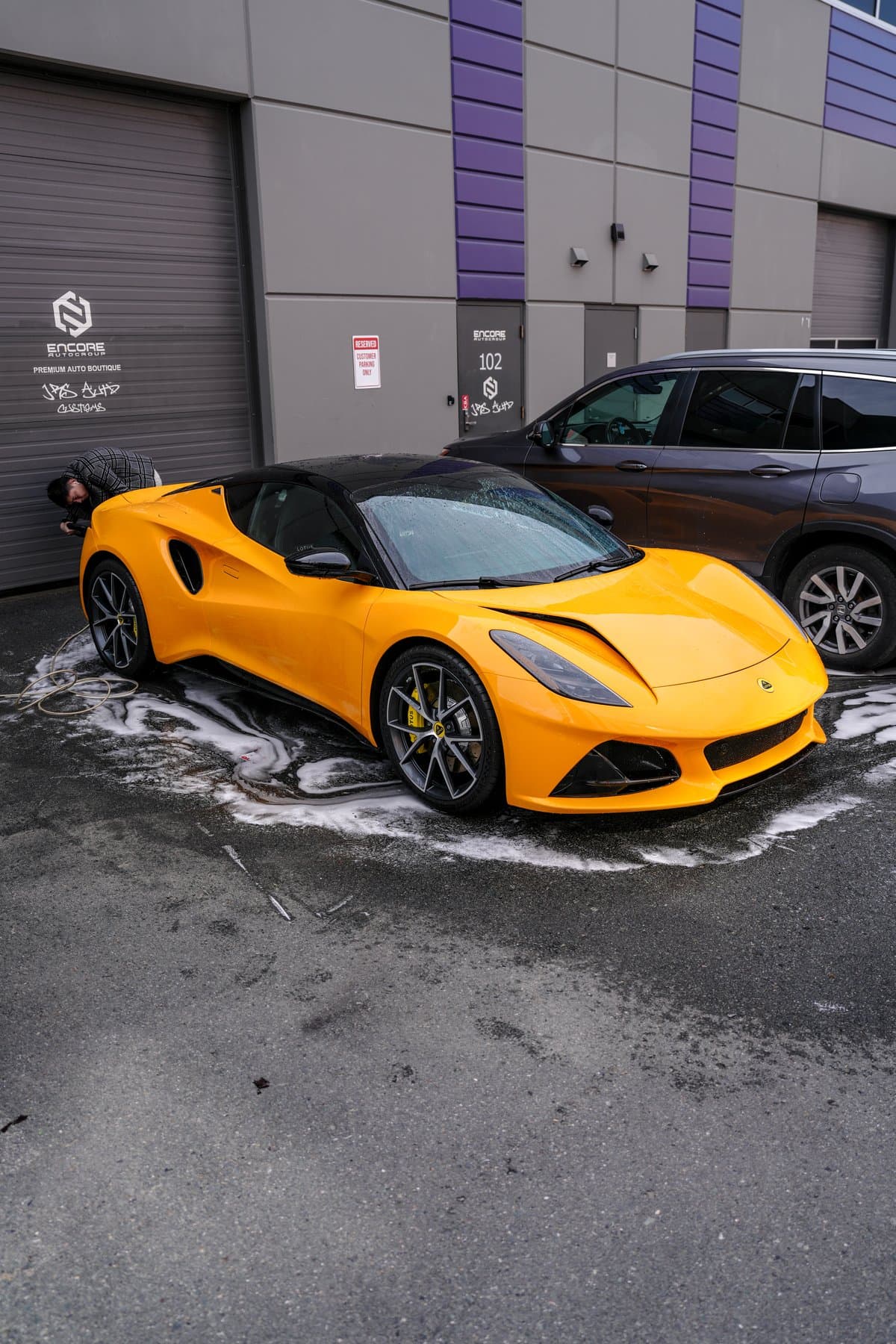
One real example is a Hethel Yellow Lotus Emira that came to the shop for multi-stage paint correction followed by a Gyeon ceramic coating, taking it from corrected gloss to a surface that is far easier to maintain. You can see that build on the JRS portfolio. On a car that lives under Vancouver street trees, that surface is the difference between pollen rinsing off and pollen needing to be fought.
The glass side of it is worth checking too. If the windscreen has haze that does not wipe away, that is a windscreen correction rather than a wash, and it is worth doing before the pollen season rather than in the middle of it. Our maintenance services cover the wash and decontamination side of this.
A simple schedule that avoids the problem
Rinse the car during the first weeks the pollen arrives, before it has had time to bond. Pay attention to the horizontal surfaces, because pollen collects on the bonnet, the roof, the boot lid and the shelf above the rear windscreen, and those are the surfaces that get missed.
Keep the windscreen rinsed before you drive. It is the least effort and it prevents the most expensive problem, because a wipers-on-dust windscreen is what turns a seasonal annoyance into a permanent haze.
If the car is parked under the same trees every day, rinse it even when it does not look dirty. Pollen is nearly invisible until it is a layer, and by the time you can see it, it has been sitting long enough to start bonding.
If the car is coated, make the April and May washes routine rather than optional. The coating is doing its job under the pollen, but it cannot do anything about the pollen that is sitting on top of it.
Related project: Lotus Emira — Ceramic Coating