
Staggered Tyres: Why Your Front and Rear Differ
Published
Your Car Was Designed With Two Different Sizes
Look at the tyres on a modern performance car and you will usually find two different sizes on the ground at the same time. The fronts are narrower than the rears. On a BMW M4 Competition, for instance, the factory setup runs 19-inch fronts and 20-inch rears, and the widths differ as well. This is not a mistake or an aftermarket shortcut. It is called staggered fitment, and it is a deliberate engineering decision that has been part of how performance cars are built for decades. A staggered setup exists for a specific reason: the two axles do different jobs. The front axle steers, carries more of the car's weight under braking, and works hardest in corner entry. The rear axle drives the car, pushes it out of a corner, and is the axle that has to deal with the torque a performance car can produce. Running the same size on both ends forces one axle to compromise. Our tires service treats the tyre and the wheel as one package to be matched rather than two parts bought separately, and that is how a staggered car should be specced.
What Staggering Actually Preserves
This is the part that gets lost when people talk about wider tyres. Going wider is a choice; staggered sizing is a structure. Because the front and rear are sized separately from the factory, the car's stability, steering feel, and traction balance are already tuned around those two different numbers. That is why the JRS wheels service treats fitment as a conversation about the whole vehicle rather than a diameter swap. If you change one axle and not the other, you are not upgrading the car, you are altering a balance the engineers already set.
The Winter Swap Is Where Staggered Cars Get Complicated
Here is the practical problem most owners of a staggered car run into each autumn. If your car runs 19-inch fronts and 20-inch rears, a winter set has to match that pattern. You cannot put a set of 19-inch winter wheels on the car and leave the 20s on, because the rear tyres would then be a different size from the front in the wrong direction — the rear would be narrower than the front. A single set of identical winter wheels cannot preserve a staggered layout, which means the seasonal swap involves either two separate winter wheel sets or a move to a non-staggered setup for winter. Our post on getting a second wheel set for winter covers the logistics of that decision, and our winter tyre guide covers the BC side of the season.
Why Not Just Fit the Same Size All Round?
This is a fair question, because on many cars the answer is that you can. You can run a matched set front and rear, and plenty of owners do. The trade-off is real, though. On a rear-wheel-drive car, a narrower rear is a deliberate choice: a wider rear tyre puts more rubber down, which increases the tendency to spin the rear under power. On an all-wheel-drive car, the same logic applies in reverse, because the fronts still do most of the turning. Our article on going wider on tyres covers the grip and clearance trade-off in detail. The short version is that width is a compromise in both directions, and the factory chose a particular answer for a reason. If you are considering replacing the staggered setup entirely, our post on downsizing below factory size is worth reading first — it is a different kind of change with a different set of consequences.
How to Tell What Your Car Runs
You do not need a workshop to find out. Look at the sidewall of the front and rear tyres and compare the full size markings. You will see something like 255/35 ZR19 at the front and 285/30 ZR20 at the rear. The first number is the section width in millimetres, the second is the aspect ratio, and the last is the rim diameter in inches. If the last number differs between the two axles, your car is staggered. The same sidewall also tells you the load rating and speed rating, which are worth checking when you are choosing a replacement set. On a staggered car these can differ between axles too, and a tyre that meets the front specification may not be the right tyre for the rear. The number to read most carefully is the rim diameter, because that is the one that has to be matched exactly to the wheel. Get it wrong and the tyre will not seat properly on the rim, regardless of how good the rubber is.
What to Do When You Replace One Tyre
Here is the practical advice that matters most for staggered cars, and it is where owners most often make an expensive mistake. On a staggered setup, the front and rear tyres are not interchangeable with each other. If one front tyre is destroyed by a puncture, you cannot replace it with a rear tyre from the same car. You have three real options: replace it with a tyre matching the other front, replace all four as a set, or fit a matched pair. The first costs least and is the one we will normally recommend, provided the remaining front tyre is in good condition and the replacement matches the manufacturer specification for load rating and speed rating. Our article on where a puncture can be repaired is useful reading before you decide, because not every damaged tyre is worth saving and not every puncture position can be repaired safely.
The Practical Summary
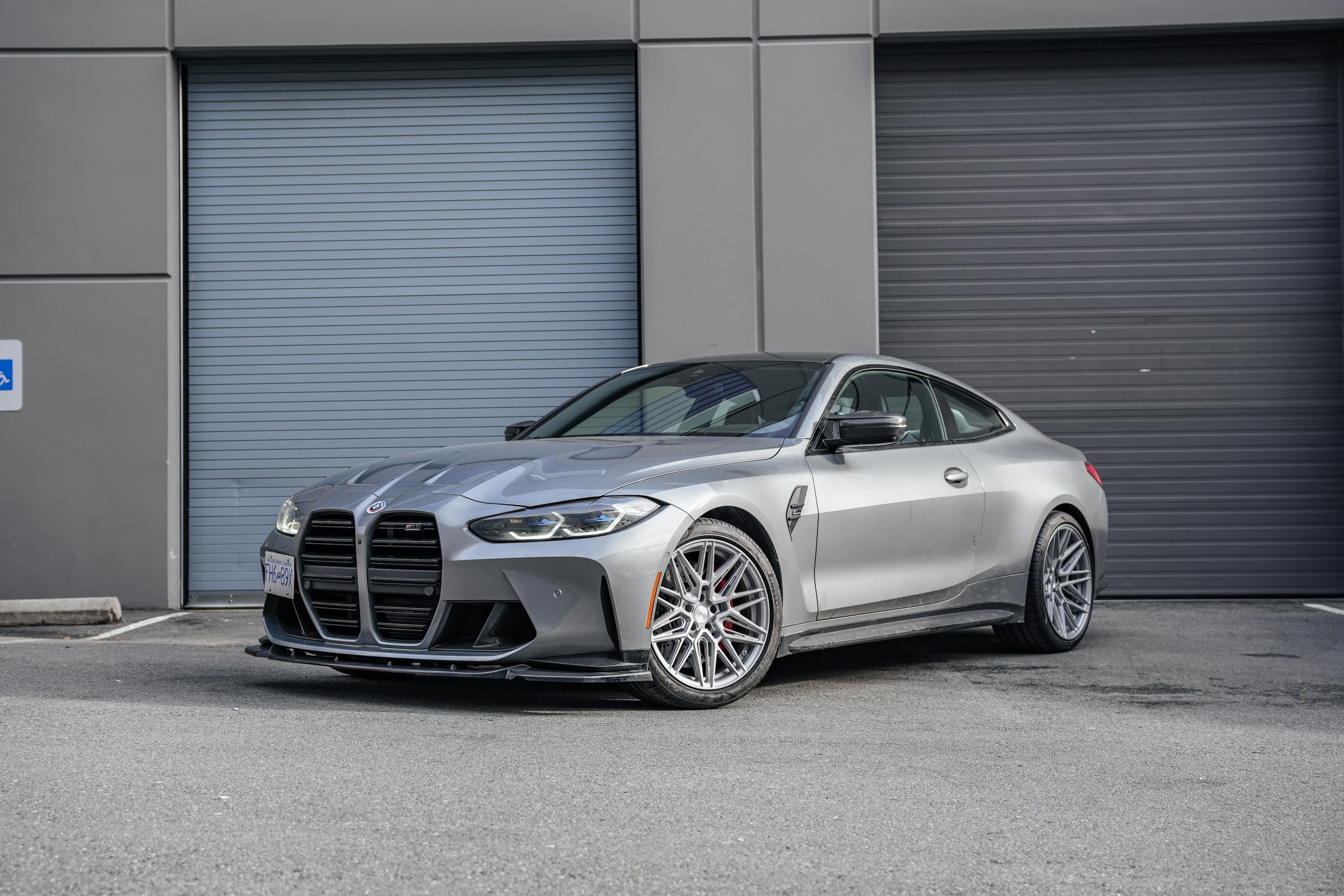
Staggered fitment is not a styling choice that a shop added to make a car look aggressive. It is how the car was engineered, and it is why the car drives the way it does. Respecting it means matching the pattern when you replace tyres, and planning the winter swap with it in mind. The BMW G82 M4 Competition in our portfolio is a good example of doing it the restrained way. JRS fitted a set of Vossen HF-7 wheels in Satin Silver, retaining the factory staggered sizing with 19-inch fronts and 20-inch rears. By staying true to BMW's original wheel and tyre specifications, the car keeps its factory driving dynamics while gaining a more refined and premium appearance. You can see that build in the BMW G82 M4 portfolio project for the full build.
Questions Worth Asking
Whatever you are planning, the questions to ask are the same. Will the new set preserve the factory staggered pattern, front and rear? What are the correct load rating and speed rating for each axle, and are they the same on both? If you need winter wheels, does the shop have the staggered sizes available in a winter compound, and what does the seasonal swap look like in practice? Our maintenance service covers what a staggered car needs on a regular basis, and a shop that will talk through these questions before quoting is the one to take the work to.
Related project: BMW G82 M4 Competition Vossen HF-7 Wheels