
Should You Get a Switchable Exhaust With Valves?
Published
Most exhaust conversations in Vancouver start the same way: someone wants the car to sound better, and then realises a car that sounds great on an empty highway is a very different proposition in a laneway at seven in the morning. The gap between those two cars is the entire reason valve control systems exist.
An active exhaust valve is a mechanism in the exhaust that opens and closes to change how much sound escapes. Closed, the exhaust is routed through a quieter path and the car runs civilised. Open, the flow is released and you get the full character of the system you paid for. You get both behaviours from one car, and you choose which one you are getting at the moment you turn the key.
It is a real category of work at JRS. Valve control systems sit on the exhaust service page alongside cat-back systems, axle-back systems, downpipes, headers and fully custom fabrication, and the description is plain about the intent: active exhaust valves for quiet cruising and full growl on demand. The two systems recommended and installed most often are iPE Innotech, where JRS is the Western Canada master dealer, and Akrapovič, where JRS is an authorized installer.
What a Valve Actually Does
The important thing to understand is that a valve is not a speaker or an amplifier. It does not create a louder note than the system underneath it. It changes which path the exhaust gas takes on its way out, and that changes both the sound and, slightly, how the car behaves.
With the valve closed, the exhaust is forced through additional chambers designed to absorb and reshape the noise. This is the quiet mode. It is not silence, and it is not fake silence either — it is genuinely quieter, and on a modern valved system it is still recognisably the same car. The car still has an exhaust note. It just stops broadcasting it to the neighbours.
With the valve open, that extra path is bypassed. The gas goes more directly out, and you hear what the system was built to produce. If you have fitted a performance exhaust, this is the mode that gives the car the character you installed it for. If you have not, opening the valve reveals whatever the car already had, which may not be exciting.
Who It Actually Suits
The honest answer is that valve control is for a specific owner, and it is worth being specific about who that is.
It suits the driver who wants one car to do two jobs. A car that is quiet enough for a residential street and a school run on Monday, and genuinely worth hearing on a dry stretch of highway heading north on a Saturday. That is not a compromise dressed up as a feature. For someone who genuinely drives both kinds of road, valving is the closest thing to having both cars.
It does not suit the driver who wants to be noticed every time they start the engine. If the plan is for the car to be loud constantly, then a valve system is an expensive way to add a quiet mode you will never use. A straightforward performance exhaust is the simpler and more honest choice, and the exhaust service page covers that option too.
It also does not suit a car that does almost no city driving. Vancouver is dense and residential in ways that many cities are not, and that matters more for this decision than it would in a place with more open road. A loud exhaust that you only hear on short drives is a poor return for the money.
The Practical Parts Nobody Mentions
There are several things about valved systems that are worth understanding before you commit, and they are the difference between a good decision and a disappointing one.
First, how the modes are selected. Some systems are controlled from a button or a switch, some from the car's own display, and some respond to driving mode selections. This matters more than it sounds, because if the quiet mode is awkward to reach, you will not use it, and if the loud mode is the default you will get tired of it. You want to know exactly how you will be operating this before the car is built, not after.
Second, what happens to the noise floor when you are in quiet mode but the car is under load. A valved exhaust is not a muffler that makes a loud car quiet at low effort. Getting the aggressive character back usually involves opening the valve, and opening the valve is a decision the car or the driver makes based on load, not just on a switch. A car being driven hard up a mountain road is a car making a lot of noise regardless of which mode you selected on the driveway.
Third, the hardware itself. Valves are mechanical components in a hot, salty, wet environment, and this is a city with road salt. Ask what the valve is made of, whether it is serviceable, and what happens when one needs attention. This is not a corner of the market where you ignore build quality, because a failed valve in a quiet mode means a car that is suddenly much louder than the owner agreed to, on a street at seven in the morning.
Fourth, the interaction with the rest of the exhaust. A valve does not replace the rest of the system — it is part of it. The valve sits in the exhaust you choose, so the decision about cat-back, axle-back or headers is still the first decision, and the valving is the second one applied on top.
Before You Book the Work
There is a straightforward way to work out whether valved exhaust is right for you, and it does not involve any of the complicated stuff.
Think about a normal week. Where do you actually drive, and at what time of day? If most of your driving is short urban trips in residential areas early in the morning, then the quiet mode will be doing most of the work and it is worth thinking carefully about how the car sounds in that mode. If most of your driving is open road, then valving is a smaller part of the experience and you may be better served by spending the money on the sound itself.
Then think about how the car will be left. A valved system is one you can set and forget, and that is its main appeal. If you want the car to sound a certain way every single time without thinking about it, the exhaust service page options are worth walking through with the shop, including what the car sounds like in each mode rather than only on the road.
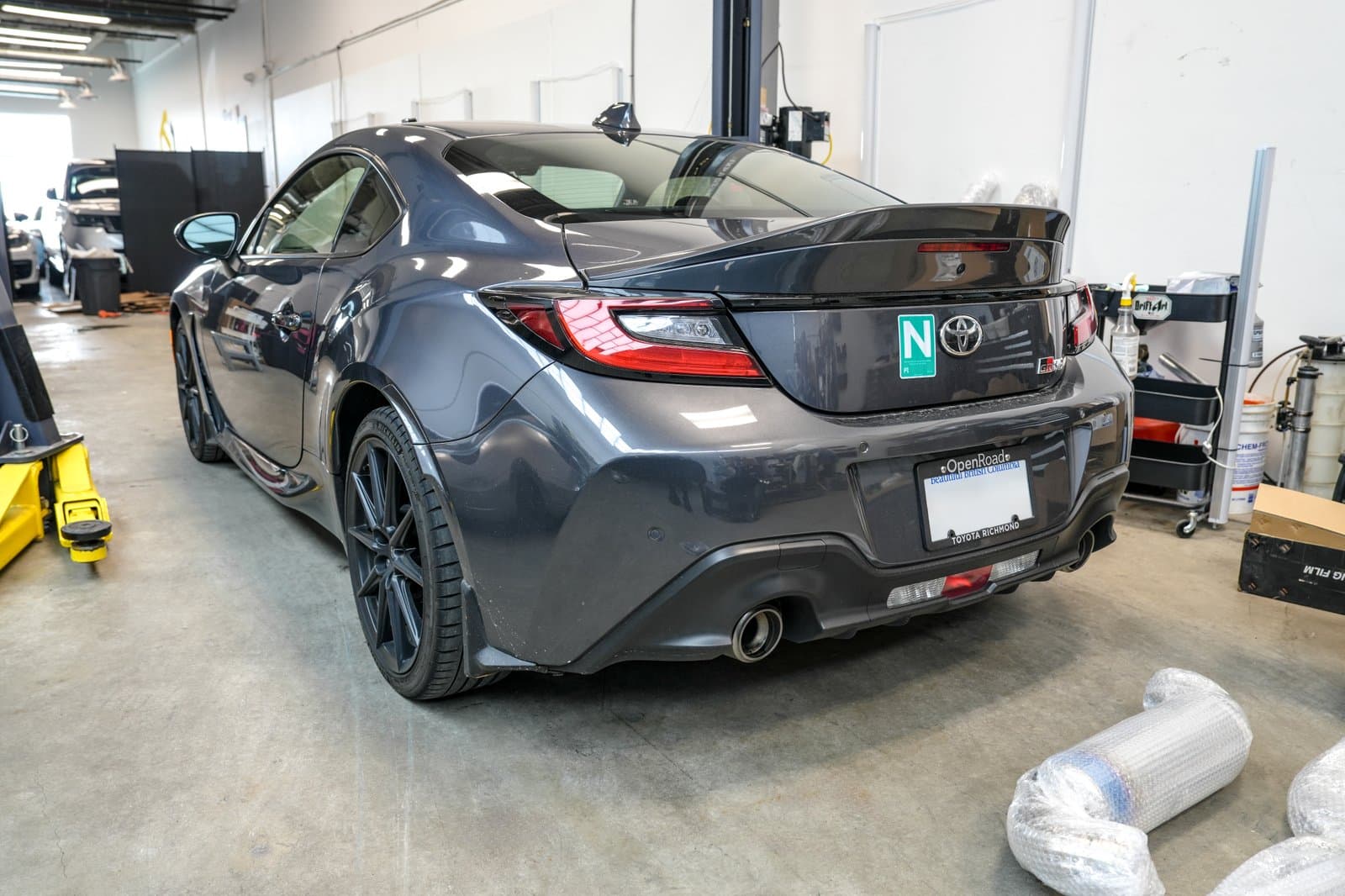
The projects that make this decision concrete are the ones where a single car carries two very different requirements. The Toyota GR86 in the JRS portfolio is a good example of a car whose character was unlocked by the exhaust choice itself, with the Japanese HKS system installed to release the character of the boxer engine. That is the goal: a system that sounds like the car underneath it. A valve does not change which character your car has. It decides when you get to hear it.
The Real Question
If you take one thing from this, make it this: valved exhaust is not really a decision about sound. It is a decision about context.
The same exhaust note is right at one moment and wrong at another. A quiet mode lets you keep the car you wanted without making a permanent sacrifice for the streets you live on. That is the real proposition, and for a Vancouver owner driving a car with a performance exhaust, it is the thing that makes the whole thing liveable.
So the question is not whether you want your car to be loud. It is whether you want it to be loud sometimes, and quiet the rest of the time, and whether you are willing to carry the complexity of a system that gives you both. If the answer is yes, this is one of the few upgrades where the driving experience genuinely changes. If your car only ever gets driven one way, a simpler exhaust will serve you better.
Related project: Toyota GR86 — HKS Exhaust Upgrade