
Touchless Car Wash: The Chemical Tradeoff
Published
What touchless actually means
A touchless wash sounds like the safe choice, and the name does a lot of work. There are no brushes, so there is no brush dragging grit across your paint. That part is true. What gets left out of the name is what replaces the brushes.
Water pressure and chemistry. To lift road film without something physical working at it, the wash leans on detergent, and it leans on it hard. The chemistry needed to shift bonded contamination without a mechanical edge is stronger than what you would use on a paint that already has protection on it.
This is the whole tradeoff in one sentence: touchless trades mechanical risk for chemical risk. A brush wash risks scratching. A touchless wash removes the scratches and adds a different kind of exposure.
What the chemistry actually does
Here is the part worth understanding rather than worrying about. Your paint has a clear coat over it, and that clear coat is not indestructible. It has a chemical tolerance, and when a strong detergent sits on it in the sun and stays wet for a long enough cycle, it can soften it. Softened clear coat is more vulnerable to the next thing that touches it.
None of that means a touchless wash is dangerous. It means it is not neutral. On an unprotected car in a city where your paint already has road film, brake dust and salt on it, a touchless wash is a reasonable, cheap way to take the winter off a car that has been sitting in road salt.
It becomes a poor trade for a car that has been protected, because you are now putting the strongest available detergent on a surface that has something worth protecting, in order to remove dirt that a gentler process would have shifted.
Why coated and wrapped cars are a different case
A ceramic coating is a bonded chemical layer. It is not a sacrificial wax that rinses off, and it was designed to make routine maintenance easier. A strong alkaline or acidic detergent can strip the top of that layer, and if it is stripped unevenly, the coating stops behaving consistently across the panel. You get patchy water behaviour: sheeting in some places, beading in others.
PPF is different again, and more forgiving. The film is a physical urethane layer, so detergent mostly just cleans the surface of it. But strong chemistry still dulls the finish over time, and dulling is permanent in the sense that it does not come back on its own.
There is a second problem with touchless on a protected car, and it is the one owners notice first. Touchless washes cannot remove the contamination that has bonded to the surface. It rinses off. So the film builds, and once there is a bonded layer, the wash needs more chemical to do less mechanical work.
This is exactly why the maintenance service uses compatible chemicals only, and why it offers a decontamination wash rather than a rinse. The package list names it directly: a compatible decon wash, an inspection of the coating layer, and a maintenance topper. If your protection needs its top layer restored and your wash is not restoring it, you are slowly eroding it.
What professional prep involves that a wash does not
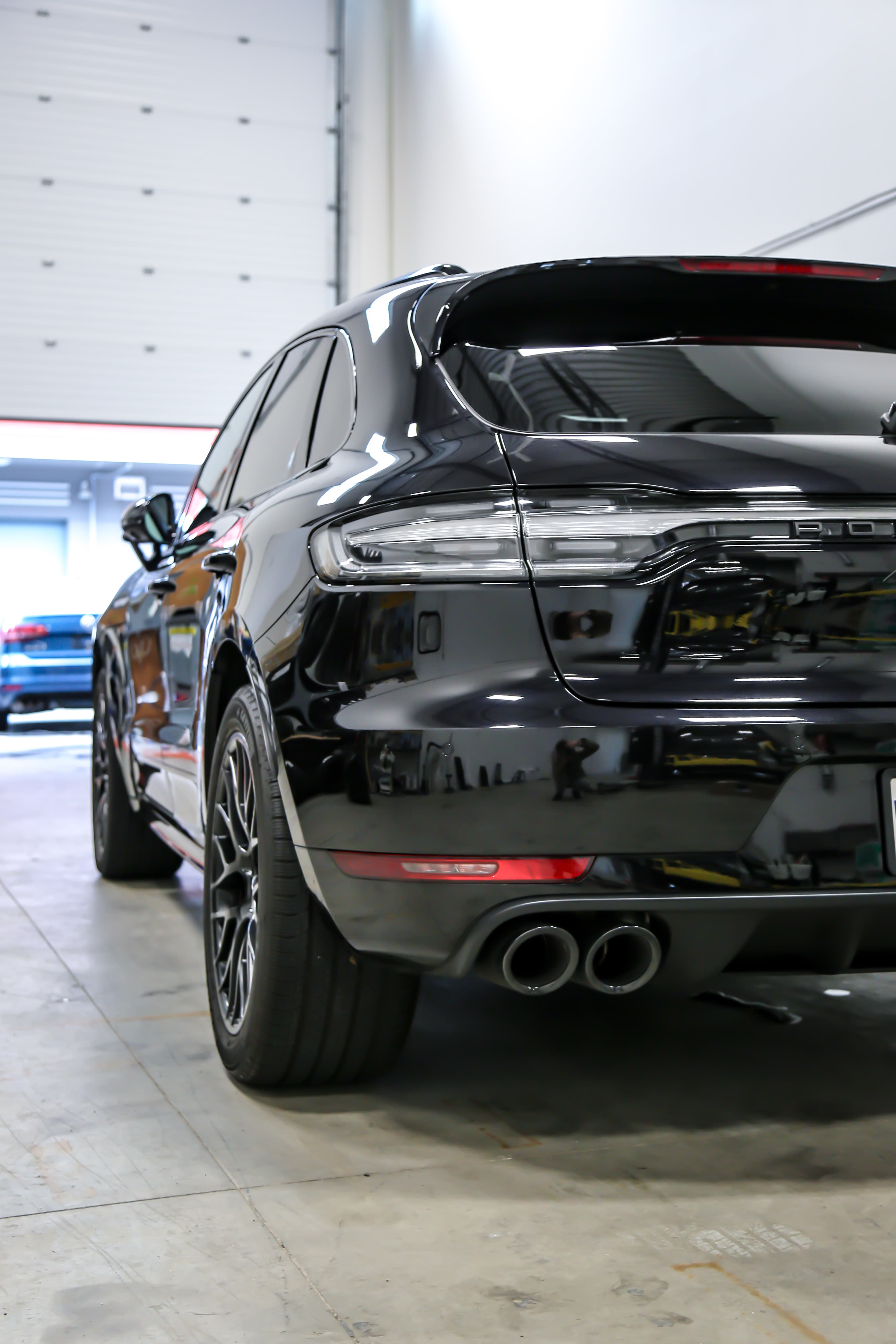
The clearest way to see the difference is to look at what a real coating job starts with. Take a black Porsche Macan GTS that came to JRS for long-term protection. Its record names the process: a full exterior decontamination, then paint surface preparation, then the coating itself. Decontamination is not a wash. It is removing the bonded layer chemically and mechanically before anything is applied on top.
That Porsche Macan GTS project is worth looking at for a second reason. The description notes that the result delivers sharper reflections. Reflections are the honest test of a surface, because they show you everything: a film, a haze, a dull patch, a chemical etching that no amount of wax will hide.
If you cannot tell whether your paint is clean, look at a reflection in good light. If it is not as sharp as it was, something is sitting on it, and a touchless rinse is not going to take that off. That is a job for a controlled decontamination process, not a higher detergent setting.
The practical decision
The touchless wash is not a mistake. For a car that lives on the street all winter with no protection, it is a reasonable and cheap way to handle the salt. The problem is when it becomes the only wash, because then the chemicals that are doing the work are the only chemicals touching the car.
If your car is protected, the sequence that makes more sense is a proper wash that uses compatible products, followed by a decontamination step when the surface actually needs it. JRS's ceramic coating service is built on the same principle from the other end: every package starts with thorough decontamination and preparation, because what you seal in is what you are going to live with. A coating applied over contamination traps it.
The practical rule is simple. Use the touchless wash when the car needs salt off and you have nothing on the paint worth protecting. Once there is a coating or film on the car, the wash you choose should be the one the coating was specified to live with.
And if you are still deciding whether to protect the car at all, the daily essential service and the maintenance service both start from the same place: compatible chemicals, and wash technique that does not work against what you have already paid for.
Related project: 2020 Porsche Macan GTS | GYEON MOHS EVO Ceramic Coating