
EV Maintenance in Vancouver: What Differs From ICE Cars
Published
Electric vehicles have genuinely fewer moving parts than petrol or diesel cars, which means there is less to wear out and fewer routine service items to manage. That is a real advantage. But the items that do need attention on an EV are different from the items that matter on an internal combustion car, and some of those differences are particularly relevant to Vancouver's climate.
Why brake pads last longer on most EVs — and why they sometimes do not
Regenerative braking captures energy normally lost during deceleration and feeds it back into the battery. On most drives in city traffic and on hilly terrain, this means the friction brakes are used significantly less than they would be on an equivalent petrol car. The practical result is that brake pads on an EV driven mostly in the city can last considerably longer — 50,000 to 80,000 kilometres is not unusual.
The caveat is highway driving. On longer motorway trips with minimal deceleration events, regenerative braking contributes less to overall braking demand and the friction brakes do more work. If an EV is used predominantly for highway driving, the brake pad life expectancy moves closer to a conventional vehicle. In Vancouver, where a commute is often a mix of highway and city driving, the actual wear rate depends heavily on driving style and the local road terrain.
Brake fluid still needs to be changed on the same schedule as a conventional car. The hydraulic fluid in the brake system degrades over time regardless of how often the friction brakes are used, and the fluid's moisture absorption rate is not reduced by regenerative braking.
Tyre pressure and tyre wear on heavier EVs
Electric vehicles are heavier than their petrol equivalents because of the battery pack. That additional mass puts more load through the contact patch of each tyre on every corner, accelerating tyre wear. Combined with the instant torque available from the electric motor, tyre wear on an EV driven with any enthusiasm can be significantly faster than on a comparable petrol car.
Tyre pressure monitoring systems on EVs are typically calibrated for the vehicle's specific weight and tyre specification. Check tyre pressures monthly using a reliable gauge, and check them cold before first use of the day. In Vancouver's winter, tyre pressures drop roughly one to two PSI for every ten-degree Celsius drop in ambient temperature, which is worth remembering in the shoulder seasons when the temperature swings between morning lows and afternoon highs.
Some EV owners choose to rotate tyres more frequently than the standard interval specifically because of the heavier vehicle mass. Four to five thousand kilometres earlier than a petrol car of equivalent power is a reasonable approach if the car is driven spiritedly.
Battery health in Vancouver's cold and heat
Extreme cold reduces battery efficiency and reduces range. At temperatures below minus 10 Celsius, the chemistry inside a lithium-ion battery pack is less able to accept and deliver charge efficiently. In a Vancouver winter, this effect is real but not catastrophic — most modern EVs manage cold-weather battery performance through thermal management systems that precondition the battery pack before driving.
Parking in a garage or carport rather than outside makes a measurable difference to cold-weather range and battery longevity. Repeated deep discharging and charging in very cold temperatures accelerates battery chemistry degradation over time. If the car is parked outside through a Vancouver January, expect noticeably reduced range and a longer charging session.
Summer heat is the other battery stressor. Prolonged exposure to temperatures above 30 degrees Celsius accelerates the same degradation mechanisms as very cold temperatures, just in the opposite direction. Parking in shade or indoors when possible helps both the battery and the interior trim.
Items that still need regular attention
Cabin air filters on EVs should be changed on the same schedule as on a conventional car — typically every two to three years, or more frequently if the car is driven in dusty conditions or on unpaved roads. A clogged cabin filter reduces HVAC airflow and forces the climate system to work harder.
Wiper blades wear at the same rate as on any vehicle and should be replaced annually or when they begin to streak. In Vancouver's wet season, worn wiper blades are not just a visibility nuisance — they are a safety issue.
The 12-volt auxiliary battery that powers the car's electronics, lights, and safety systems on an EV is separate from the main drive battery. This battery is charged by the main battery and the drive system, but it still ages and can fail. Most EVs will warn you if the 12-volt battery is approaching the end of its life. Do not ignore that warning.
What a shop that works on EVs needs to know
Working on an EV requires awareness of the high-voltage system and the specific torque specifications for the vehicle. Not all independent shops have the equipment or training to safely service an EV. When booking work at a shop, confirm that they have experience with your specific make and model. JRS Auto Customs has experience working on EVs as part of its broader vehicle service work.
For the full maintenance schedule that covers your vehicle through the year, see the maintenance page. And for protection options for your EV's paint and glass, see the ceramic coating page.
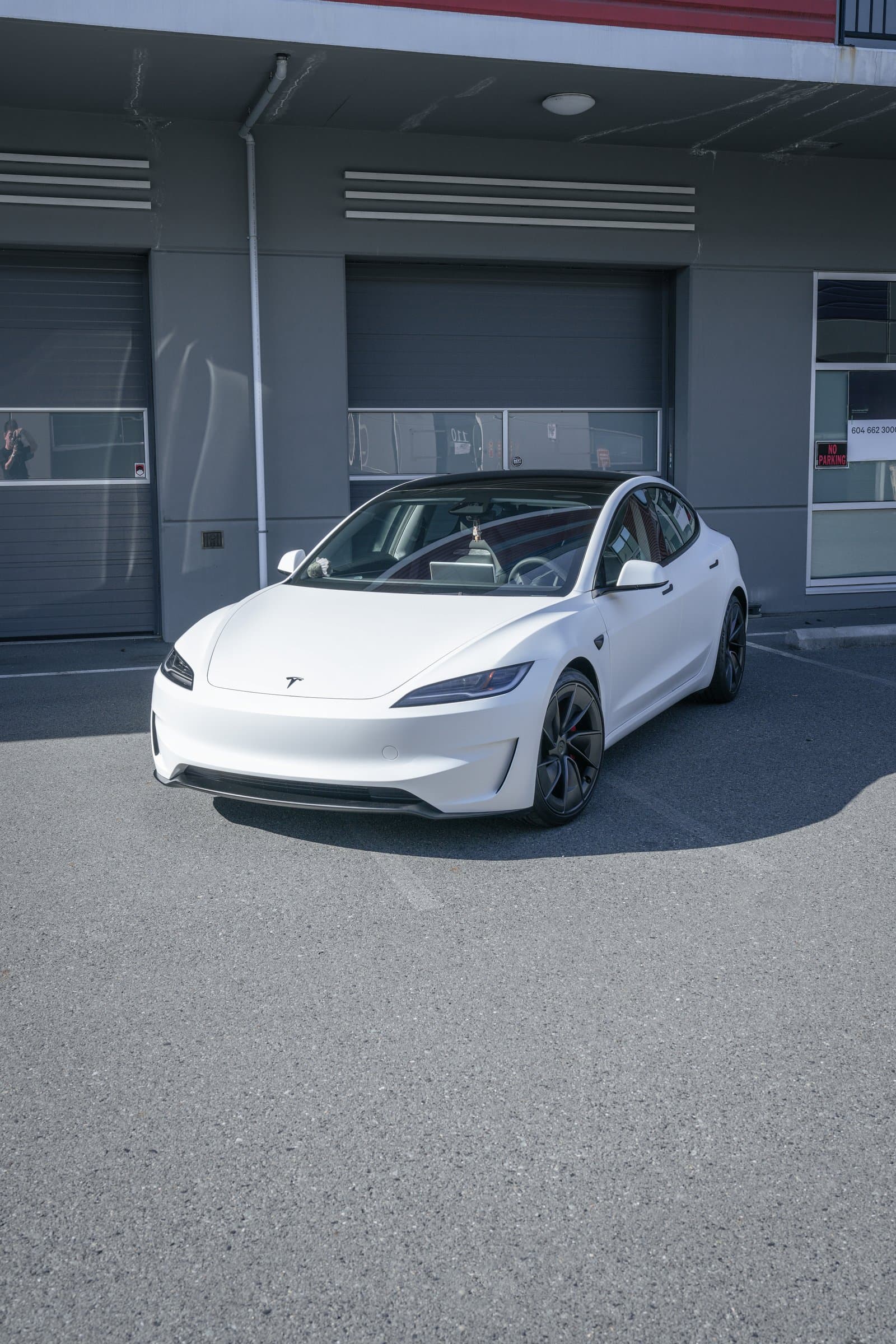
Related project: 2024 Tesla Model 3 Performance — Ceramic Vanilla White