
Exhaust Maintenance for Vancouver's Wet Weather
Published
Most drivers think about their exhaust when it gets loud or starts making a noise. But by that point, the underlying problem has usually been developing for months. Vancouver's climate puts continuous stress on exhaust systems in ways that are easy to ignore — until a rusted-through muffler dumps fumes into the cabin on a rainy November morning.
Why Vancouver's Climate Is Hard on Exhausts
An exhaust system operates in one of the harshest environments on a car. It deals with combustion byproducts, temperature cycles from cold to red-hot and back, and — in Vancouver — persistent moisture from rain, condensation, and road splash. Road salt compounds the problem. Salt lowers the corrosion threshold of steel and accelerates rust on any unprotected metal in the system.
The most vulnerable parts are the surfaces closest to the road: the undercarriage, the mid-pipe, the resonator, and the muffler. On lowered cars, the exhaust hangs closer to the ground and is more exposed to road splash. On any car, the flex pipe just after the exhaust manifold is susceptible to cracking from repeated heat cycles, and that cracking is accelerated by salt corrosion on the metal surface.
What to Inspect Before Winter Arrives
A basic exhaust inspection takes under ten minutes and requires no tools. With the car cold, get underneath with a torch and work from the front of the system to the back. Look for surface rust flaking off any steel component — this is a sign the metal is thinning. Check the rubber hangers and mounts for cracking or missing sections. A broken hanger lets the exhaust sag and changes the angle of the system, which puts stress on the flanged connections and leads to exhaust leaks.
Listen for any changes in exhaust tone when you start the car cold. A change in sound at startup — a rasp, a crackle, or a sudden increase in volume — usually indicates a leak somewhere in the system. A small leak at a flex pipe or a gasket can let exhaust gases into the cabin, which is both a health and a safety concern.
The catalytic converter also deserves attention. A failing catalytic converter will trigger a check engine light and reduce engine efficiency. On BC roads, the converter is exposed to road splash and can be damaged by an overheating engine as easily as by contamination. If the engine has ever overheated, have the converter checked before winter.
Aftermarket Exhausts: Extra Attention Required
Aftermarket exhausts are often made from thinner-gauge steel than factory systems, which means they can corrode faster if not inspected. Many aftermarket systems use stainless steel for the main muffler and resonator but mild steel for the mid-pipe and flanges. The mild steel sections will rust in Vancouver conditions unless treated. Regular inspection of the weld seams and flange connections is especially important on aftermarket systems.
If you have an aftermarket cat-back or axle-back system, check that the install was done with new hardware. Older installs with reused bolts and gaskets are prone to leaks at the flange connections. These leaks can be hard to detect until they become audible.
Winter Driving and Short Trips
One of the most damaging conditions for an exhaust is the short winter trip that never fully warms the system. When the car only runs for ten or fifteen minutes, condensation builds up inside the muffler and never evaporates. Over a season, this accelerates internal corrosion in the muffler and the resonated piping. Cars driven daily on longer routes stay drier inside the exhaust system.
If your car is primarily used for short urban trips, occasional longer drives — highway runs that fully heat the exhaust — will help drive out moisture. This is not a substitute for inspection, but it helps extend the life of the system.
When to Book an Exhaust Service
Book an exhaust inspection before the worst of the rain season if you have not had the system checked in the past twelve months. The best time is late summer or early autumn — before the salt season starts but after any summer heat has already stressed the system. Any rusted-through sections, cracked flex pipes, or failed hangers should be addressed before winter, when the damage accelerates.
If you are considering an exhaust upgrade and want a system that holds up better to BC conditions, talk to JRS Auto Customs about stainless steel or titanium options. Browse our recent work below.
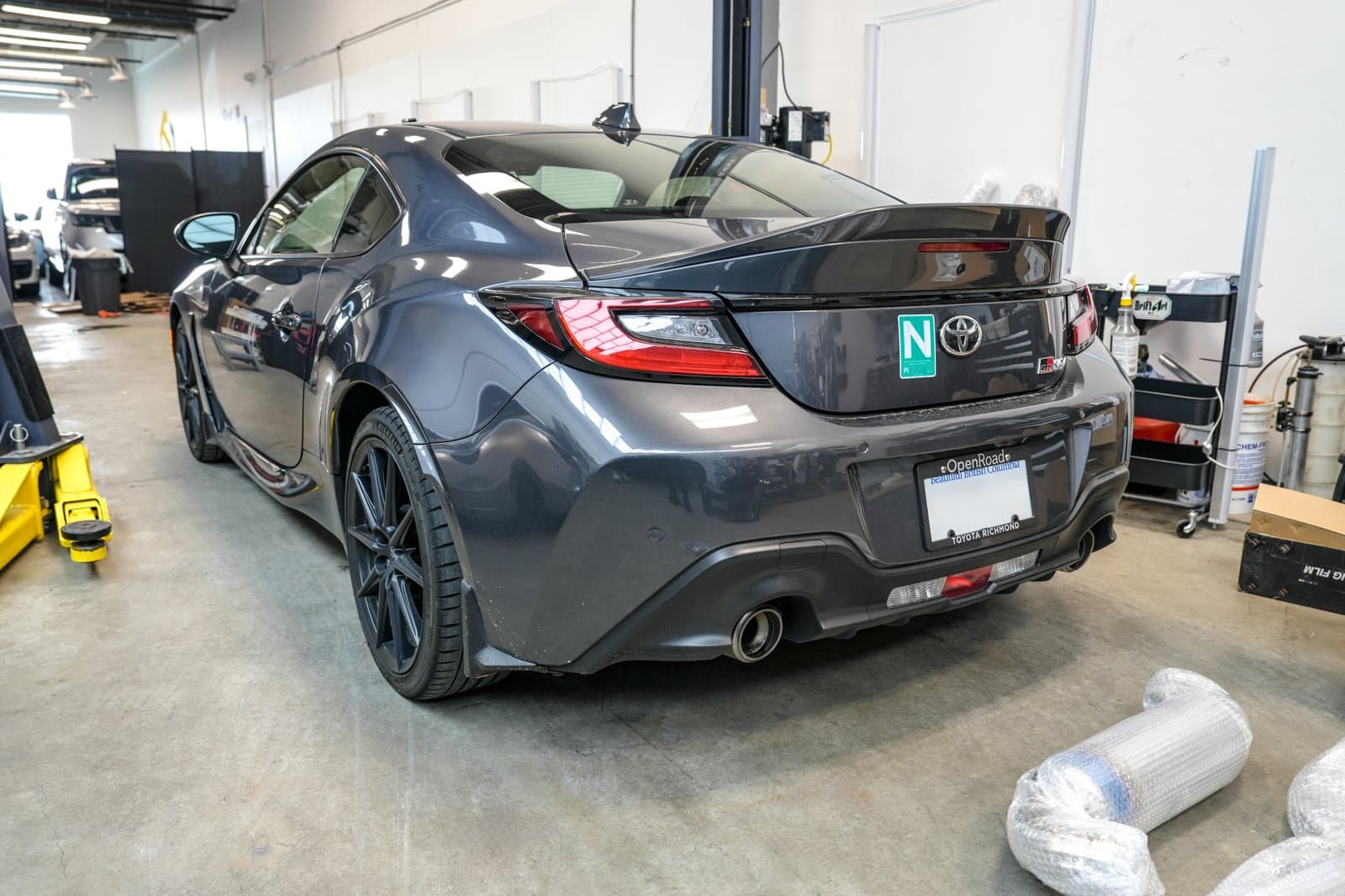
Exhaust & Performance UpgradesRelated project: Toyota GR86 — HKS Exhaust Upgrade