
What to Consider Before Upgrading Your Exhaust in Vancouver
Published
Vancouver has a reputation for thoughtful car customisation. The owners here tend to do their research before spending money, and they have a realistic sense of what they want from a modification. That pattern shows up clearly in the exhaust upgrade conversations happening in local forums, at meets, and in our shop. It is not just about getting a louder car. For most Vancouver drivers, an exhaust upgrade is about better sound, modest performance gains, and a car that feels more satisfying to drive — all within a regulatory and environmental context that shapes what makes sense here specifically.
What BC's Noise Rules Actually Mean for Your Upgrade
BC's drive-by noise limits are stricter than some other provinces. The threshold is 92 decibels under the Canadian standard — the same one applied at roadside stops by bylaw officers. A system that reads 95 dB at a mechanic's shop may read 98 dB at the roadside on a warm day with a different road surface. The practical implication is that the most aggressive straight-through setups popular in other markets are not straightforward choices in Vancouver. That is not a problem for most cat-back or axle-back configurations, but it is a constraint worth understanding before you commit to a specific system.
On the emissions side, vehicles registered in BC after 2018 use OBD emissions monitoring systems that flag readiness checks if a catalytic converter or oxygen sensor is removed or bypassed. BC also has periodic emissions inspections for vehicles of a certain age in the Lower Mainland. A properly engineered cat-back system that leaves the factory catalytic converters and OBD sensors undisturbed avoids these complications. That is one reason cat-back setups are the most common recommendation for daily-driven vehicles.
Vancouver's Climate Changes What an Exhaust Upgrade Means
The coastal environment is the part of the Vancouver exhaust conversation that does not come up as much as it should. Salt air accelerates corrosion on exposed exhaust components, particularly on systems with thinner-walled steel or mild steel flex pipes. A quality stainless steel system — or better still, titanium on high-end builds — will hold up significantly better over years of Lower Mainland winters than a budget system with compromises in material spec. This is not a minor consideration for a modification that costs thousands of dollars.
Installation quality also interacts with the local climate. Proper rustproofing of the undercarriage before an exhaust install, and attention to the condition of existing hangers and mounts, matters more here than in a dry interior climate. Moisture gets into rubber hangers, causes them to crack, and a broken hanger changes the way an exhaust hangs — which changes its sound and its clearance from bodywork. This is the kind of detail an experienced shop catches that a casual install may miss.
What You Actually Gain on a Daily-Driven Vehicle
The performance gains from an exhaust upgrade on a daily-driven car are real but situational. On a turbocharged engine, improved exhaust flow reduces back pressure and can reduce turbo lag and improve throttle response measurably. On a naturally aspirated engine, the gains are more modest but still perceptible — better gas flow through the system improves how the engine breathes, and a quality muffler reduces restriction without the drone that characterises cheap systems at highway speed.
For most Vancouver daily drivers, the appeal is the combination of better sound quality, modest performance improvement, and the satisfaction of a car that feels more engaging to drive. That combination is real and for many owners it justifies the investment. The key is choosing a system designed for your specific vehicle and goals rather than picking based on brand popularity alone.
Which Type of Exhaust Upgrade to Consider
Axle-back systems replace the rear muffler and rear piping only. They are the most affordable entry point and can add a refined note without changing emissions hardware. Cat-back systems replace everything from the catalytic converter back — the front pipe, mid-pipe, and rear section — and offer more meaningful flow improvement and sound character. Full header-and-downpipe systems, replacing the manifolds and primary piping, are the most aggressive option and are generally reserved for heavily modified or track-focused vehicles.
For most Vancouver vehicles, a cat-back system represents the best balance: a noticeable improvement in sound and response, compatibility with emissions monitoring, and typically no need for retuning. Turbocharged vehicles may benefit from a retune after a cat-back install to optimise air-fuel ratio, but it is not always necessary depending on the specific system and how the car is driven.
When to Book the Work and What to Ask Before You Commit
If you are considering an exhaust upgrade, late spring through early autumn is the practical window in Vancouver. The work involves cleaning and treating the undercarriage, and it is easier to do that before the salt season starts. It also gives the installer better conditions to work in and a cleaner surface to assess.
Before committing to a system, ask what material spec it uses, whether it is designed for your specific vehicle, and how it performs on BC roads specifically. Ask about installation quality and what rustproofing steps are included. The shop should be able to explain how their recommended system behaves in Vancouver's coastal climate and what to expect over the first few years of use.
JRS Auto Customs handles exhaust upgrades and can walk through what makes sense for your vehicle and how you drive. The conversation costs nothing and gives you a clear picture of what is involved before you commit to anything. Browse the exhaust service page to see what the process looks like and what options are available for your car.
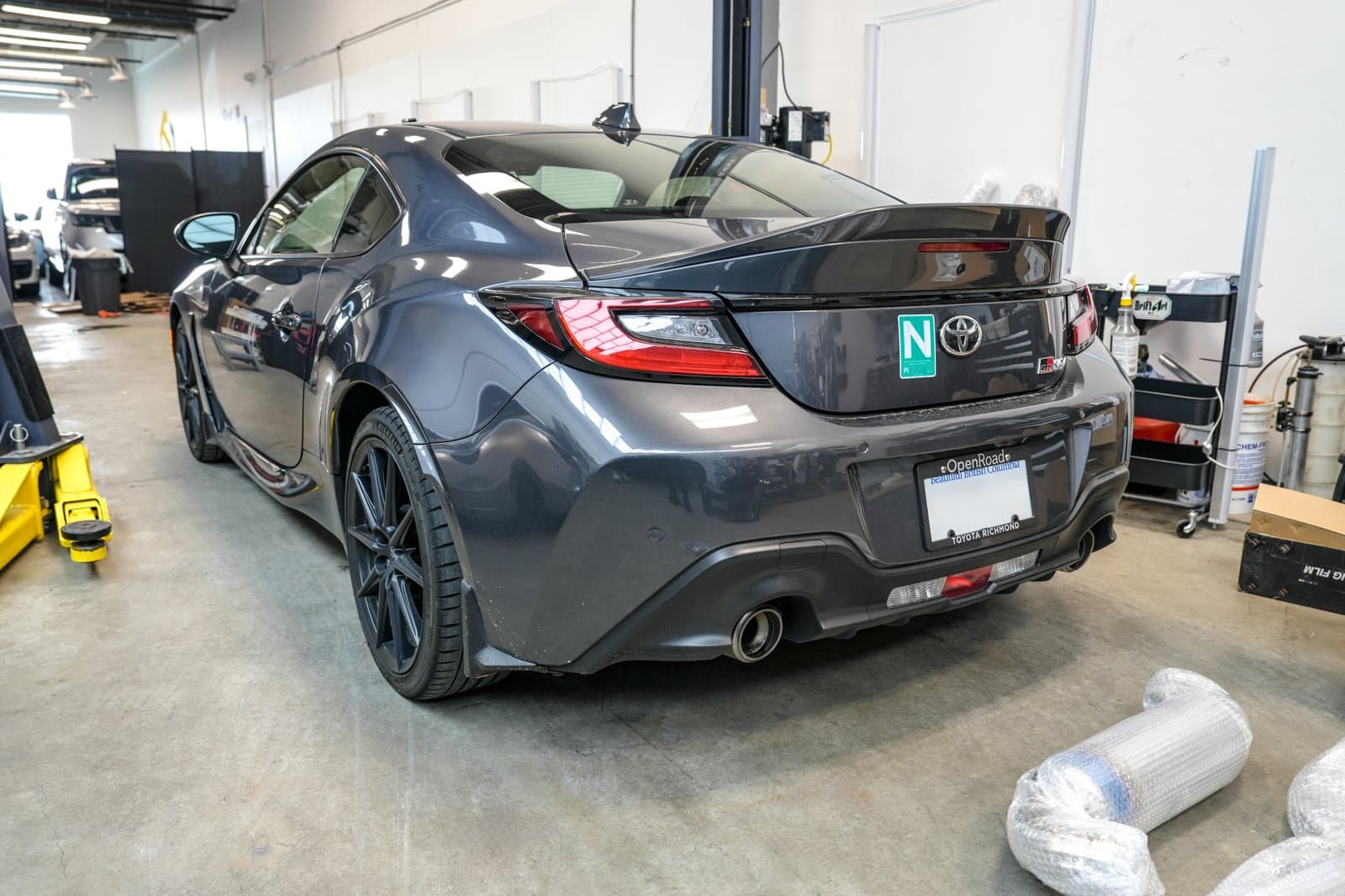
Related project: Toyota GR86 — HKS Exhaust Upgrade