
When Does Your Car Actually Need an Exhaust Upgrade
Published
Every week at JRS Auto Customs, a customer asks whether an exhaust upgrade makes sense for their car. The honest answer depends almost entirely on how the car is used, what it weighs, and what you are trying to achieve. For most Vancouver drivers — who commute, run errands, and drive the occasional Highway 1 trip — the stock exhaust is doing exactly what it was designed to do. For a driver with a modified naturally aspirated car or a turbocharged setup that is still making factory-level power, the answer may be different.
What an Exhaust Upgrade Actually Changes
An aftermarket exhaust changes two things: the backpressure characteristics of the exhaust flow, and the sound signature of the car. On a turbocharged engine, the exhaust gases already leave the engine under pressure from the turbo, so the restrictive nature of a stock exhaust system is less of a bottleneck than it is on a naturally aspirated engine. Reducing backpressure on a turbo car primarily changes sound — the power gains, if any, are modest and show up only at higher RPMs. On a naturally aspirated engine, the exhaust is the primary pumping mechanism. An unrestricted exhaust allows the engine to exhale more freely, which can produce measurable power gains across the rev range — particularly useful on high-revving engines or cars that spend time on winding roads.
The third thing that changes is weight. A titanium or stainless steel cat-back or axle-back system is lighter than the stock unit, which matters on a track car or a lightweight build but is irrelevant on a heavy SUV or a daily driver.
When an Exhaust Upgrade Is Worth It
The clearest case for an exhaust upgrade is a car with a modified or high-output naturally aspirated engine that is still running its stock exhaust. On these cars, the stock system was designed to meet cost, noise, and emissions targets — not to extract maximum power. A performance exhaust allows the engine to breathe more freely, and the difference in response and power delivery is noticeable. A cat-back or axle-back system is the most common starting point: it replaces the rear section of the exhaust from the catalytic converter or rear muffler back, without changing the front pipes or catalytic converter — keeping the system BC-inspection legal.
Turbocharged cars with a downpipe upgrade are another legitimate case. Replacing the factory downpipe with a high-flow unit removes a significant restriction and is the single most effective exhaust modification on a forced-induction engine. A downpipe upgrade usually requires a tune to work properly — running a high-flow downpipe without retuning can cause engine management issues.
When It Is Not Worth It
For a daily-driven turbo car that is making its factory power levels, an exhaust upgrade changes the sound. Whether that change is worth the cost depends entirely on what you want from the car. On a naturally aspirated daily driver, the stock exhaust is doing its job. Replacing it for the sake of a louder exhaust note on a car that sits in Vancouver traffic is rarely a satisfying investment.
There is also the BC vehicle inspection to consider. British Columbia has a noise limit for road vehicles. A straight-pipe system or a system without a catalytic converter will not pass inspection. Even a decat (catalytic converter delete) on certain models triggers a CEL and a failed emissions result. Before spending money on an exhaust system, know what the inspection requirements are for your vehicle and your target sound level.
Vancouver-Specific Considerations
Vancouver's climate adds a few practical considerations. Road salt accelerates corrosion on unprotected steel exhaust components. If you are running a mild steel cat-back in a daily driver, a stainless steel system is worth the price premium — it holds up significantly better through a Vancouver winter and does not require replacement after a season or two. Titanium systems are corrosion-proof and lighter, but come at a much higher price point.
For drivers in North Vancouver or the surrounding mountain areas who regularly drive the Sea-to-Sky Highway, the road surface — and the road debris it generates — is a factor. Loose gravel kicked up by other vehicles is a genuine threat to the exposed tip of an axle-back or cat-back system. Positioning the tip carefully during installation, and checking it after any heavy gravel road use, is part of responsible ownership.
Exhaust Upgrades and Maintenance at JRS Auto Customs
JRS Auto Customs installs performance exhaust systems in Vancouver and can advise on what is compatible with your vehicle and inspection requirements. They also carry a selection of Milltek, Akrapovic, and other performance exhaust systems. If you are considering an exhaust upgrade, book a consultation before you commit — understanding what the upgrade will and will not do for your specific car is the first step to a result you will be happy with. Browse exhaust options in the exhaust service page
.
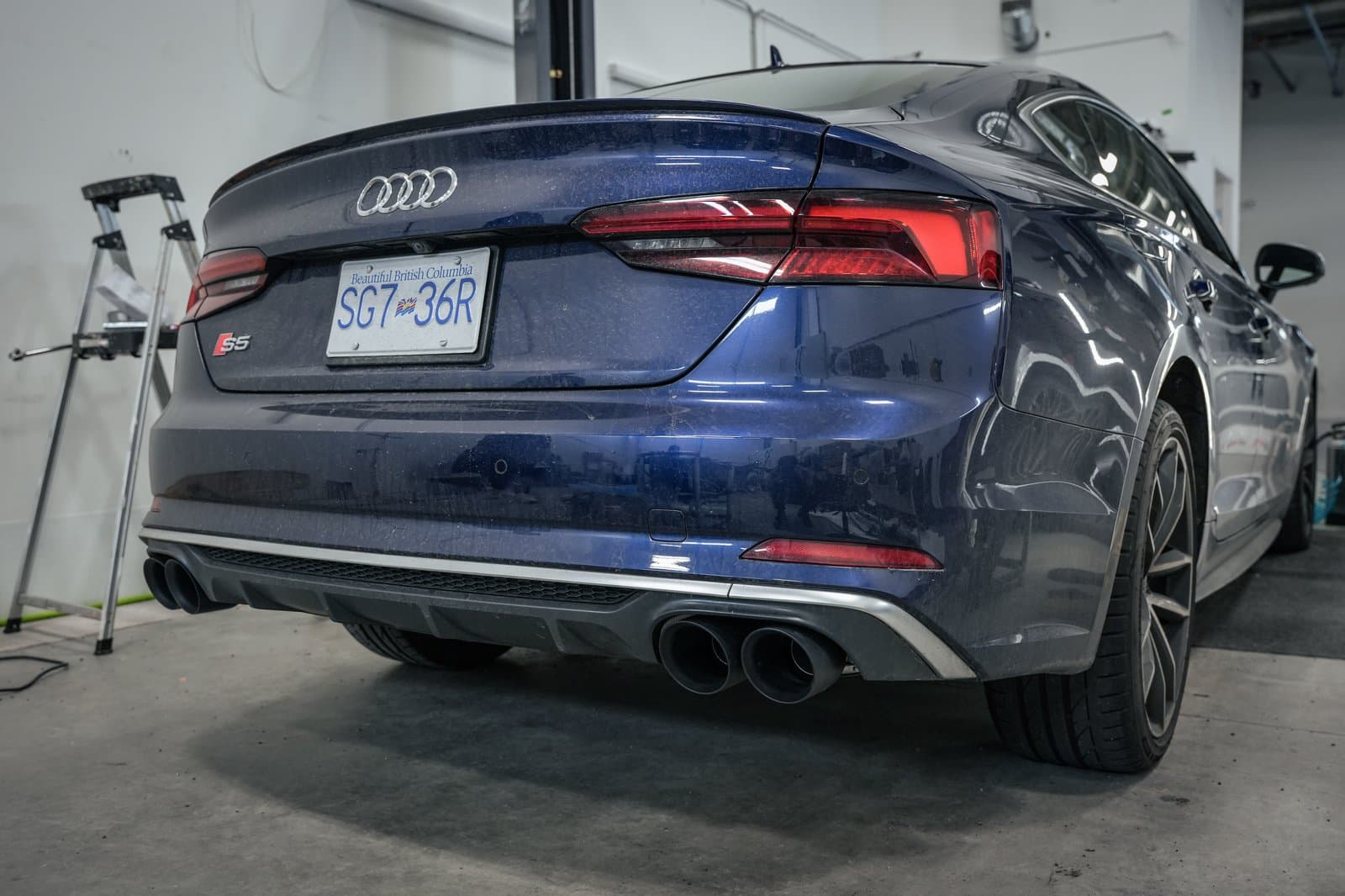
Related project: Audi S5 — Milltek Exhaust Upgrade