
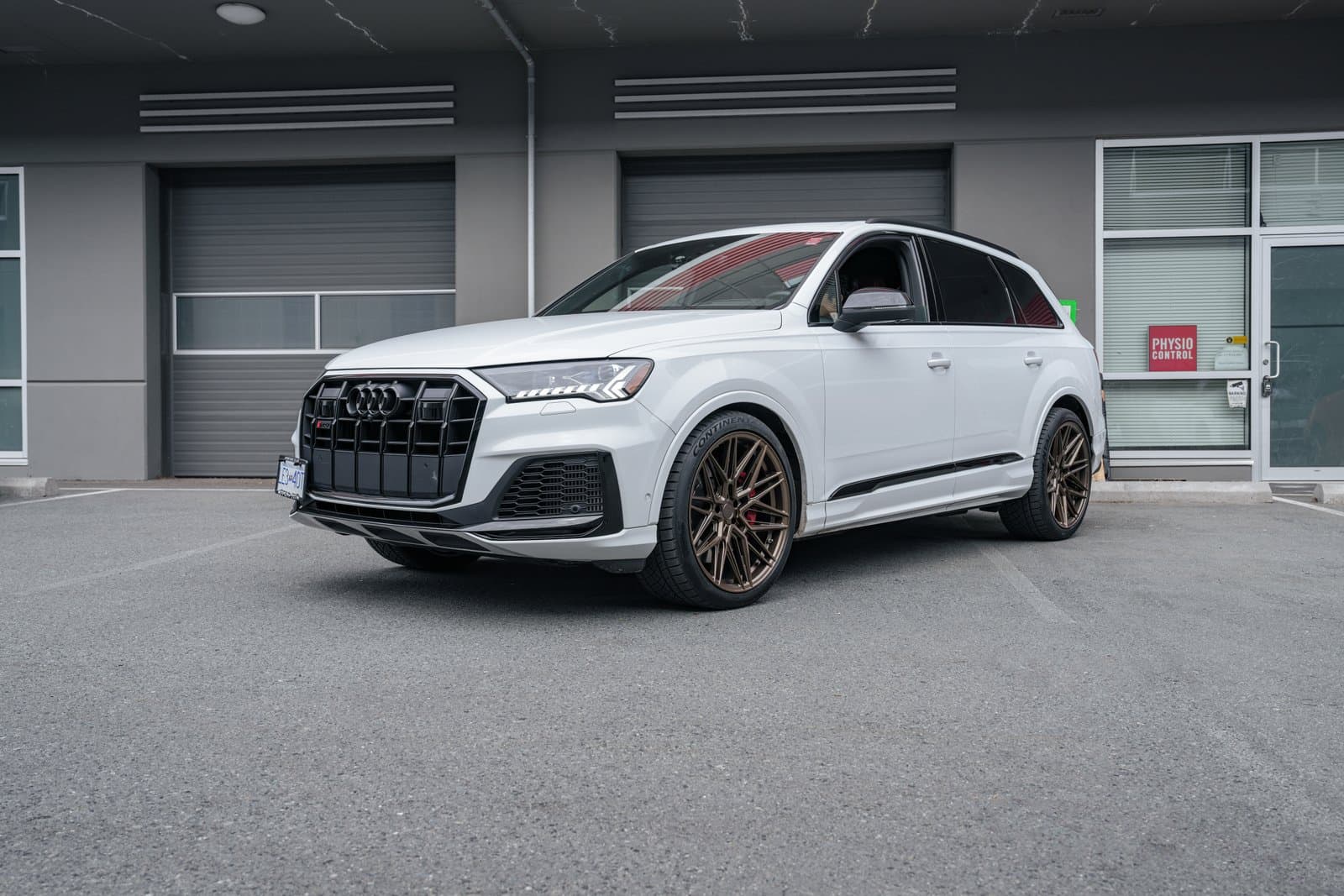
Lowering Your Car in Vancouver: What the Roads Do to It
Published
Lowering a car changes its relationship with the road in ways that are immediately noticeable on Vancouver streets. Some of those changes are desirable. Some are not. Here is what Vancouver's roads actually do to a lowered car, and what to think about before you commit to a drop.
How Lowering Changes a Car
Lowering a car is achieved by replacing the springs with shorter springs, by adjusting the coilover perch position, or by using lowering blocks. The net effect is a lower centre of gravity, which reduces body roll in corners and changes the suspension geometry. On a performance car or a car that is driven enthusiastically on mountain roads, this is a genuine handling improvement. On a daily driver in Vancouver, the handling improvement is modest and the tradeoffs are immediate.
The change in suspension geometry is worth understanding. Most production cars are designed with suspension geometry that works at the factory ride height. Lowering the car changes the angle of the control arms, the steering knuckles, and the shock absorbers relative to their optimal positions. This can introduce negative camber at the front wheels, which increases tyre wear on the inner edge, and can affect toe settings, which changes straight-line stability. On a car with factory-recalculated lowering geometry — many coilover systems account for this — the effects are manageable. On a car with generic lowering springs on stock geometry, the effects are more pronounced.
The Vancouver Parkade Problem
Vancouver parkades are the most immediate practical problem for a lowered car. The ramps are short, often steep, and the transition from ramp to floor is frequently a sharp edge — the point where the ramp drops to meet the floor. On a stock-height car, this transition is taken at speed without drama. On a lowered car, it is a point of contact risk on every entry and exit.
The specific risk is the front lip or spoiler, the oil pan, and the lower control arm. Any of these will contact a steep parkade transition before the tyres do. On a car with a factory front splitter or a front lip, this is a contact every time, not an occasional event. Measure the clearance at your most frequently used parkade before committing to a drop.
Strata parkades and private parking structures are often worse than commercial parkades — the transitions are sharper, the ramps are steeper, and maintenance is deferred. A car that clears one parkade comfortably may contact another.
Potholes and Road Damage
Vancouver's road surface is genuinely hard on lowered cars. A pothole that a stock-height car rides over with a sharp bump and continues is a pothole that can bend a control arm, crack an alloy wheel, or damage a tyre sidewall on a lowered car. The reduced suspension travel means the impact energy is transmitted more directly to the chassis and the wheels.
This is particularly true in spring, when frost heave and water damage create potholes that were not there in autumn. A car that was fine at its new ride height in September may find new hazards in March. Budget for tyre and wheel damage as a foreseeable cost of running a lowered car on Vancouver roads.
Adjustable coilovers with bump rubber or helper springs can reduce the harshness of impacts, but they do not eliminate the physics. For a car that is lowered purely for appearance, the spring rate and damper setting should be chosen with daily driving comfort in mind, not just the lowest possible ride height.
When Lowering Makes Sense for a Daily Driver
For a car that is primarily a daily driver in Vancouver, a modest drop of 20 to 30 mm is the practical limit. This provides a visual change without making the car unusable in everyday conditions. It clears most parkades, reduces the pothole risk to manageable levels, and still provides the appearance benefit most owners are looking for.
A car that is lowered for performance use — on a car that does not do daily parkade commutes — is a different case. On those vehicles, the tradeoffs are accepted as part of the performance brief. For everyone else, the appearance and handling improvement should be weighed against the daily realities of Vancouver's infrastructure.
JRS Auto Customs handles wheel upgrades, suspension assessment, and maintenance in Vancouver. For our wheels services, visit our wheels services page.
wheels servicesRelated project: Audi SQ7 Vossen HF7 Wheel Upgrade