
Choosing the Right Tires for Vancouver's Mixed Conditions
Published
Vancouver presents a tire challenge that most Canadian cities do not. You need a tire that handles dry summer roads, wet autumn motorways, the occasional snow event on the North Shore, and the mix of urban streets where salt and sand accumulate inconsistently. The question is not simply 'all-season or winter' — it is what kind of each, and whether the investment in a second set makes sense for how you actually drive.
Understanding Vancouver's Road Conditions
Vancouver gets an average of 48 cm of snow per year — modest by Canadian standards — but it falls unevenly. The North Shore mountains can see heavy accumulation while downtown streets remain largely clear. The result is that tire recommendations based on snowfall totals alone can mislead you. What matters more than total annual snowfall is how your specific routes handle snow when it does fall.
The urban driving environment in Vancouver compounds the problem. Packed snow and ice on residential streets, untreated parking lots, and inclines — particularly in areas like Burnaby Mountain, Coquitlam, and the North Shore — can be genuinely challenging without the right tire. At the same time, mild temperatures on the Lower Mainland mean that deep winter tires can spend a significant portion of the season operating below their optimal temperature range, wearing faster than they should.
Wet road handling is a year-round consideration in Vancouver. Even in summer, the combination of worn factory tires, rain-slicked roads, and high traffic volumes on Highway 1 and the Port Mann Bridge creates stopping-distance challenges that many Vancouver drivers underestimate. This is why wet-weather grip — not just winter performance — should be part of your tire selection criteria.
All-Season Tires: What Vancouver Drivers Need to Know
Modern all-season tires are a genuine category, not a compromise. The Three-Peak Mountain Snowflake (3PMSF) certification is now common on performance-oriented all-season tires, indicating they meet a minimum snow traction standard. Look for this symbol if you want meaningful cold-weather capability from your all-season set.
The key trade-off with all-season tires in Vancouver is winter capability versus summer grip and tread life. A tire with aggressive winter siping and 3PMSF certification will give up some dry-road grip and typically wear slightly faster than a summer-biased touring tire. For most Vancouver drivers who stay primarily in the city and Lower Mainland, a quality 3PMSF all-season is a practical single-set solution.
Tire width matters in Vancouver's wet conditions. A narrower tire cuts through water on the road surface more effectively than a wide tire in the same conditions, reducing hydroplaning risk. If you have swapped to wider performance tires, be aware that the wet-weather handling trade-off is real — particularly in heavy rain on the highway.
When Dedicated Winter Tires Make Sense
If your regular routes include Highway 1 through the Fraser Canyon, the Sea-to-Sky Highway in winter conditions, or steep residential streets in the North Shore or Tri-Cities, dedicated winter tires are worth the investment and the storage hassle. Winter tires are made from a different compound that stays pliable at low temperatures, and their tread patterns are designed to evacuate slush and snow from the contact patch.
The Mountain Pass and Cypress Mountain roads in winter conditions are genuinely dangerous without proper winter tires. This is not an edge case — these are regular commuter routes for North Shore residents. If you drive them in winter, two dedicated winter tires are the correct choice.
The other case for winter tires is if you have a performance vehicle with summer or performance all-season tires. Summer tires in near-freezing temperatures on a wet road are a significant safety risk. If your car came with summer tires and you drive it year-round, switching to a 3PMSF all-season or a dedicated winter set is a meaningful safety upgrade.
Tire Maintenance Through a Vancouver Year
Whatever tire type you run, the maintenance basics are the same: check inflation pressure monthly — tyre pressure drops roughly 1 psi for every 5°C drop in temperature, which in Vancouver means your tyres are likely underinflated by early December. Underinflation increases wear on the outer shoulders, reduces fuel efficiency, and compromises handling.
Rotate your tyres every 8,000 to 10,000 km. Even front-wheel-drive vehicles wear the front tyres faster; the rears can develop irregular wear if not rotated regularly. In Vancouver's stop-and-go traffic, this wear pattern is accelerated compared to highway driving.
Check tread depth at the start of each season. The minimum legal limit in BC is 1.5 mm, but most safety professionals recommend replacing summer tyres at 3 mm and winter tyres at 4 mm, where wet-weather performance begins to degrade noticeably.
For drivers who run a dedicated winter set, proper storage matters. Store winter tyres in a cool, dry place away from direct sunlight, ideally in airtight bags. Sunlight and ozone are the two main aging factors for stored tyres.
Book a tyre inspection at JRS Auto Customs to check tread depth, inflation, and overall condition before the wet season or winter arrives.
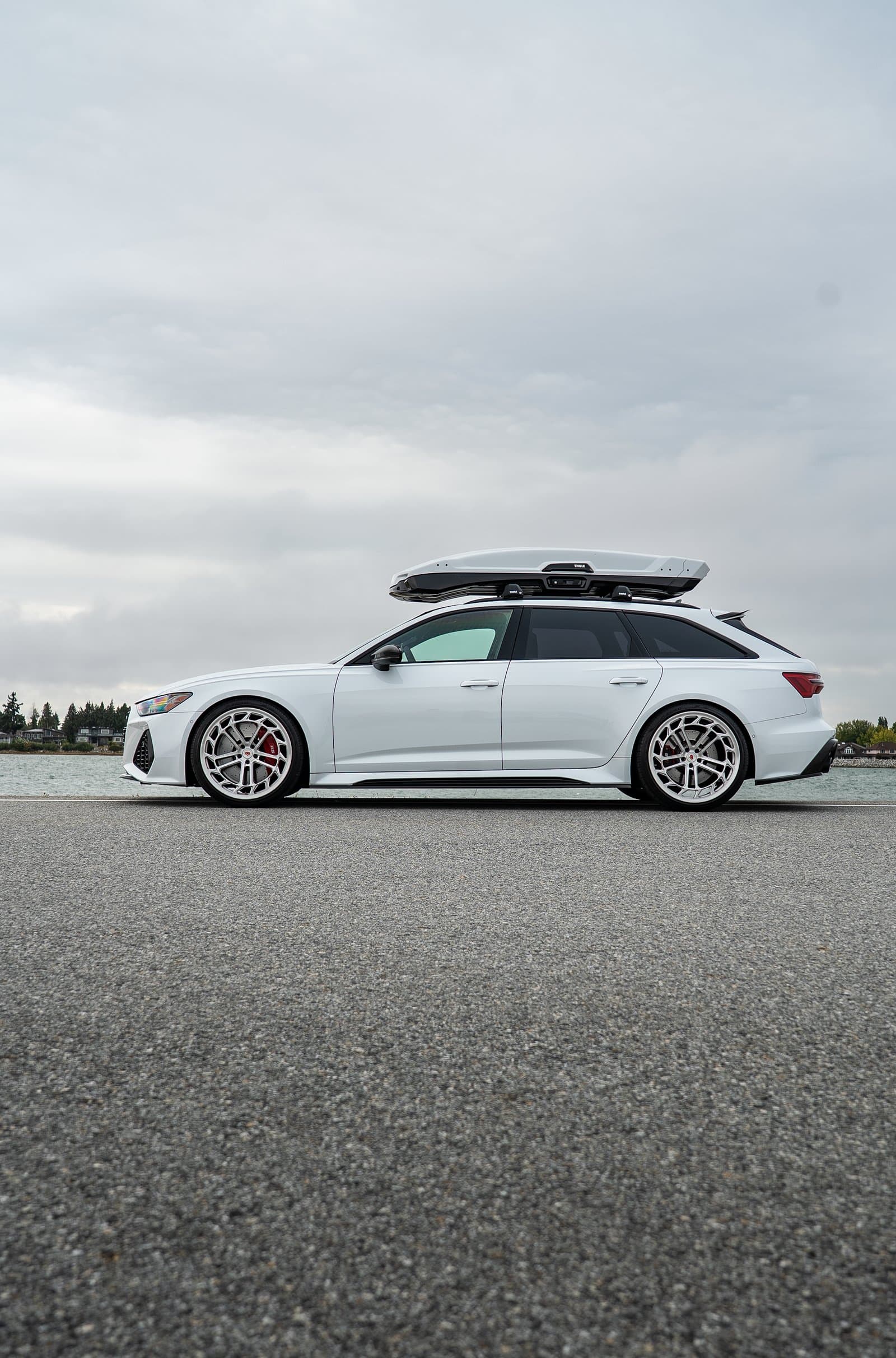
Tyre and wheel services at JRS Auto Customs.Related project: Audi RS6 Vossen LC2-C1 Custom Wheels