
How to Choose the Right Tires for Vancouver
Published
Buying tires in Vancouver is not straightforward. The city does not get heavy snow most winters, but it gets enough freezing rain, occasional accumulation, and cold wet roads that a set of pure summer tires is a liability from October through March. At the same time, a dedicated winter tire set is an expense and storage challenge that many drivers do not want to manage. Here is how to think through the decision based on your actual driving pattern.
All-Season vs Winter Tire: Understanding the Real Difference
An all-season tire is a compromise — it is designed to work across a broad temperature range but excels at nothing. A dedicated summer tire is optimised for warm, dry and wet conditions. A dedicated winter tire is optimised for cold temperatures and snow. In Vancouver, where October through March typically means ambient temperatures between 2 and 10 degrees Celsius, an all-season tire is operating at or below its ideal temperature range for most of the winter. This is not catastrophic, but it means longer stopping distances and reduced grip on wet roads compared to a winter-rated tire.
The rubber compound in a winter tire stays pliable at temperatures below 7 degrees Celsius, where an all-season compound begins to harden. That compound difference is the whole story — it is why winter tires stop shorter in Vancouver's cold rain even when there is no snow on the ground.
The Three Scenarios and What Each Driver Needs
If you drive primarily in the city — downtown, East Vancouver, the Broadway corridor, Burnaby — and rarely head to the North Shore mountains or the Fraser Valley in winter, an all-season tire rated for wet conditions, with a speed rating appropriate for your vehicle, is a reasonable choice. Look for the three-peak mountain snowflake (3PMSF) symbol on the sidewall, which indicates the tire has passed minimum snow traction testing. Not all all-season tires carry this.
If you commute over a mountain pass regularly, drive to the Interior in winter, or live somewhere like North Vancouver where elevation means you are more likely to encounter snow accumulation, a dedicated winter tire set is the appropriate call. They do not need to be on the car year-round — change them over in October and swap back in March or April. Storage is the main inconvenience; most tire shops offer seasonal storage if you do not have space.
If you drive a performance car with summer performance tyres, you face the sharpest trade-off. Summer performance tyres are not rated for cold temperatures at all. Below roughly 5 degrees Celsius on a wet road, they lose meaningful grip. For a performance car driven year-round in Vancouver, switching to an all-season or winter-rated tire for the cold months is not optional — it is a safety decision.
Load Index and Speed Rating: Match, Do Not Exceed
Every vehicle has a minimum load index and speed rating specified by the manufacturer. The load index is the maximum weight each tyre can carry; the speed rating is the maximum speed the tyre is rated for. Fitting a tyre with a lower load index than your vehicle requires is unsafe. Fitting a tyre with a lower speed rating than your vehicle's top speed is also a problem — it may be illegal under BC motor vehicle regulations and will trigger a failed inspection. You can fit a higher load index or speed rating than the minimum; you cannot go below it.
The speed rating letter — H, V, W, Y — corresponds to a specific maximum speed. A V-rated tyre goes up to 240 km/h. If you are switching from the OE tyre size to a different size, always check that the replacement tyre's speed rating meets or exceeds what your vehicle requires.
Tyre Size and Width: Bigger Is Not Always Better
A wider tyre provides a larger contact patch with the road, which can improve dry grip and handling response. It also displaces less water, which means a wider tyre is more prone to hydroplaning on standing water than a narrower one. In Vancouver's frequent rain, that is a real consideration. Going to a significantly wider tyre than the manufacturer recommended size also changes the tyre's load-carrying characteristics and can cause premature wear, handling issues, and rubbing.
If you are considering a wheel and tyre package — wider wheels with lower-profile tyres for a sportier look — make sure the overall tyre diameter stays close to the original specification. A significant change in overall diameter affects the accuracy of your speedometer and can stress the differential and transmission.
Book a Tyre Consultation Before You Buy
Choosing the right tyre involves matching your vehicle, your driving pattern, your budget, and Vancouver's actual road conditions. JRS Auto Customs in North Vancouver sells and installs tyres across all sizes, and can advise on what makes sense for your specific vehicle rather than just selling you what is in stock. Bring your vehicle details and current tyre size, and the team will walk you through the options.
Find out more about tyres and tyre fitting at JRS Auto Customs, or speak to us about upgrading to a wheel and tyre package suited to your driving.
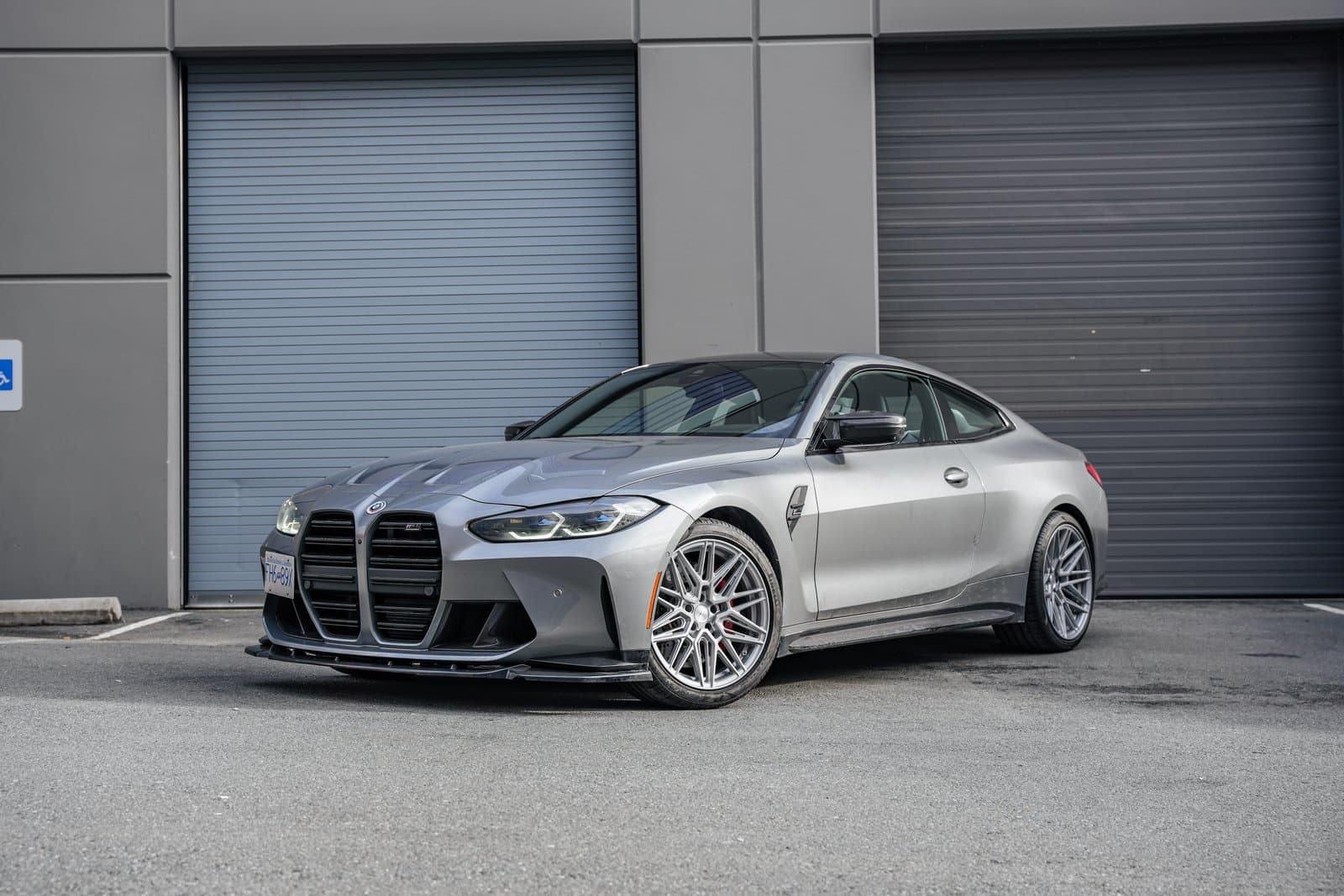
Related project: BMW M4 G82 on Vossen HF7 Hybrid Forged Wheels