
How to Protect Your Wheels This Vancouver Winter
Published
Every November, something starts eating away at the wheels on your car. It is not an accident — it is Vancouver's road-grit and salt season, and it has been doing this every year since you bought the wheels. By March the finish on a set of factory-finished or even powder-coated rims can look dull, spotted, and pitted. The question is not whether to protect them, but which protection actually works for the way you drive.
Why Vancouver Wheels Take a Beating Every Winter
Metro Vancouver uses a mixture of rock salt and calcium chloride on major routes. Both are corrosive to bare aluminium and to many wheel finishes, especially when the brine sits in the spoke valleys and behind the barrel edge where water pools after a rainstorm. Add brake dust — a fine carbon-ceramic powder that bonds to warm rims — and you have a three-way grinding paste pressing into the wheel's surface every time you brake.
Most factory finishes — clearcoat over paint, basic powder coat, or satin-sprayed aluminium — are not designed to resist that combination indefinitely. They hold up for a few seasons if you wash regularly, but once the finish is compromised, corrosion spreads under the surface. The cost to re-finish a wheel properly can quickly exceed what the right protection would have cost from the start.
Paint Protection Film on Wheels
Paint protection film (PPF) is a transparent thermoplastic urethane film originally developed for military helicopter rotor blades. Applied to a wheel, it acts as a sacrificial physical barrier — rock chips, road salt, and brake dust contact the film instead of your rim's finish. The film takes the damage. You replace the film, not the wheel.
The critical advantage of wheel PPF is its self-healing top coat. Minor surface scratches vanish when the film is heated — by sunlight, warm water, or even a heat gun. A stone chip that would permanently mark a bare wheel or a ceramic coat leaves no lasting mark on quality PPF. The film is also thick enough to absorb the energy of a sharp stone impact without tearing.
unknown nodewheel PPF installation
The trade-off is cost. Wheel PPF wrapping is labour-intensive — the wheel must typically be removed and the film is applied to the barrel and spoke faces with precision. On complex multi-spoke or concave wheels this can take several hours per wheel. The material cost for quality automotive PPF is also significant.
Ceramic Coating on Wheels
Ceramic coating is a liquid silicone-resin solution that cures to a hard glass-like layer on the wheel's surface. Unlike PPF it adds no thickness — it chemically bonds to the finish and changes its surface energy. The result is a surface that repels water aggressively and makes contaminants far easier to wash off.
The biggest practical advantage of ceramic on wheels is maintenance. Brake dust, road grime, and insect residue slide off far more easily than on an uncoated wheel. After a winter drive you can often rinse the rims with a pressure washer and be done — no aggressive scrubbers needed. That matters in Vancouver where a single storm can coat your car in a fresh layer of road film every few days.
unknown nodeceramic coating for rims and body panels
The limitation is straightforward: ceramic coating cannot absorb a physical impact. A sharp stone chip or a kerb strike will mark the coating and potentially the finish beneath it. It also requires the wheel surface to be in excellent condition before application — any existing scratches, oxidation, or paint defects will be locked in under the coating.
Which Is Right for Your Driving
For most drivers who commute within Metro Vancouver and the North Shore, the answer comes down to three factors: budget, winter driving frequency, and how much you value a showroom finish at trade-in time.
If you regularly drive Highway 1, the mountain passes, or any route where salted gravel is laid down in volume, PPF on your front wheels and leading edges is worth serious consideration. The physical protection it provides against stone chips simply cannot be replicated by any surface coating. For rear wheels, ceramic coating is often sufficient if you are not tracking heavy debris.
If you are primarily an urban driver and budget is a consideration, ceramic coating alone will make a meaningful difference to how easily your wheels stay clean through the winter. The reduction in cleaning time alone justifies the cost for many owners.
The ideal approach for a performance car or a set of premium wheels is often a combination: PPF on the high-impact zones (outer lip, spoke faces closest to tyre contact) and ceramic coating over the rest. This gives you the physical defence where it matters most while keeping the rest of the wheel easy to maintain through the season.
JRS Auto Customs installs both wheel PPF and ceramic coating at our Vancouver shop. We can assess your wheel finish, discuss which protection strategy fits your vehicle and driving patterns, and book the work before the worst of the season arrives. Give us a call or send us a message to get started.
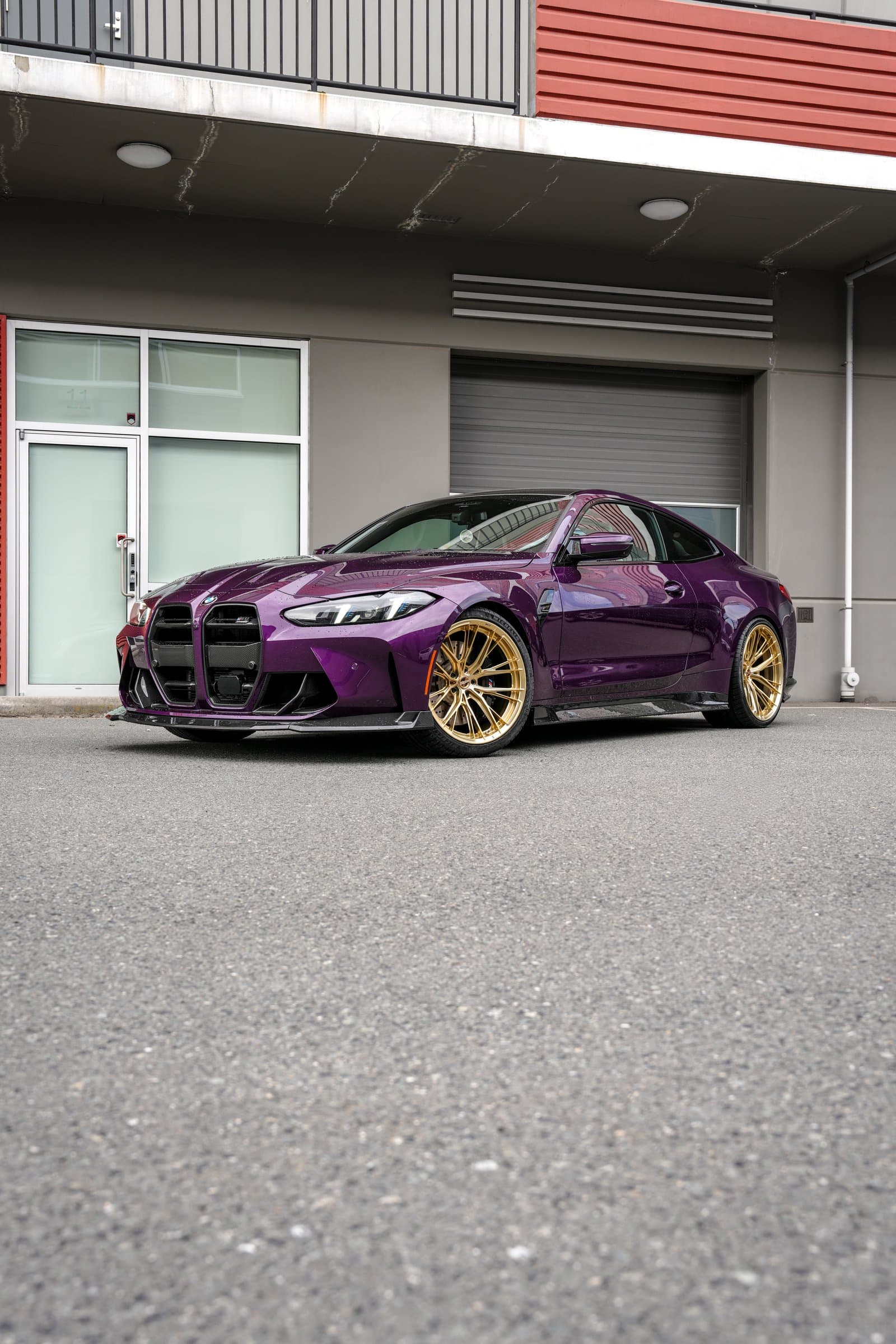
Related project: BMW M4 — Forgelite Wheels + RZ Aero Kit