Wide-Body Kits: What a Full Conversion Involves
Published
A different category of change
There is a clear dividing line in car modification, and it is not about money. One category changes how a car performs. The other changes what the car is. A splitter, a set of side skirts, a rear wing — all of the parts we covered in what actually counts as a body kit — bolt to panels that already exist, and the car underneath them is the same car that left the factory. A wide-body kit is not that. It replaces panels with wider ones, and in doing so it changes the shape of the vehicle itself.
That is why the term causes so much confusion. Owners use "body kit" for everything from a subtle lip spoiler to a full flare conversion, and those are projects with genuinely different costs, different complexity, and different consequences. JRS handles full body kits with paint matching under our performance and body modification service — wide-body and tuner-spec body kit installation with paint matching — as a distinct service, working with partners including Varis, Rocket Bunny, Pandem and Liberty Walk. Understanding what the wide-body decision actually involves is worth doing before any money moves.
What actually has to happen to the car
A wide-body kit is not a set of parts that bolt on. It is a set of parts that have to be married to the original body, and that is where most of the work and most of the risk lives.
The original fender has to be modified. There are two ways. It can be rolled and stretched outward, or it can be cut and a new flare panel welded on. The first is less invasive and preserves more of the original metal, but it can only achieve so much, and it is irreversible. The second gives the kit its full intended width but means the factory panel is gone. Either way the fender has to end up sitting flush against the new flare with a gap you could not slide a business card into — a visible edge down the side of the car is the tell of a rushed fit.
The rest follows from the fenders. Front and rear bumpers come off, because the kit includes its own that have to align with the widened body. Side skirts drop in and have to line up with both the new arches and the rocker panels. Headlights and tail lights are frequently reworked, because the kit changes the shape of the panel they sit in. It is a multi-day job with many points where a small misalignment shows.
This is also where the wheels stop being a separate decision. A body wide enough to cover the wheels properly needs a fitment that fills the arch — a flush or tucked setup. That means the offset, the width and the tire size all have to be chosen together, because a wheel that tucks under a wide arch will not tuck under a standard one, and pushing a wheel out to the edge of the arch is the opposite of what the bodywork was designed for. Read our guide to custom wheel fitment has the numbers. It matters more here than on a stock car.
Paint matching is where most wide-body jobs get decided
Once the panels are on, they need to match the car. This is the step that separates a conversion that looks factory from one that looks assembled, and it is the part with no shortcut.
The obvious choice is to paint the new panels the same colour as the car, so the body reads as one continuous shape. The alternative is to leave the parts in carbon fibre, which is a real aesthetic in its own right. We compared paint-matched and raw carbon body kits separately. The version that takes more work is the third one: a panel that was never the same colour as the car in the first place. A car that has been repainted, or a colour that shifted with age, needs its panels matched to what the car looks like now, not to the factory paint code in the book.
Matching across a seam is the difficult part. A kit panel and an original panel meet along an edge, and if the colour or the metallic flake does not line up, the seam becomes a line across the car. On a pearl or a colour with a strong flake, this is the difference between a car that looks remarkable and a car that looks like it has been in an accident.
The part nobody mentions: width and inspection
A wide-body kit makes the car measurably wider than it was. In British Columbia that has a regulatory dimension, and it is the reason so many wide-body builds end up as show cars rather than daily drivers.
This is not a warning against it — plenty of Vancouver owners run wide-body cars, and JRS works on them. It is a fact to plan around. A car that is wider than its factory specification may need inspection attention, and may not be road-legal as modified. Before committing, the useful questions are what the car will be used for, and whether it needs to be inspected in that state. Our guide to BC vehicle inspection and a modified car sets out how the process actually works, and it is worth reading before the kit is ordered rather than after it is fitted.
What to ask before you order
Four questions separate a good wide-body experience from a bad one. Whether the fenders are being stretched or replaced, and which method is being used. Whether the kit is being installed as a full system rather than assembled from pieces, because the fitment depends on all of it being designed together. Whether the paint will be matched to the car as it is now. And what the plan is for inspection and road legality in this province.
One more, and it is the one most people forget: whether the car will need a different wheel and tire setup to fill the arches properly. A wide-body car on the original wheels and tires looks unfinished in a way that is hard to describe and easy to see. Budgeting for the fitment at the same time as the bodywork is what makes the finished car look deliberate rather than assembled.
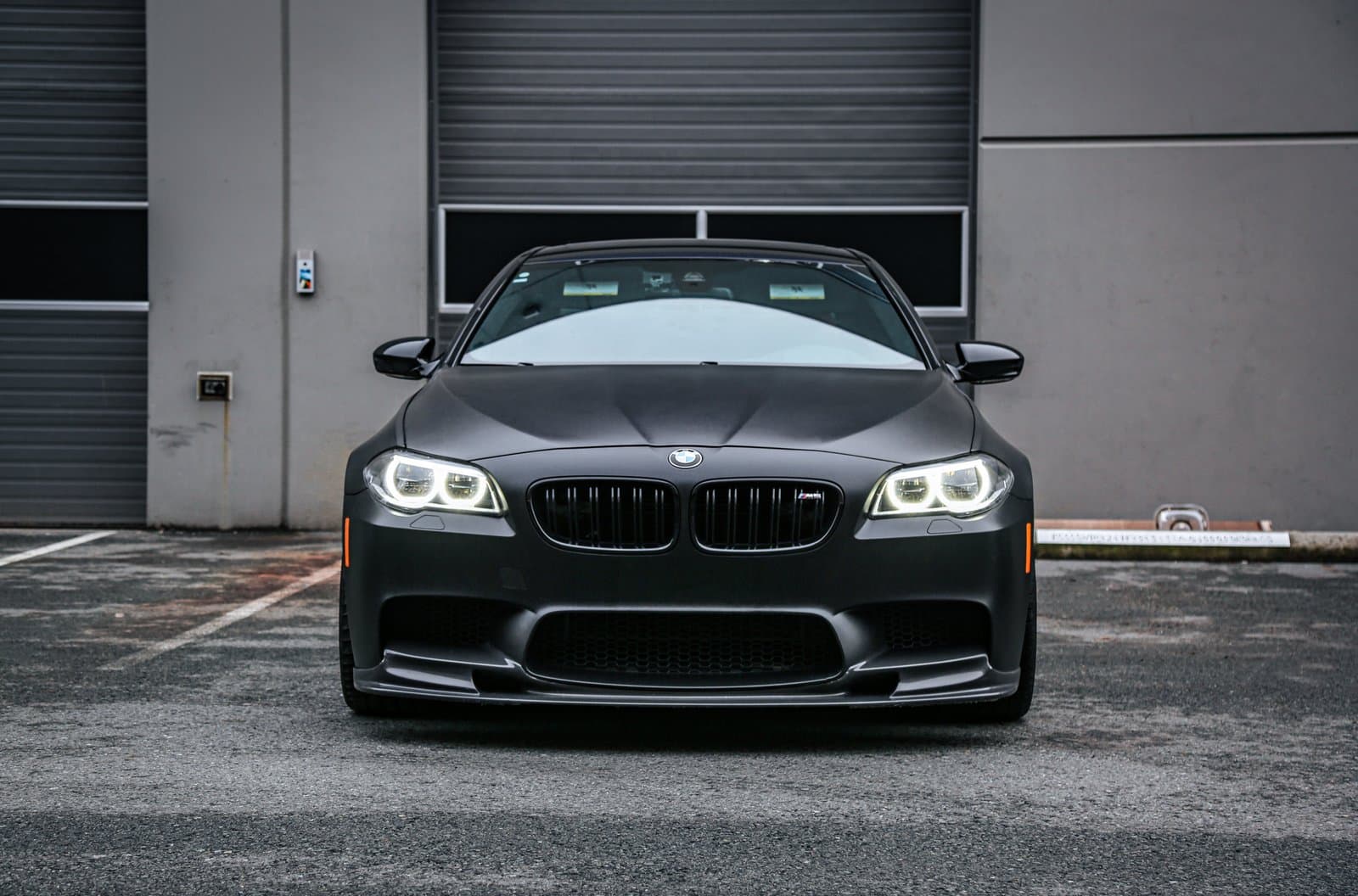
The BMW M5 in our portfolio shows the shape of a complete conversion — a full 3DDesign carbon fibre body kit with an Akrapovic exhaust, the Japanese aero components and the Slovenian system combining into one finished statement. The Audi SQ8 carries a full ABT body kit with Vossen HF5 wheels underneath it, which is the same pairing in a different order: the bodywork first, then the fitment that fills it. Both are the sort of project that takes a shop the better part of a week, and both are the reason a wide-body kit is worth treating as a considered decision rather than a parts order.
The honest summary
A wide-body kit is the most transformative thing you can do to a car short of replacing it, and it is not a casual purchase. It changes the shape of the vehicle, it consumes the original fenders, it forces a wheel and tire decision, it demands real paint work, and it puts the car’s legal road width in play. Done well, the result is a car that looks like nothing else on the street, because nothing else on the street is built this way. Done quickly, it is a visible seam, a colour mismatch and a car that is wider than it should be. The difference is entirely in the planning, and the planning happens before a single part is ordered.
Related project: BMW M5 — 3DDesign Kit and Akrapovic Exhaust