
Multi-Piece Wheels: How They Are Built and Why They Fit
Published
One Piece or Several: What the Name Actually Means
When you start looking at aftermarket wheels, one word comes up over and over again: multi-piece. It sounds like a marketing line, and in a way it is — but it also describes a real difference in how a wheel is built, and that difference has consequences for fitment, for weight, and for how you look after it once it is on the car. JRS works with both kinds, and the question comes up often enough to be worth answering properly before you spend anything.
A monoblock wheel, sometimes called a one-piece or cast wheel, is machined from a single piece of aluminium. The barrel, the face and the spokes are one continuous structure. A multi-piece wheel is assembled from separate components: the centre section that bolts to your hub, the outer barrel or lip, and the spokes that connect them, with hardware holding it all together. A three-piece wheel splits it further, with the centre hub, the barrel and the spoke set as three distinct parts.
Our wheels service lists custom fitment, wheel wrapping, powder coating, wheel repair and TPMS work, and it sources both forged monoblock builds and multi-piece custom orders. Both appear in the same catalogue because both are legitimate answers — to different questions.
What Changes About the Fit
The most practical difference is the number of variables you are managing. A one-piece wheel is a single object with a single offset, a single width and a single centre bore. Fit it or it does not fit. A multi-piece wheel can be assembled in more than one configuration from the same three component types, which is exactly why the format exists.
Concave depth is the clearest example. The barrel comes in different profiles, and the centre section can be combined with them to produce different amounts of concavity. A deep concave fitment pushes the outer lip outward from the mounting face, so the wheel sits further out under the arch and the spokes appear to pull inward toward the hub. This is how you get the flush, aggressive look that fills a widebody arch properly.
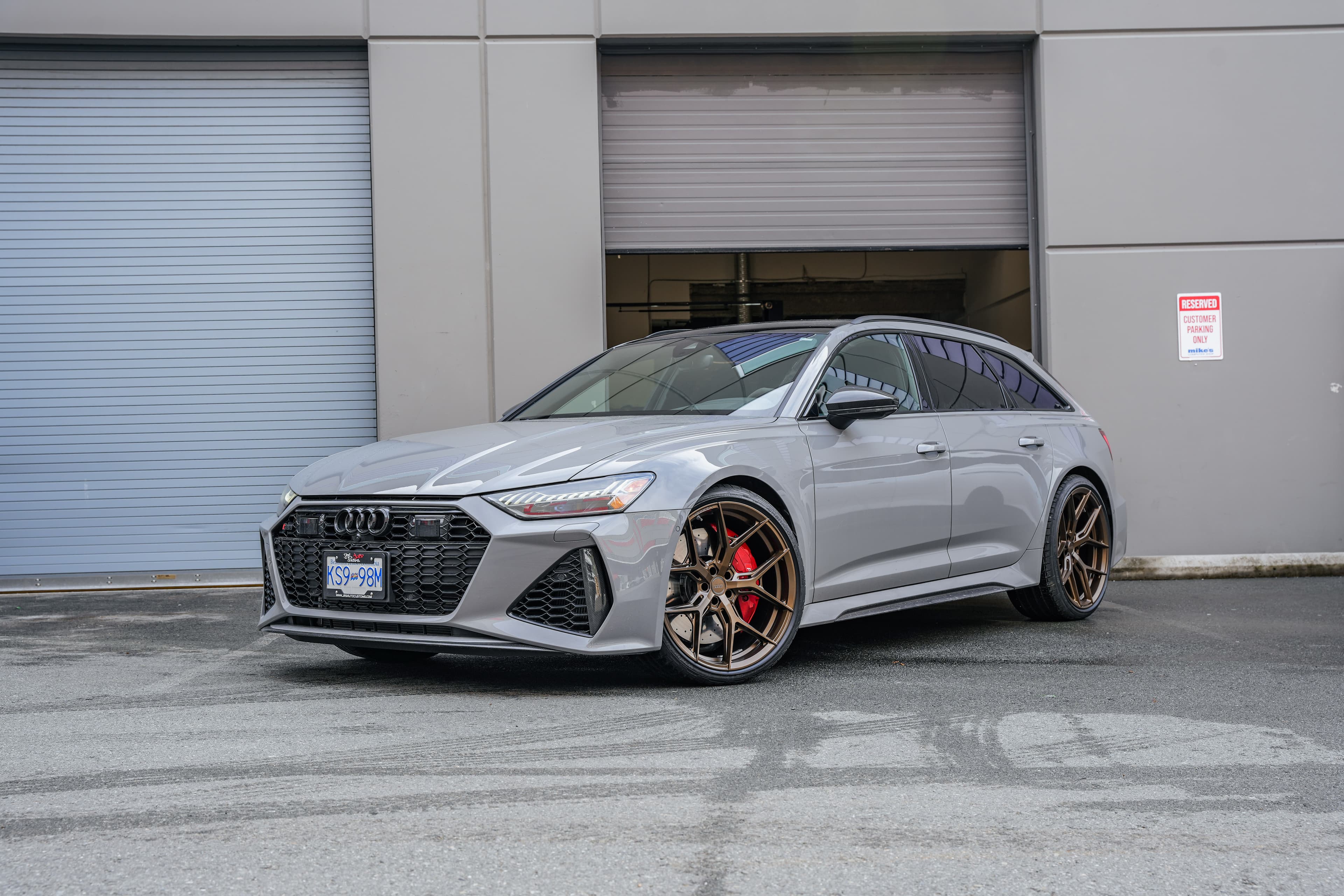
We fitted exactly that combination on an Audi RS6 Avant that came to us for full Paint Protection Film and a wheel upgrade: 22-inch Vossen HF-5s in Satin Bronze, 22x10.5 Deep Concave at the front and 22x10.5 Super Deep Concave at the rear. The deeper rear profile fills out the widebody stance, and the staggered sizing is a good illustration of why multi-piece construction exists at all. The same face design can be made to sit at two different depths.
The custom fitment guide covers how offset, backspace and hub bore are worked out together, because on a multi-piece wheel the centre section you choose sets the offset and the barrel you choose sets the overall width. Changing one changes the other.
Why People Choose Them
Three reasons come up repeatedly. The first is the visual result: a concave profile is very difficult to achieve on a one-piece wheel without making it far heavier, so the look that reads as properly aggressive usually comes from the multi-piece format.
The second is weight. Because the components are machined separately, each one can be made to carry only the load it actually needs to carry. The barrel does not have to be a solid piece of aluminium running from one face to the other, so material comes out of the structure. The broader question of how wheel weight changes the way a car drives is covered in our forged versus cast comparison, which covers the manufacturing differences that show up in the metal itself.
The third is flexibility. Because the centre section, barrel and spokes are separate, a wheel can be reconfigured — a different offset, a different width, a different finish on the centre — without replacing the whole assembly. That is a genuine advantage for anyone whose fitment needs are still settling, or who wants to change the look of a set they already owns.
What Care Is Different
This is the part that catches multi-piece owners out, and it is why an article on the subject is worth reading before you buy rather than after. A one-piece wheel is a single surface. A multi-piece wheel is a set of surfaces joined by hardware, and that means more edges, more seams, and more places where contamination can sit.
The barrel of a multi-piece wheel is not one smooth cylinder. It is a stepped assembly, and the step between the centre section and the outer lip is exactly where road film, brake dust and salt collect and stay. Salt brine is the real enemy here, because it sits in the recess and holds moisture against metal that never fully dries out. A single-piece wheel hides this better simply because it has fewer places for it to hide.
That is the reason a thorough barrel wash matters so much on this type of wheel, and it is covered in detail in our guide to cleaning the wheel barrel — a part most owners never touch.
Brake dust is the other one. On a multi-piece wheel the hardware — the bolts and the hardware holding the sections together — sits in the path of the dust, and dust that gets behind the lip or around the centre section is not simply rinsed away. It has to be loosened first and then removed deliberately.
The finish on the faces also behaves differently. Machined faces and the harder, more durable finishes used on multi-piece designs will not look the same under every finish, and the difference shows up earlier than it does on a uniform one-piece wheel.
Refinishing and Finishing a Multi-Piece Wheel
Because the wheel comes apart, refinishing is more involved than the same job on a one-piece wheel. The wheel is disassembled, each component is stripped of its existing finish, the surfaces are treated and repaired, and then each piece is refinished before the wheel is reassembled. A refinished original wheel keeps the correct specifications for the vehicle, which is the argument we make in our guide to refinishing versus replacing alloy wheels.
If you want to change the colour rather than restore the original, the same disassembly applies. A wheel can be refinished, powder coated, or vinyl wrapped, and those three routes are compared in our guide to changing your wheel colour.
None of this makes multi-piece wheels a worse choice. It makes them a different choice, with a different set of maintenance realities attached.
Making the Decision
If you know the fitment you want and you want the deepest possible concave face, multi-piece is close to the only way to get there. If you want the simplest, lightest, most maintenance-free wheel you can bolt on, a forged monoblock is the more straightforward answer, and we can talk through that side of it as well.
What matters is that you understand what you are buying before the order goes in. Ask what the offset and width of the assembled wheel actually is, not just the diameter. Ask whether the centre section and the barrel are being combined in a way that suits your arch clearance and your tyre width. Ask how the wheel will be finished and who is going to do it.
If you are running tyres that are wider than the factory setup, the fitment conversation gets more detailed, and our guide to going wider on tyres is worth reading before you commit.
JRS fits custom wheels in Vancouver with proper offset, backspace and hub bore for the specific vehicle, and we will walk through those numbers with you before anything is ordered, so the wheel that arrives is the wheel that fits.
Related project: Audi RS6 Avant | Nardo Grey | Full PPF + Vossen HF-5