Your Car in the Shop: How Long PPF and Wrap Work Takes
Published
The number you get is a range, and the range is wide
The first question at almost every consultation is not about film or colour. It is about time. How many days will my car be away, and can I drive it home at the end of the day? The honest answer is that nobody can give you a single number for a car like yours, because the number is determined by how much of the vehicle is being covered and how much work has to happen before the material goes on. But you can get a good idea of the shape of the answer, and you can plan around it.JRS publishes the broad ranges on our paint protection film page: partial kits take one to two days, and full-vehicle wraps typically take three to five days depending on vehicle complexity. Those are the two ends of the scale, and almost every car sits somewhere between them. We give a precise timeline at quote, once we have seen the specific vehicle.Those numbers count shop days, not calendar weeks, and they are not a promise that the car is finished at four o’clock on the last day. Film work is hand work, and hand work is not usefully compressed by hurrying it.We will also give you a timeline for a colour change on the colour change service. A wrap has an extra variable PPF does not: the film has to bond, and bonding is temperature-dependent. A wrap installed in a cold shop is a different job from the same wrap installed in a warm one, which is one reason the season you book in affects how long the car is in the bay.
Why one car takes two days and another takes five
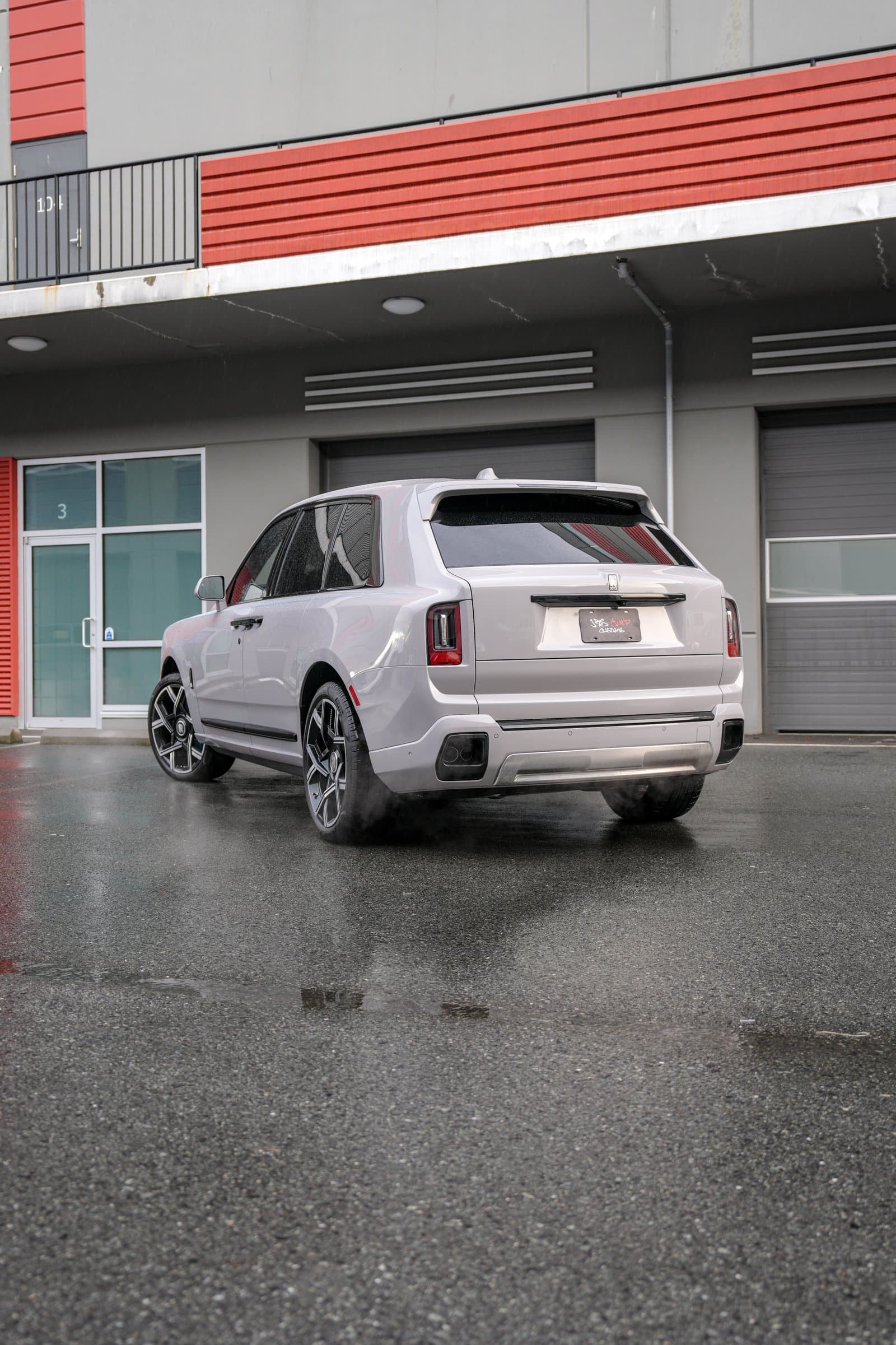
The range is not arbitrary. Four things move it.First, area. A partial kit and a full-body job are not the same task scaled up. A full-body application covers every painted panel on the car — doors, quarters, roof, trunk, rockers, bumpers — and each one is a separate piece of work that gets prepared, measured, cut, tacked, trimmed, and tucked. Our Land Rover SV full-body PPF was wrapped edge to edge across the whole vehicle, and the full clear PPF on a Rolls-Royce Cullinan was our most meticulous application yet, protecting every hand-polished panel. Neither is a single long job. They are many skilled hours on many separate panels, and the panels have to be done in a sequence that lets earlier work settle before later work happens on top of it.Second, condition. Film wants a clean surface, and a clean surface sometimes means correction work first. Paint with oxidation, swirls or bonded contamination needs decontamination and sometimes a correction stage before the film will bond and look right. A car that has been looked after needs much less of that.Third, disassembly. Some panels have to come apart — handles, trim pieces, lights, badges, sometimes door seals — so the film can be cut and tucked properly underneath instead of stopping short at the edge. That is labour, and it is labour nobody can skip if the result is going to look right.Fourth, cure and settle. This is the part that surprises people most, and it applies even to a straightforward install. Fresh film and fresh coating both need time to settle before the car is used hard. If you are also having ceramic coating applied over the PPF, that changes the sequence again, and our guide to ceramic coating applied over PPF covers that layering in detail.
What actually happens during the days your car is in the shop
It helps to know the shape of the work, because a lot of the awkwardness people describe is really just not knowing what stage the car is at.Day one is preparation. The vehicle is washed and decontaminated, panels are assessed for damage, and anything that needs correcting gets corrected. Trim comes off. This is the longest and least visible part of the job, and it is the part that decides whether the finish looks right later.The middle days are installation. Film is worked onto the panels one at a time, squeegeed to move the air out, trimmed to the contours, and tucked at the edges. The PPF process at JRS is specifically hand-trimmed to each vehicle — every roll is cut to the contours of that car, lifted, wrapped and tucked so the coverage looks like it was never there.The last day is finishing and inspection. Edges are sealed, the whole vehicle is checked under good light, and the panels that were disembled are put back. Then the car goes into a settling period before you drive it away properly.None of that is a formality. The edge work decides how the car looks a year from now, because a rushed edge is the first thing to lift.
Planning around being without the car
This is where most of the planning actually happens, and it is the part nobody thinks about until the first time.Assume you will not have the car on the day you expect. Treat the timeline as a range with an upper end, not a promise with a date. When we quote, the number we give is the one we plan around, but the honest way to book is to leave a gap after it. If the quote says three to five days, plan on five and be pleasantly surprised.Then think about what you actually need during those days. A loaner is worth asking about for a full-body PPF or a full wrap, because that is a multi-day absence, not an afternoon. If there is no loaner, work out what your days look like without the car before you book, not after. Commuting, school runs, and a car that is also the family’s only vehicle are all reasons to start the conversation early.Book ahead of the work, not just ahead of the day. Vancouver shops fill up in the autumn as owners react to the first salt of the season, so the further out you book the more choice you have. Our guide to when to bring your car in covers which months tend to be busy and why, including why a cold winter month is slower than a mild one.Two timing points are worth making. Do not schedule the work immediately before a trip, a wedding, or anything else where the car has to look its best — you need the settling period after the job as well as the job itself. And do not book a wrap and expect to drive the car home the same day. The material needs to bond, and a fresh wrap that has been handled too early is exactly the thing that lifts at the edge later.If you are booking PPF and colour change together, the order matters as much as the timing. Our post on putting PPF under a colour change wrap covers which one goes on first and why.
Questions worth asking when you book
You should leave a consultation with a timeline you could repeat to someone else. Ask these and you will.Ask for the range rather than the best case. A shop quoting the fastest possible number is describing a car that went perfectly, and yours may not. Ask what the upper end looks like and what would push it there.Ask what happens to the car at the end of each day. A well-run shop will have the car in a controlled space overnight, not outside. For a wrap in particular, temperature between the hours it is not being worked on matters.Ask what preparation is included and what is not. If a correction is not in the quote, that is not a problem, but you should know it. If the paint needs correction and it is not being done, the finish will not look the way you are imagining it.Ask what the settling period is and when you can start using the car normally, including whether you should avoid pressure washing near the film edges. Our post on the first 30 days after PPF and ceramic coating goes into that in more detail.And if you are comparing quotes from more than one shop, make sure you are comparing the same scope. Two quotes that look close on price may describe very different amounts of work, and that is worth checking before you commit to either. We wrote about how to read a paint protection quote for exactly this reason.One last thing. The number of days your car is in the shop is not a measure of how good the work is. It is a measure of how much work there is and how carefully it is done. A shorter job that was rushed is a worse outcome than a longer one that was not.
Related project: Rolls-Royce Cullinan Facelift Full PPF